Football is Australia's most played team sport. But what do the latest figures really tell us, and what do they mean for Tasmania?
No surprises here folks.
Football played with a round ball is the most played team sport in Tasmania and right across Australia.
Also no surprise that we are mostly ignored.
The Australian Sports Commission has just released its latest AusPlay figures, covering July 2025 to June 2026.
There is some genuinely good news for football.
But before we start celebrating, I thought we might do a little AusPlay 101.
Not all participation figures are created equal.
First, what is AusPlay?
AusPlay is a national survey run for the Australian Sports Commission.
It asks Australians about the sport and physical activity they do.
Importantly, it is independent of the sporting codes themselves.
Football Australia doesn't supply the football numbers. The AFL doesn't supply the Australian football numbers either.
The survey answers are weighted to estimate participation across the whole population.
The first thing to understand is that playing football doesn't necessarily mean being registered with a club.
For adults, someone having a weekly kick with friends might be counted. So might someone in a social competition or a club competition.
AusPlay also separates organised participation from participation more generally.
That matters when we compare sports, or talk about how much money flows into sporting organisations.
So, is football really number one?
Among the team sports, yes.
By a considerable margin.
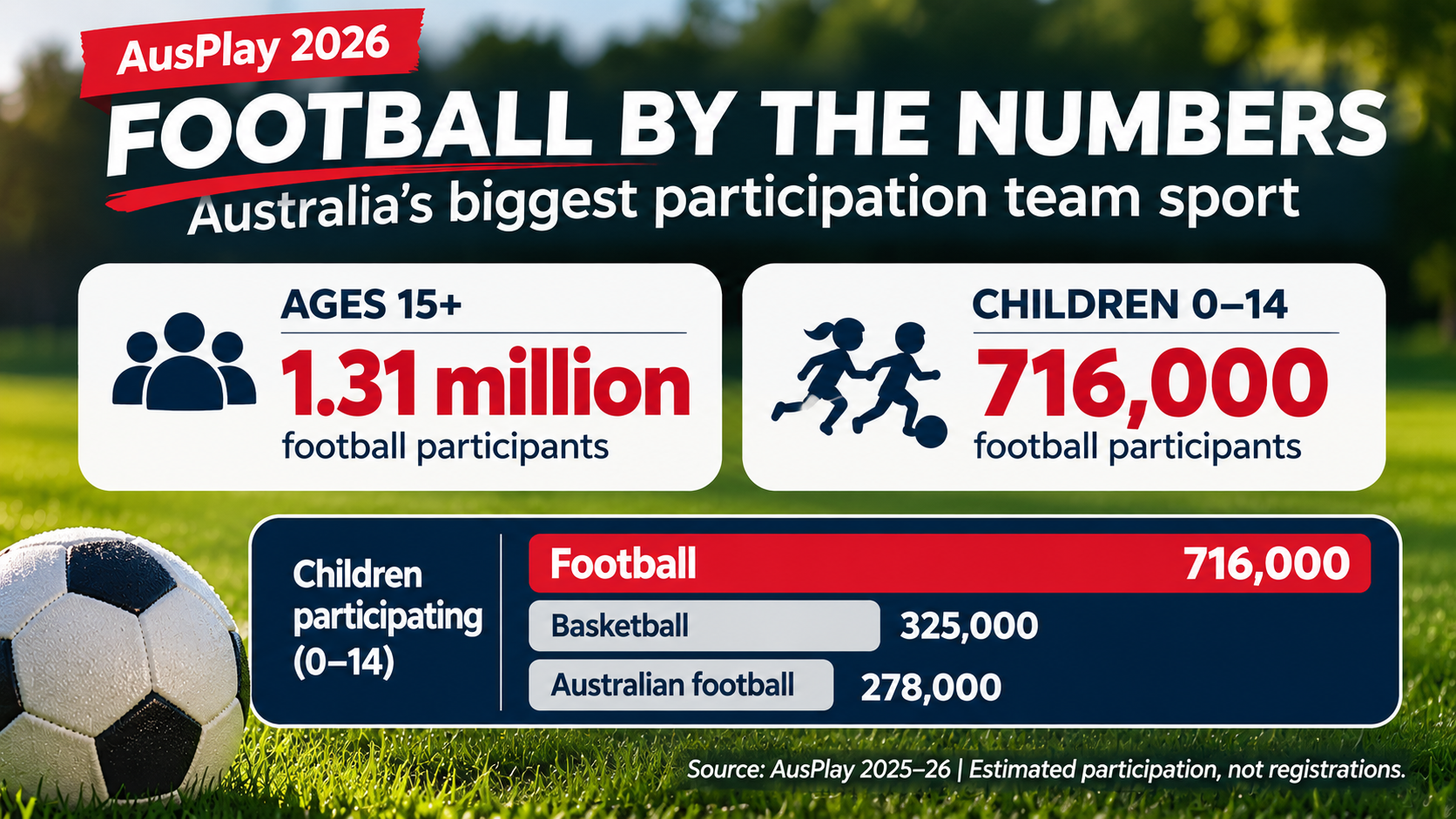
According to the latest AusPlay estimates, participation among Australians aged 15 and over looks like this:
Sport Participants
Football (soccer) 1,314,068
Basketball 1,005,392
Cricket 555,760
Australian football 534,875
Netball 465,371
That's more than 1.3 million Australians aged 15 and over playing football.
Around 309,000 more than basketball. Nearly 780,000 more than Australian football.
Football's lead over the other major team sports is substantial.
But these are people who played at some point during the year, not necessarily registered players.
The estimate for organised football among those aged 15 and over is about 859,000.
Still an impressive number.
Football doesn't need to exaggerate. The figures speak for themselves.
But what about the children?
This is where football really stands out.
AusPlay also measures participation among children aged 0 to 14.
Football's position is even stronger.
Sport Children participating
Football 715,796
Basketball 324,647
Australian football 277,715
Netball 236,319
Cricket 156,821
Have another look at those figures.
More than 715,000 children playing football.
More than twice the basketball number. More than two and a half times the Australian football number.
Only swimming has more children taking part, across every activity AusPlay measures.
These children's figures also work a little differently.
For children, AusPlay only counts organised activity outside school hours.
So this isn't kids having a kick in the backyard.
These are children in a club, a program or a competition.
Which makes 715,000 even more impressive.
Children can play more than one sport, of course, so these aren't separate groups.
Anyone who spends their weekends around junior football grounds won't be surprised.
Finding enough grounds, coaches, referees and volunteers for them all is the real challenge.
Is football growing?
The signs are encouraging.
In 2023–24 AusPlay estimated about 632,000 children were playing football.
In 2025–26 it was almost 716,000.
That's an increase of about 13% in two years.
Most of that growth came in the first year. Last year the number rose by about 2%.
Adults went the other way. The estimate sat at about 1.23 million for two years, then jumped to 1.31 million this year.
Survey figures have margins of error, so I wouldn't read too much into any single year.
AusPlay also changed how it ran the survey in July 2023. All three of these years use the new method, so they are more directly comparable. Earlier years aren't.
The direction is encouraging.
We just shouldn't pretend every movement in a survey estimate is an exact number of players gained or lost.
How are the girls going?
This is another area where the headline figures deserve a closer look.
Nationally, AusPlay estimates about 185,000 girls aged 0 to 14 play football.
That's a substantial number.
But boys still make up about three-quarters of children's football.
Among Australians aged 15 and over, women are only about one in five football participants.
For all the wonderful publicity the Matildas have generated, we still have a big gender gap.
That doesn't mean the Matildas haven't made a difference.
It means getting girls to play and keeping them playing are two different challenges.
Girls need competitions that suit them and facilities they want to use.
Most of all they need environments where they actually want to stay.
We also need to be careful about assuming the participation figures tell us why teenage girls leave sport.
They don't.
Now, what about Tasmania?
This is the part that matters most to me.
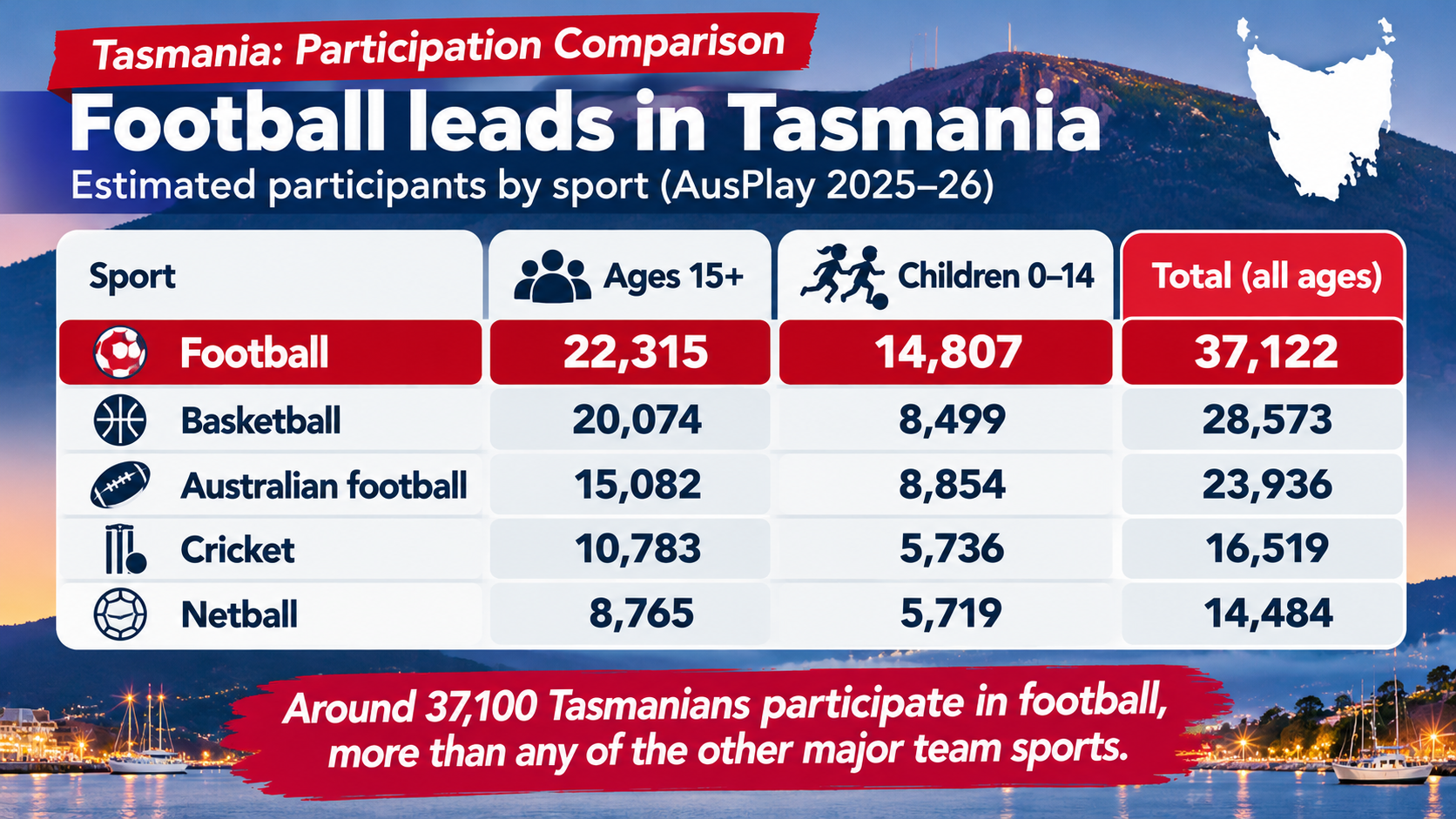
AusPlay estimates about 22,300 Tasmanians aged 15 and over play football.
Another 14,800 children aged 0 to 14 play too.
That's around 37,100 Tasmanians across all ages.
How does football compare with other sports in Tasmania?
Football (soccer)
Ages 15+: 22,315
Children 0–14: 14,807
Basketball
Ages 15+: 20,074
Children 0–14: 8,499
Australian football (AFL)
Ages 15+: 15,082
Children 0–14: 8,854
Cricket
Ages 15+: 10,783
Children 0–14: 5,736
Netball
Ages 15+: 8,765
Children 0–14: 5,719
Source: Australian Sports Commission, AusPlay 2025–26. Estimated participation, not registrations.
Among Tasmanian children, football is clearly ahead.
Among adults, football's estimated participation is slightly ahead of basketball, although the figures are close enough that we should be cautious about declaring a clear winner.
The comparison with Australian football is interesting too.
Nationally, football has about 2.6 times as many child participants as Australian football.
In Tasmania it's closer to 1.7 times.
Australian football has a stronger presence here than it does nationally.
Hardly surprising given our history.
But the latest estimates still place football ahead.
So why do we hear different participation figures?
Football Australia also publishes participation figures.
Its 2025 National Participation Report recorded about 1.93 million participants nationally.
Football Tasmania reported 41,395 participants across various formats and programs, including 15,193 in affiliated outdoor football.
You might notice Football Tasmania's figure is higher than AusPlay's 37,100.
That's because they measure different things.
Football Australia and Football Tasmania report participation across registrations, programs and different formats of the game.
AusPlay estimates people through a population survey.
The figures aren't necessarily wrong.
They just shouldn't be mixed together as though they measure the same thing.
If we're comparing football with basketball or AFL, AusPlay gives us a useful common basis.
If we want to know how many people are registered with clubs, we need registration records.
If we want to know how much money comes into football through fees, we need the paying registrations.
Each question needs its own figures.
Now, let's talk about the money
Football Tasmania CEO Tony Pignata has previously claimed that Tasmanian Government investment per participant looked something like this:
Sport Claimed government investment per participant
Australian football $540
Basketball $138
Football (soccer) $19
That's quite a gap.
Those figures were also raised in the Tasmanian Parliament by Independent MP Helen Burnet during budget estimates in June 2026.
Before anyone starts sharpening their pencils, these are Football Tasmania's calculations, not independently verified figures.
We would need to know which investments were included, over what period and how the participants were counted.
But the comparison certainly raises a question worth asking.
Does public investment in sport reflect the number of people actually playing it?
Perhaps more importantly, should it?
Not all sporting funding is the same
Money spent building a professional stadium isn't the same as money spent on community playing fields.
Both may have legitimate purposes.
One might hold thousands of spectators watching professional sport.
The other might host thousands of children playing sport all year round.
Other government programs, local councils and the sporting codes themselves all contribute to participation and facilities.
So we need to be careful with funding comparisons.
There isn't one neat spreadsheet that tells the whole story.
What is happening in Tasmania?
AFL Tasmania has established a $1.5 million community football facilities fund over three years.
That's $500,000 a year available for improvements such as playing surfaces, lighting and changerooms.
It's an AFL-funded community facilities program, and a sensible investment in community sport.
Football Tasmania, meanwhile, has been advocating for a Home of Football.
The Tasmanian Government has committed $350,000 towards a detailed business case.
The proposal includes six full-sized pitches, four five-a-side pitches and a state football headquarters.
That's encouraging.
But a business case isn't a football facility.
A commitment to investigate a project isn't the same as funding its construction.
These are different kinds of funding, so they aren't a dollar-for-dollar comparison.
They do show how much work remains to be done.
Being number one doesn't mean being entitled to everything
I don't believe football should receive every available sporting dollar simply because it has the most participants.
Other sports have legitimate needs.
AFL has a strong history in Tasmania. Basketball has a strong following. Cricket, netball and many smaller sports all make valuable contributions to our communities.
Some sports also need more expensive facilities, or different ones.
But surely participation should be a significant consideration when governments decide where to invest.
If hundreds of thousands of children are choosing football, there needs to be enough infrastructure to support them.
Otherwise we risk celebrating participation numbers while making it harder and harder for people to actually play.
The people behind the numbers
Having spent more than a few years involved in grassroots football, I know that participation doesn't happen by magic.
Someone has to organise the competitions, prepare the grounds, coach the children, manage the registrations, find the referees and answer the emails.
Lots and lots of emails.
As President of the CRJFA, Tasmania's largest junior competition, I see the other side of these numbers.
As participation grows, so does the pressure on facilities.
More teams need more training space.
More girls' teams need suitable changerooms.
More matches need more pitches.
Grounds already carrying enormous workloads don't suddenly find extra hours in the day.
Governments understandably like announcing participation growth.
But growth creates demand.
Demand eventually requires investment.
The real story
So what have we learned from AusPlay 2026?
Football is in a very strong position.
It is the most played team sport in the country.
Its junior base is remarkable.
The latest estimates also place football at the top of Tasmania's major team sports, despite the long tradition of Australian football here.
But we still have work to do.
The gender gap remains substantial.
We need to understand what happens to young players as they move through their teenage years.
We need the facilities and opportunities available to football to keep pace with demand.
I also think football needs to be careful about how it presents its own figures.
There is no need to turn survey estimates into registration numbers, or to confuse total participation with organised participation.
The true story is strong enough.
The funding discussion deserves the same honesty.
If we want to argue that football isn't receiving its fair share, we need to know what governments are spending, where that money goes and who benefits.
Ultimately this isn't about football beating AFL or basketball in some imaginary contest.
It's about giving Australians the chance to play the sports they choose.
Football has the participants. The question is whether we have the facilities, investment and structures to look after them.
That's a question worth asking well beyond football.
Sources: Australian Sports Commission, AusPlay 2025–26 National, Sport and Tasmania Data Tables; Football Australia 2025 National Participation Report; Football Tasmania's Home of Football announcement; Tasmanian parliamentary budget estimates, June 2026; Tasmanian Government Home of Football business case announcement, May 2026; AFL Tasmania Community Football Facilities Fund.
AusPlay figures are survey estimates rather than registration counts. Per-participant funding figures attributed to Football Tasmania have not been independently verified.