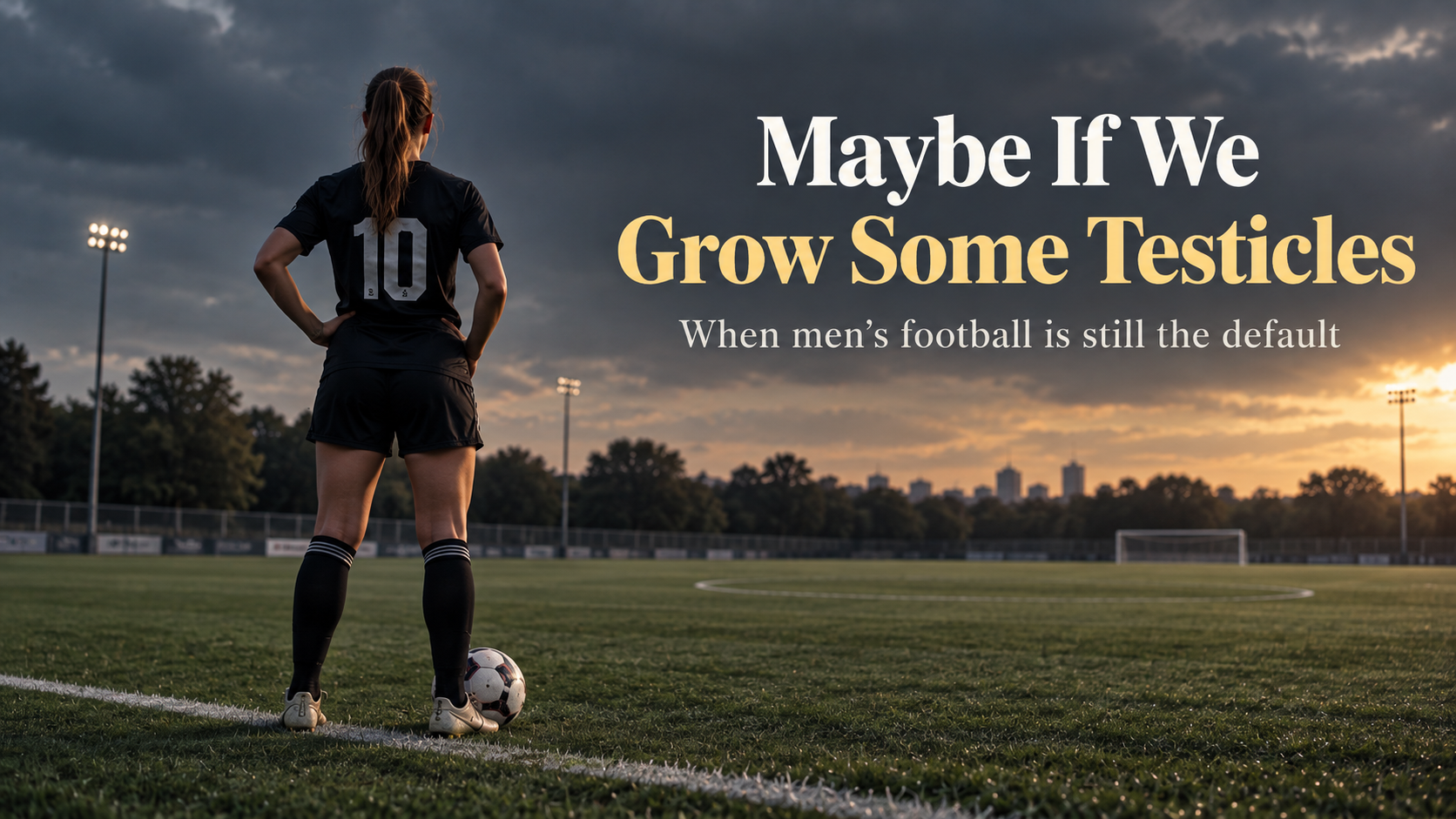
Maybe If We Grow Some Testicles
Football Tasmania is promoting its State NPL XI match against Western Australia.
State versus State.
Tasmania's best against Western Australia's best.
Representative football.
A bigger stage.
A chance to wear the state badge.
And when the match was first announced, I did ask about the women.
I wrote:
"If representative football is valuable, why are the girls missing out again?"
So I can't pretend this has only just occurred to me.
It hadn't.
But I don't think I felt it then quite the way I feel it now.
At the time, the absence of a women's team was one question among many.
Why were we doing this?
What was the objective?
Why Western Australia?
What would success look like?
Was the money better spent elsewhere?
And, yes, why were the women missing out?
I wrote about all of that here:
Representative Football Is Back. But Why?
Now, watching Football Tasmania promote the men's match and celebrate the opportunity for Tasmania's best male players, that last question has pushed all the others aside.
Because I am looking at it not just as somebody involved in football.
I am looking at it as a woman.
And perhaps, at 68, as a woman who is finally able to see some things about her own life much more clearly than she once did.
I was conditioned from birth
I grew up in a world where men were more important than women.
That was simply how things were.
Women did jobs around the house.
Men had careers.
Girls did not go to university.
They went to business college.
They learned to type.
They learned shorthand.
They became somebody else's secretary.
That was very much the world created by my parents and their beliefs about women and girls.
Nobody had to sit me down and say:
Men are superior.
It was just there.
In the expectations.
In the opportunities.
In what boys were encouraged to become.
And in what girls were encouraged to accept.
Fortunately, business college gave me very good typing skills.
So all these years later I can sit at a keyboard at ridiculous hours of the morning writing things designed to annoy, challenge and occasionally provoke people.
There is some irony in that.
Would my life have been different if I had gone to university and got a degree?
Almost certainly.
Would it have been better?
I have absolutely no idea.
I have had a fascinating life.
But that is not really the point.
The point is that we are conditioned.
And sometimes it takes a very long time to understand just how deeply that conditioning sits inside us.
I haven't always got it right either
I can see it in my own football life.
I spent many years as President of a football club.
I was surrounded by men.
Male coaches.
Male administrators.
Male football conversations.
At home I had sons.
My football world was overwhelmingly male.
So I am not going to sit here now and pretend that my own outlook was always perfect when it came to women's football.
It wasn't.
There were times when I needed to be reminded.
Times when somebody needed to say:
What about the women?
What about the girls?
Why aren't we doing the same thing for them?
I can look back now and recognise that.
I am not particularly proud of it, but pretending otherwise would be dishonest.
I was a product of the same conditioning I am writing about.
Perhaps the difference is that in this older and, hopefully, more thoughtful period of my life, it is much easier to see.
And once you start seeing it, it is everywhere.
The men's game is still the default
Men's football is important.
Men's coaching is important.
Men's representative football is important.
Men's pathways are important.
Men's matches are events.
Men's achievements require promotion.
And women's football?
Too often it is still the extra.
The addition.
The thing we will get to once everything else is sorted.
We talk endlessly about the growth of women's football.
Participation.
Pathways.
Opportunity.
Role models.
Keeping girls in the game.
The legacy of the Women's World Cup.
All worthy things.
All important.
But at some point the words have to turn into action.
Think about the women at Devonport
This is the bit that really gets me.
Think about those women at Devonport.
Think about what they have achieved.
Three consecutive Women's Super League titles.
The Statewide Cup as well.
Sustained excellence.
Not a lucky season.
Not a flash in the pan.
Year after year.
There are some marvellous female footballers in that team.
And there are marvellous female footballers right across Tasmania.
Women who train.
Women who sacrifice.
Women who travel.
Women who organise their lives around football.
Women who represent their clubs brilliantly.
Women who have earned the right to be taken seriously.
Then they watch Tasmania put together a men's representative side, fly it across the country and promote it as an opportunity for our best players to test themselves on a bigger stage.
What must they think?
Perhaps they should grow some testicles.
Maybe then somebody would notice them.
Yes, that is ridiculous
Of course it is.
That is why I wrote it.
Because sometimes ridiculous makes the point better than polite language ever could.
Women have spent generations being told that the things men do matter more.
Men's jobs mattered more.
Men's sport mattered more.
Men's opinions mattered more.
Men's ambitions mattered more.
And if women wanted the same thing, we were often expected to ask nicely.
And be grateful.
And not make too much noise.
Because when men push for more, they are ambitious.
When women push for more, they are difficult.
Men challenge.
Women complain.
Men demand better.
Women whinge.
Men are strong.
Women are never satisfied.
It is an old story.
And football is hardly immune from it.
Gratitude is not equality
One of the things women are often told is to look how far things have come.
And yes.
They have.
Women's football has come a very long way.
Girls now have opportunities I could not have imagined when I was young.
Women coach.
Women administer.
Women referee.
Women lead.
Women play at levels and in competitions that simply did not exist for previous generations.
That is all true.
But women should not be required to spend the rest of our lives being grateful for progress somebody else has decided is sufficient.
Gratitude is not equality.
And progress should not become an excuse to stop asking questions.
I do not want less for the men
This is the part that will inevitably be misunderstood by someone.
So let me be very clear.
I do not want the men to lose this opportunity.
I hope they enjoy it.
I hope they represent Tasmania proudly.
I hope they play well.
I hope they win.
This is not about taking something away from them.
Equality is not about making men's lives smaller.
It is about making women's opportunities bigger.
It is about noticing when the men's opportunity is automatically funded, promoted and celebrated while the women's equivalent does not appear to exist.
That is the issue.
Not the men.
The assumption.
This is life in a microcosm
Perhaps that is why this match has started bothering me more than it did when it was first announced.
It is not really about one football game.
It is about a lifetime of watching the same pattern repeat itself.
Men are the default.
Women are the addition.
Men's football is simply football.
Women's football needs the word "women's" in front of it.
Men's opportunities are part of the program.
Women's opportunities are often special initiatives.
Men's success is expected to be promoted.
Women's success is something we are told we should be grateful to see acknowledged.
And after a while, everybody becomes conditioned to it.
Including women.
Including me.
The part that makes me uncomfortable
That is probably the most uncomfortable part of all this.
I have been involved in football for decades.
I have led a club.
I have sat in boardrooms.
I have made decisions.
I have challenged plenty of things.
But I can still look back and see occasions where I viewed football through a predominantly male lens.
I can see times where somebody had to remind me about the women.
That matters.
Because if we want football to change, perhaps the answer is not simply pointing at a room full of men and blaming them.
Sometimes women have absorbed the same assumptions.
Sometimes we help maintain the very culture that disadvantages us.
Not deliberately.
Not maliciously.
Just because it has always been there.
That is how conditioning works.
And then one day you see it
Age does not automatically make us wiser.
But it can give us distance.
It gives us time to look back.
It gives us the opportunity to ask why we accepted certain things without question.
I look at things very differently now than I did at 28.
Or 38.
Or 48.
I notice more.
I question more.
And I am much less interested in being told that women should simply be happy with what they have got.
So when I now look at this representative match, the question seems incredibly simple.
If representative football matters, women should have representative football.
If showcasing Tasmania's best players matters, Tasmania's best female players should be showcased.
If wearing the state badge matters, women should get to wear it too.
If competing against another state is valuable, women should get that opportunity too.
It should not require somebody complaining.
It should not require women repeatedly asking where their opportunity is.
And it certainly should not require us to grow testicles first.