Nothing Bloody Changes
It is the Thursday after the Hobart Cup and my body still aches from transporting all the gear back to storage.
I still haven’t finished replying to feedback from the Cup or dealing with the issues that came out of it.
Nikki is still editing and uploading photos.
I have stopped yelling at Ken.
My boys have stopped telling me to dial it down.
I am still waking ridiculously early, which probably comes from spending the build-up to the Cup chatting to ChatGPT at all hours for a running weather update.
Is it dangerous? How much rain? What about the wind? Has the forecast changed? What does Saturday look like now? And Sunday?
Yesterday I woke at 2.30am. Today I added another half an hour and made it to 3am. Hopefully I am slowly heading back towards my usual 4am.
Life goes on.
And nothing has bloody changed.
We Saw It With Our Own Eyes
For three days we saw, with our own eyes, just how big football is in Tasmania.
324 teams.
Around 4,000 young footballers.
742 games.
45 playing fields.
Thousands of children playing football across Greater Hobart.
Thousands of parents, grandparents, coaches, managers and supporters.
Ground after ground full of football.
You could drive across Hobart and see kids playing everywhere. Tiny ones on 4v4 pitches, older kids playing 9v9 and 11v11, boys, girls, clubs, schools, visiting teams and local teams.
Football absolutely everywhere.
Sometimes participation figures just become numbers on a page. Someone says football is one of the most played sports in Tasmania and everyone nods, then moves on.
But this was different.
You could actually see it.
You could stand at one ground and look around at hundreds of children playing football, then drive ten minutes down the road and see the same thing happening again.
And again.
And again.
This was not a small event.
It was enormous.
More Than 826,000 Facebook Views
The social media figures tell part of the story too.
Between 12 August and 8 September, Hobart Cup content on Facebook recorded 826,000 views.
More importantly, there were 60,172 viewers.
The page received 53,900 visits and almost 6,900 content interactions.
There were 795 follows, resulting in 728 net new followers.
There were also 112 conversations started.
And more than half of the views, 50.1 per cent, came from people who were not already following the Hobart Cup page.
For a junior football tournament in Tasmania, those numbers are extraordinary.
People were interested.
Families were engaged.
Clubs were engaged.
Players were engaged.
Grandparents were following.
People outside our existing audience were finding the Cup too.
It had an audience, and a substantial one.
The Media Still Missed the Bigger Story
To be fair, 7NEWS did ask me for an interview.
The timing was terrible for me and I could not make it work, so that one is on me.
I also spoke to the ABC.
And, as seems to happen every year, part of the interest was in where the entry money goes.
I find that incredibly frustrating.
The Hobart Cup entry fee is $395 per team for most age groups.
Compare that with major interstate tournaments such as the Gold Coast Cup and Kanga Cup, where team entry is around $1,200 or more.
Yet somehow the question here becomes: where does the money go?
Well, it goes into running the bloody tournament.
Ground hire.
Referees.
Security.
Medals.
Trophies.
Footballs.
Software.
Venue managers.
Staffing.
Equipment.
Set-up.
Pack-down.
Administration.
You do not put 324 teams and around 4,000 children onto football pitches across Greater Hobart for three days for nothing.
And I think sometimes that question completely misses the bigger story.
The bigger story was thousands of children playing football.
The bigger story was families travelling into Hobart.
The bigger story was the economic activity around the city.
The bigger story was a junior sporting event generating 826,000 Facebook views and more than 60,000 viewers in 28 days.
That was the story.
And What About the Risk?
There is another part of this conversation that rarely gets mentioned.
Risk.
I have written about this before because it matters.
The Hobart Cup has become my baby. I love it, I want to keep it and I want to keep growing it.
But that does not mean the risk magically disappears.
Before a ball is kicked, money has already been committed to grounds, medals, trophies, security, software, staff, equipment, set-up and all the rest of it.
Then there is the weather.
Withdrawals.
Last-minute changes.
Unexpected costs.
And sometimes, apparently, a nesting plover.
This year one Masked Lapwing managed to close an entire field at Wentworth Park.
Suddenly a carefully constructed roster had to be changed. Games had to move. Teams had to be contacted. The whole puzzle had to be rebuilt.
Plovergate.
Funny now.
Not especially funny at the time.
And that is the thing about running something like this. You can spend months trying to plan for every possibility and then something completely outside your control happens and somebody still has to fix it.
That is part of the risk too.
The financial risk, obviously.
But also the responsibility.
If the weather turns, if a venue changes, if a field closes, if a team withdraws or if something goes wrong, there is no magic tournament fairy who appears and sorts it out.
You sort it out.
I carry that risk because I believe in the tournament and because I want it to exist.
So when one of the first questions becomes “where does the entry money go?”, I sometimes want to ask a different question.
What about the risk involved in putting the whole thing on in the first place?
At $395 a team for most age groups, compared with around $1,200 or more for some major interstate tournaments, I am very comfortable with the value the Hobart Cup provides.
And I am also very comfortable saying that creating something like this, backing it financially and carrying the responsibility when things go pear-shaped has value too.
Even Football Put Football Up Against Football
Football Tasmania also scheduled its own grand final against the Hobart Cup weekend.
That made very little sense to me given the scale of what was happening across Hobart.
To be fair, Tony Pignata came out to the Hobart Cup, saw it for himself and acknowledged the clash.
He told me they would change it next year and move the grand final back a week.
Good.
That is exactly the sort of practical response football needs more of.
But the broader frustration remains.
Here we had one of the largest junior sporting events in Tasmania happening across Hobart, thousands of children playing and enormous community engagement.
And when the weekend is over, football still goes back to fighting for the same things it has been fighting for forever.
Then Everyone Goes Home
The marquees come down.
The goals get packed away.
The teams go home.
And football goes straight back to fighting for the same things.
Ground space.
Decent lighting.
Change rooms.
Training availability.
Better surfaces.
Enough facilities to actually cater for the number of people who play the game.
And somehow, despite the participation, despite the demand and despite the evidence sitting right in front of everyone, football still seems to be expected to make do.
Politicians See It Too
We had politicians of all persuasions with children involved in the Hobart Cup.
They were there.
They saw it.
They know how many families football touches.
We have had Premiers who like football.
Premiers who profess to support football.
People in government who genuinely enjoy the game.
And then, when the serious decisions are made and the serious money is spent, things happen for other sports.
Football gets another meeting.
Another plan.
Another review.
Another promise.
Another discussion about priorities.
And nothing bloody changes.
This Is Not About Hating AFL
I am not writing this as an anti-AFL piece.
I am tired of every discussion about football funding immediately turning into some ridiculous code war.
That is not the point.
The point is fairness.
The point is proportionality.
The point is that if thousands upon thousands of Tasmanian children are choosing to play football, the infrastructure available to them should bear some reasonable relationship to that participation.
It doesn’t.
And everybody knows it.
When the Stadium Money Is Spent, What Is Left?
There will continue to be arguments about Tasmania’s stadium.
Maybe it will cost $750 million.
Maybe it will cost $1 billion.
Maybe, by the time everything associated with it is included, people will argue the real figure is closer to $2 billion.
You can debate the number forever.
My question is much simpler.
When that money is spent, what will be left for football?
Will there suddenly be decent lights on the grounds where our children train?
Will there be enough pitches?
Will girls get equitable access to good facilities?
Will junior clubs stop scrambling for somewhere to train?
Will players stop being squeezed onto inadequate spaces because there simply isn’t enough capacity?
Will football finally receive investment that reflects the number of Tasmanians actually playing it?
Because I don’t have much confidence that it will.
I Think About Mabel
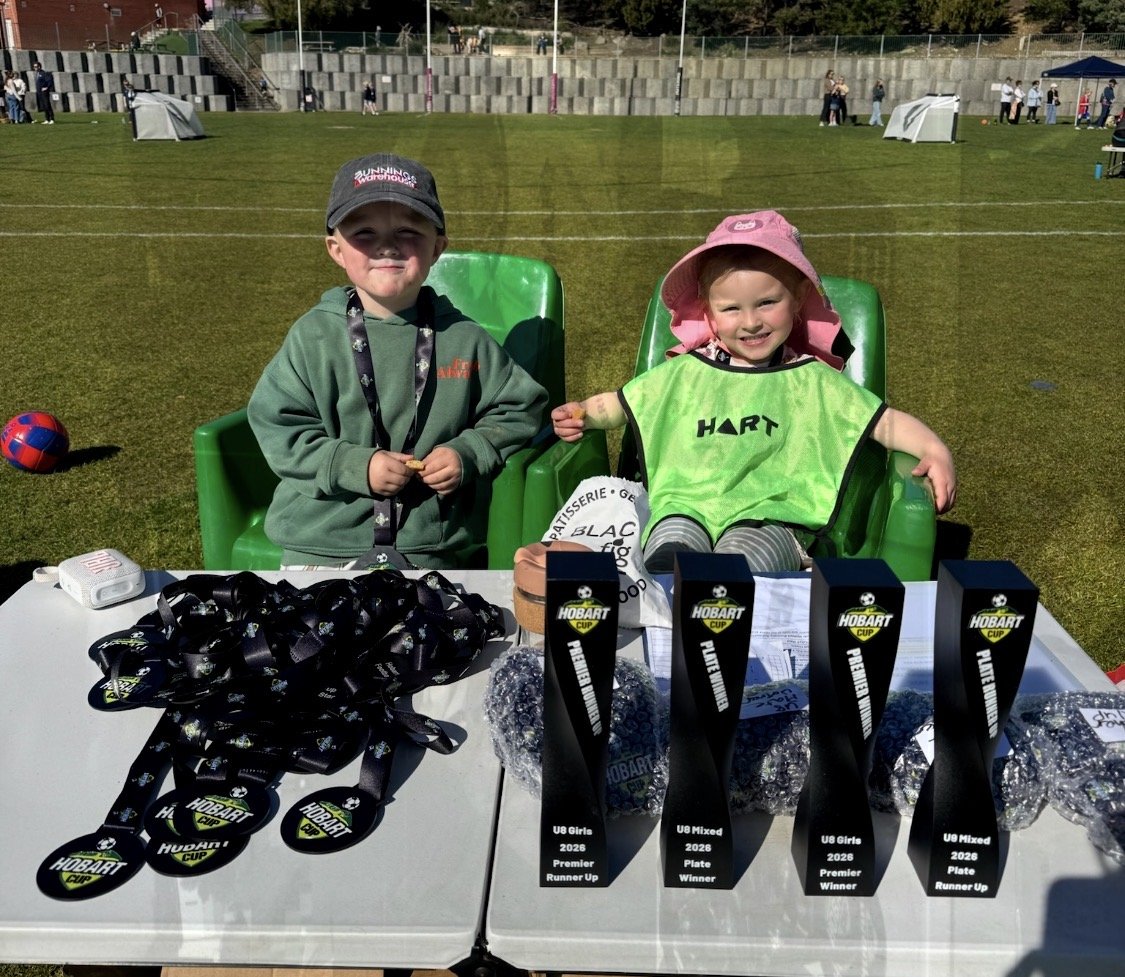
And that is the bit that gets to me.
My granddaughter Mabel is little now. She loves to play soccer. She is three.
She is part of the generation coming through behind all the children we watched at the Hobart Cup.
And I find myself wondering whether, when she is older, she will still be fighting for exactly the same things.
A decent ground.
Decent lights.
Enough space.
A fair share.
Basic sporting infrastructure that should not be considered some extraordinary luxury.
I hope she isn’t.
Because by then I may be too bloody old to keep writing about it.
And with my eyesight, there may come a day when I cannot even stand on the sideline and properly watch her play.
That thought makes this feel very personal.
I do not want another generation of kids inheriting the same argument.
Football Brings Economic Benefit Too
The Hobart Cup brought obvious economic benefit.
Teams travelled.
Families stayed in accommodation.
They bought meals.
They bought coffee.
They bought fuel.
They visited shops.
They spent money across Hobart.
And they did it because their children were playing football.
Sport does not exist in some little bubble separate from the economy.
Events like this bring people into the city and generate activity.
Again, you could see it with your own eyes.
Participation Has To Matter
At some point Tasmania needs to have a serious conversation about how sporting investment is decided.
Not based on which sport has the most political momentum.
Not based on which project makes the biggest announcement.
Not based on which code has historically had the loudest voice.
Participation has to matter.
Community benefit has to matter.
The number of children actually using these facilities every week has to matter.
Because football keeps providing the evidence.
We fill the grounds.
We fill the teams.
We fill the competitions.
We run tournaments with thousands of children.
We generate enormous engagement.
We bring families together.
We bring people into Hobart.
And then we go back to fighting over lights.
That is the absurdity of it.
How Many More Kids?
So yes, I have said all this before.
I will probably say it again.
But after standing there at the Hobart Cup and watching thousands of children playing the game they love, I keep coming back to one question.
How many more kids have to play football before football is finally treated like it matters?
Because right now, after all these years, it still feels like nothing bloody changes.