Team Palestine, Football Tasmania and the Politics of the Playing Shirt
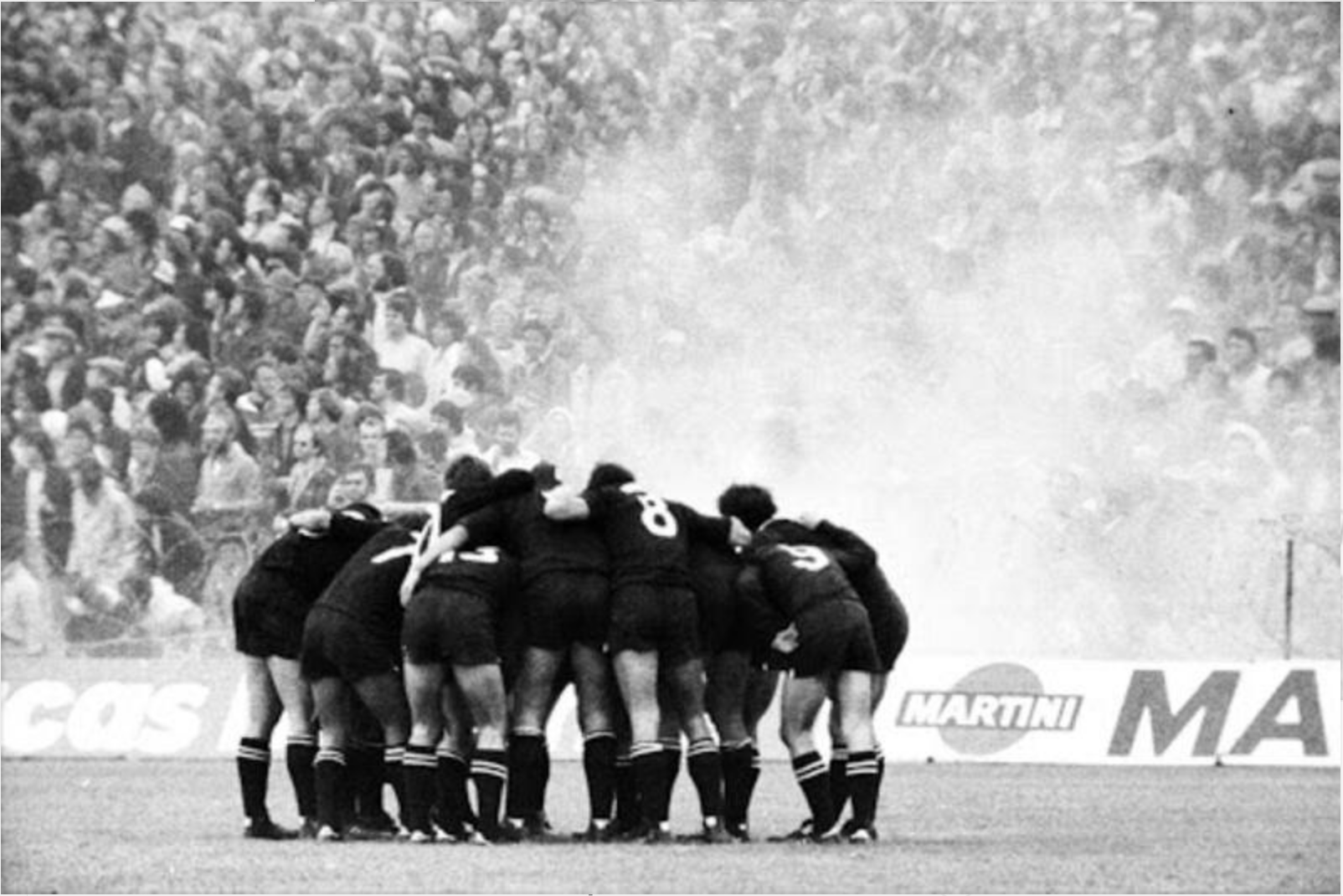
The infamous Flour Bomb Test at Eden Park, 12 September 1981. As the All Blacks faced South Africa's Springboks, protesters took their opposition to apartheid into the skies above the stadium. The match became one of the defining moments of a tour that divided New Zealand.
A forfeited futsal match in Hobart sent me back to 1981, my father's fury and a rugby tour that split New Zealand in two.
When rugby was a religion
I was 23 when the Springboks toured New Zealand in 1981.
Rugby was almost a religion in our house. It was the same in thousands of homes across the country.
The All Blacks were part of our lives. Watching them play brought families together.
I can still remember my father being absolutely furious with the protesters interrupting the rugby.
How dare they interfere with his game!
And I understood how he felt.
I loved rugby. I wanted to watch the All Blacks play South Africa.
But I also wanted apartheid to end.
I wanted two things at the same time.
I won't pretend I was a deep political thinker at 23. I was probably more interested in my own life than in what was happening on the other side of the world.
The world was smaller then.
We had the TV news, the newspaper and the radio.
No internet. No social media.
I knew apartheid was wrong. But I didn't really understand what life under it was like. Or the part sport played in keeping South Africa connected to the rest of the world.
Why the Springbok tour divided New Zealand
For those too young to remember, South Africa was governed under apartheid. It was a system of racial segregation that denied the Black majority their basic rights.
Rugby was very much part of that system.
For decades, Māori players were left out of All Black teams touring South Africa because of their race.
In 1928 the All Blacks toured South Africa without Māori players.
In 1949 New Zealand did it again.
In 1960 there were protests across the country under the slogan No Maoris, No Tour. More than 150,000 people signed a petition against sending another racially selected team.
The tour went ahead.
Then came something I still find hard to comprehend.
In 1970 Māori players were finally allowed to tour South Africa. Under apartheid they were classed as honorary whites.
Think about that.
New Zealand players, selected to represent their country, needed a special racial label to play rugby in South Africa.
Until I started researching this piece, I had no idea.
I find it outrageous.
Perhaps it tells me something about my younger self. Rugby was such a big part of my life, yet I knew very little about the discrimination behind it.
By 1981 the pressure to isolate South Africa from world sport was growing. Campaigners believed that playing South African teams helped legitimise the apartheid government.
New Zealand's rugby authorities invited the Springboks anyway.
For rugby supporters, All Blacks versus Springboks was one of the great rivalries.
For the protesters, letting the tour go ahead meant ignoring apartheid.
The country was bitterly divided.
Matches were disrupted. Protesters clashed with police. At the final Test at Eden Park a light plane dropped flour bombs onto the field.
Looking back, I wonder how much I simply chose not to see.
Forty-five years later I'm researching something I should have understood much better at the time.
It makes me wonder what we might be overlooking today.
A futsal match in Hobart
Last Sunday Team Palestine turned up at Aurora Sports Stadium for their 3.30pm game in the Hobart Social Men B competition.
They didn't play.
Football Tasmania had directed them to remove From the River to the Sea from the back of their shirts.
They refused.
The game was awarded to their opponents, the Dutchies, 3–0.
The players say the Dutchies were told not to turn up. So they used the court for a kick-around with family and friends instead.
The shirts also carry Always Was, Always Will Be. At the collar the Aboriginal flag and the Palestinian flag sit side by side.
Oscar Moodley's report in the Mercury set out both sides of the dispute.
Football Tasmania CEO Tony Pignata OAM told the Mercury the team is welcome to wear Palestinian national shirts. The issue is the slogan.
Player Feras Shaheen, a member of the Tasmanian Palestine Advocacy Network, says the rule is vague and subjective. He also says it isn't being applied consistently.
His argument is that almost everything can be considered political, including national identities and the names used by football organisations.
Tony strongly disputes the inconsistency claim. He says FT is open to talking it through so the team can play.
They're due back on court this Sunday.
The result so far is a forfeit. And a controversy that has travelled well beyond a social futsal competition.
I can understand why the players feel so strongly.
I can also understand the difficult position Football Tasmania is in.
Perhaps that's why this story has sent me back to 1981.
The world is bigger, but are we listening?
Getting older has made me a deeper thinker. It has certainly made me a more determined researcher.
I've made a point of reading about the history of Palestine. Much of what I've learned has disturbed me.
The region has thousands of years of religious, cultural and political history. The modern Israeli-Palestinian conflict has its own more recent and complicated origins.
The more I read, the more I realise how much I still don't understand.
I can see why people feel helpless when they watch suffering and see so little being done about it.
But I keep wondering about something else.
In 2026, we have unprecedented access to information, images and personal testimony. Yet people can still feel that nobody is listening.
Perhaps being exposed to more information doesn't necessarily mean we understand one another any better.
And perhaps that helps explain why people turn to sport to make their voices heard.
That doesn't mean every protest is appropriate. Or that every message belongs on a football shirt.
It does mean we should try to understand why people feel compelled to make those statements in the first place.
What does Law 4 actually say?
Football has rules about political messages on playing equipment.
The one that matters here is Law 4 of the FIFA Futsal Laws of the Game.
It prohibits political, religious and personal slogans, statements and images on playing equipment. That includes messages on undergarments.
Sanctions can be imposed by the competition organiser, the national association or FIFA.
Here's the part many people miss.
A message doesn't have to be offensive or hateful to be prohibited. It can be restricted simply because it is political.
Slogans promoting futsal, respect and integrity are generally permitted.
Political ones are not.
The laws also acknowledge that deciding what's political isn't always easy. They give guidance on political organisations, governments, events and messages that might be provocative.
They recommend resolving disputes about slogans before a match or competition starts.
Reading the rules as published, I think Football Tasmania has a sound basis for treating this slogan as political.
That doesn't mean FT is saying the players are promoting hatred.
But it raises another question.
Does breaching Law 4 automatically mean a 3–0 forfeit?
No. Law 4 itself doesn't prescribe that result.
The authority for a forfeit would need to come from the applicable competition or disciplinary regulations.
I'd like to know exactly which rule Football Tasmania applied.
Football has dealt with political messages many times before.
Football has been here before
Frédéric Kanouté: Palestine, 2009
In January 2009 Sevilla striker Frédéric Kanouté scored in a Copa del Rey match against Deportivo La Coruña.
He lifted his shirt to show an undershirt with the word Palestine in several languages. It was a gesture of solidarity during the conflict in Gaza.
He received a yellow card. The Spanish federation later fined him €3,000 under a rule banning messages regardless of their purpose.
It's the closest case to Hobart in one respect. A message about Palestine and a federation enforcing its equipment rules.
The penalty was a fine.
The match result stood.
Robbie Fowler: Liverpool dockworkers, 1997
In March 1997 Robbie Fowler scored for Liverpool against Norwegian club Brann in Europe and lifted his shirt.
Underneath was a T-shirt supporting Liverpool dockworkers who had lost their jobs during a long, bitter industrial dispute.
UEFA fined him 2,000 Swiss francs, about £900 at the time, for displaying the message.
Political messages in football aren't only about wars and borders. Workers' rights and local disputes end up on shirts too.
The match result stood.
Dmitri Tarasov: Vladimir Putin, 2016
In February 2016 Lokomotiv Moscow midfielder Dmitri Tarasov took off his shirt after a Europa League match against Fenerbahçe in Turkey.
His undershirt showed Vladimir Putin and a supportive slogan. Relations between Russia and Turkey were badly strained at the time.
He was fined €5,000 by UEFA, and his own club said it would fine him too.
The rules cover messages supporting political leaders as well.
The match result stood.
Pep Guardiola: Catalonia, 2018
Manchester City manager Pep Guardiola wore a yellow ribbon in support of imprisoned Catalan political figures.
The English FA considered it a political symbol and warned him about wearing it on the touchline.
He kept wearing it.
The FA fined him £20,000.
He was a manager, not a player, and the regulation concerned the technical area rather than a playing shirt.
But it shows that football authorities can warn and fine someone without changing a match result.
The match result stood.
England and Scotland: Remembrance poppies, 2016
This is the one I find particularly revealing, because many people would never consider a poppy political.
In November 2016 England and Scotland players wore poppies on black armbands during a World Cup qualifier at Wembley.
FIFA had refused to approve the displays under its restrictions on political symbols.
Both associations went ahead anyway.
FIFA fined the English FA 45,000 Swiss francs and the Scottish FA 20,000 Swiss francs. The fines also covered other incidents, including crowd behaviour.
There was widespread criticism. In 2017 FIFA relaxed its guidance on certain commemorative symbols.
The same symbol can mean very different things to the people wearing it and the people judging it.
And the rules can change.
The match result stood.
What do these cases tell us?
Five cases. Different countries, competitions and causes.
None of them is identical to Hobart.
Most involved one player displaying a message during or after a match. In Hobart a team refused to change its shirts before playing.
That's a significant difference.
But look at the penalties.
Fines. Warnings. Disciplinary action.
Not one of those matches was forfeited.
That doesn't prove Football Tasmania was wrong to award a 3–0 result.
It does show that breaking an equipment rule and determining the appropriate consequence are two separate questions.
And that's an important distinction.
Can football really keep politics out of sport?
There's another argument being raised by supporters of Team Palestine, and it goes well beyond a futsal court in Hobart.
In 2022 FIFA and UEFA suspended Russian teams from international competitions following Russia's invasion of Ukraine.
Israel has not been subjected to an equivalent suspension.
For those advocating for Palestine, that raises an obvious question.
How can football insist that politics must stay out of sport when international football authorities have themselves taken decisions with profound political implications?
Others argue that the circumstances, sporting consequences and regulatory considerations are different and that the decisions cannot simply be compared.
I don't intend to resolve that debate here.
But I think it helps explain why telling people to keep politics out of football can sound unconvincing to those who believe football is already making political choices.
It also brings me back to 1981.
The protesters in New Zealand weren't simply demanding the right to wear a message.
They wanted rugby authorities to stop playing against a country governed by apartheid.
Sport was central to their protest because they believed sport was helping sustain the very system they opposed.
Whether we agree with a particular protest or not, it is difficult to argue that sport has ever existed entirely apart from politics.
The question is where football draws the line and how consistently that line is applied.
Football Tasmania's difficult position
I've spent enough years in football administration to know that applying the rules is rarely simple.
Rules exist for a reason.
Administrators have to think about fairness, consistency, the other teams and the precedent they're setting.
If one team can wear a political slogan, what happens when another team wants a different one?
Who decides which messages are acceptable?
Where's the line between national identity, humanitarian solidarity, political advocacy and words other people find provocative?
There are no easy answers.
I don't think it's fair to assume Football Tasmania has acted out of hostility to the Palestinian community.
Tony has drawn a clear distinction between Palestinian national identity, which he says is welcome, and the words on the shirts.
But there are questions worth asking.
Feras told the Mercury that friends playing in the same league had previously worn shirts carrying words such as Always Was, Always Will Be without encountering a problem.
Tony says no other teams have slogans on their shirts.
Those are conflicting accounts, and establishing what other teams have been permitted to wear would help answer the question of consistency.
There's another detail worth examining.
According to the Mercury, Football Tasmania's directive specifically concerned the words From the River to the Sea.
Not the entire message on the shirts.
That distinction matters.
If the restriction is based on the prohibition of political slogans, how has Football Tasmania determined which words fall within that prohibition?
There may be a perfectly reasonable explanation. But understanding it would help everyone see how the rule has been interpreted.
The questions that matter are straightforward.
Were the rules interpreted properly?
Did the players have a reasonable opportunity to comply?
Do the applicable competition rules authorise a forfeit in these circumstances?
And has the rule been applied consistently?
I'm not interested in speculating about who first complained about the shirts.
What matters is how football handles the situation now.
And what about the players?
The players clearly care deeply about their message.
They've stood by it, even though it has cost them a match.
I'd like to hear what they hope to achieve. And whether they see another way to make their point and keep playing.
I'd also like to know how they see the slogan.
A political statement? An expression of identity? A humanitarian appeal?
From the River to the Sea is contested. Some people use it to call for Palestinian freedom and equal rights. Others interpret it as rejecting Israel's continued existence.
Always Was, Always Will Be has its own place in Aboriginal political expression here in Australia.
Those different meanings are part of this dispute.
But I'm not here to settle the politics of the Middle East.
I'm here to ask how football responds when people bring their deepest convictions into the game.
Back to Eden Park
I keep coming back to my father in 1981.
His anger at the protesters was real.
So was my wish to watch the All Blacks.
So was my opposition to apartheid, even if I understood it far less than I do now.
I don't think I was unusual.
Plenty of people loved their rugby and hated seeing it turned into a battleground.
Read the comments under the Mercury story and you'll see echoes of 1981.
Some accuse the players of hijacking local sport.
Others thank them for standing up for people they believe are being oppressed.
People are arguing about thousands of years of history under a story about a social futsal game.
The protesters in 1981 believed sport couldn't be separated from the system they were fighting.
For them, rugby wasn't a distraction from the issue. It was part of it.
I understand that argument far better now than I did at 23.
I also understand why people want sport to be the one place where differences are left at the gate, even for an hour.
That's the tension I'm wrestling with as the Team Palestine story plays out in Hobart.
I believe football should be welcoming and inclusive.
I believe administrators need rules they can apply fairly and consistently.
I believe people should be able to speak up about the world around them.
The hard part is making all three work together.
Perhaps there's no perfect answer.
But I hope Team Palestine and Football Tasmania can find a way through before Sunday. One that respects the rules, recognises the strength of feeling and gets the players back on court.
Because underneath the slogans, the arguments and the disciplinary decisions, there's still a group of people who want to play football.
That matters too.