We've been here before: thirteen years without a State League
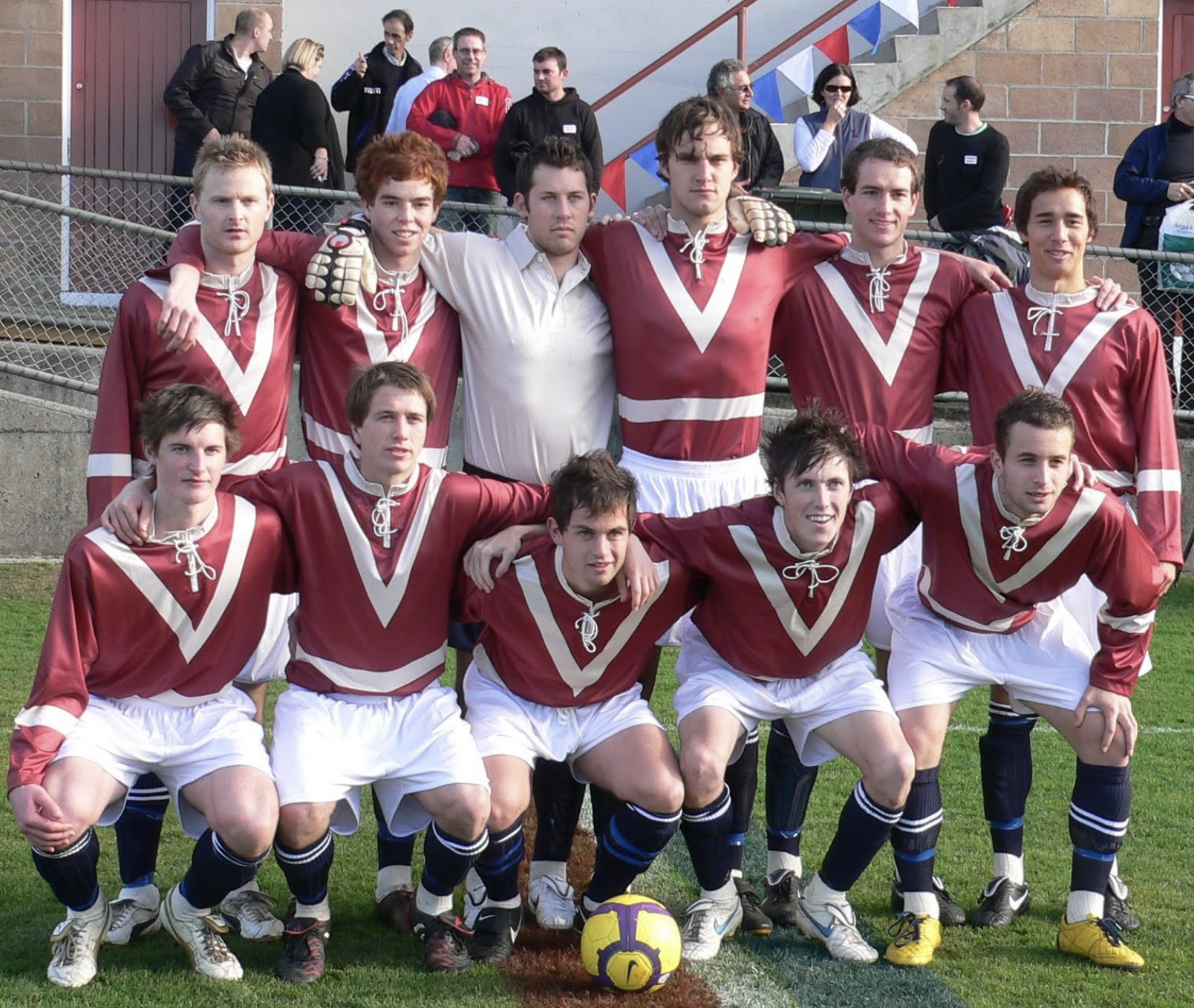
South Hobart’s starting XI in replica 1912–14 shirts during the club’s centenary celebrations in 2010. It was my first year as President and Ken’s third season as senior coach. Photo: Walter Pless.
Part Four: 2000 to 2012
When the State League disappeared at the end of 1999, football was just beginning to find its way into my life.
I had arrived in Tasmania in 1993 with Jake still a toddler and pregnant with Ned, who was born here a few months later.
Max arrived in 1995.
All three boys would turn out to be super keen to play football.
A few years later, when Max was about five or six, there was no junior football at his school.
So we went looking for somewhere the boys could play.
That search led us to Tony Chaffey, South Hobart Primary and eventually South Hobart Football Club.
Funny how life works.
By the time Tasmania finally brought back a State League in 2013, football was no longer something happening around me.
I was right in the middle of it.
Back to regional football. Again.
The second State League finished after the 1999 season.
Travel was part of the reason, especially for the northern clubs.
So Tasmania went back to what it had done before.
Northern football.
Southern football.
Regional champions.
What did not happen was the collapse of the game.
We have seen this before.
The State League disappears.
Football carries on.
In 2000 Glenorchy Knights won in the south, coached by Ken Morton.
They won just about everything that year.
The Southern Premiership.
The Steve Hudson Cup.
The Final-Five Series.
The very first Milan Lakoseljac Cup.
Devonport won in the north.
The years that followed produced strong regional competitions, sometimes with ten teams in the south.
There was plenty of football.
Thirteen years is a long time
This period lasted from 2000 through to 2012.
Thirteen seasons.
Long enough for regional football to stop looking like a temporary fix while everyone waited for the State League to return.
It became the structure.
Clubs played local rivals more often.
Travel was reduced.
Northern clubs played northern clubs.
Southern clubs played southern clubs.
That sounds rather familiar after Part Two.
Tasmania had already spent six seasons without a State League between 1982 and 1987.
Now it was doing it again.
Only this time for more than twice as long.
Statewide football still found a way
No State League did not mean no state champion.
The northern and southern champions played off for the title.
From 2009 it became a knockout series with the top four from each region.
The titles went all over the island.
University in 2001.
South Hobart in 2002.
Devonport in 2003 and 2004.
Glenorchy Knights in 2005.
Somerset in 2006.
Hobart Zebras in 2007.
South Hobart in 2008.
Clarence United in 2009.
Then South Hobart three years running from 2010 to 2012.
Launceston City were never far away.
Northern Rangers emerged as a serious club late in the period.
So perhaps this was another Tasmanian compromise.
Play most of your football regionally.
Keep the travel manageable.
Then bring the best clubs together at the end.
It was not the week-to-week experience of a State League.
But it gave you local football and north against south.
Meanwhile football had found our family
This is where the history becomes much more personal for me.
Tony Chaffey was enormously important in leading us towards South Hobart.
He had done so much work developing young players through South Hobart Primary School and the club.
I want to be careful not to write South Hobart's later success as though it suddenly appeared when Ken arrived.
It did not.
Nathan Robinson coached South Hobart to the Southern title in 2002.
Then they beat Devonport over two legs to become state champions.
It was the club's first state title since 1959.
Forty-three years.
The pathway was there.
The junior work was there.
Clubs are never built by one person.
Then my own football life accelerated
In 2007 I met Ken.
By then the boys were playing and South Hobart had become a huge part of our lives.
In 2008 Ken took over as coach.
South won 14 of 18 league games and beat Devonport 3-0 in the state final.
Then in 2010, South Hobart's centenary year, I became President.
That team went through 21 league games without losing one.
They beat Northern Rangers 1-0 for the state title.
Not a bad first year.
I do smile looking back at the beginning of this series.
In 1978 I was in Auckland and probably barely knew where Tasmania was.
In 1988 I was living in Glebe, going to the odd Swans game with no idea football would ever become part of my life.
By 2010 I was President of a football club.
Life comes at you quickly.
And Tasmania still had no State League.
So did we actually need one?
So what do those thirteen years tell us?
Could Tasmanian football survive without a State League?
Of course it could.
It had just done so for thirteen years.
Clubs developed players.
Regional leagues worked.
South Hobart became a very strong club without playing a statewide season.
So did Devonport.
Would bringing one back be worth it?
Tasmania decided yes.
Again.
The T-League
By 2012 Football Federation Tasmania was building a new statewide competition.
It was not even called the Victory League at first.
It was the T-League.
Melbourne Victory came on board as sponsor in July 2012 and the name changed.
This was not the old State League under a new name.
There was a licence.
Clubs had to apply.
It was not just about having a good team.
There were expectations around club structure, youth teams and pathways.
The federation was now deciding what a top club should look like.
That was new.
John Boulous, the FFT chief executive, said at the time, "It won't be for every club."
He meant it.
And then came the interview
I remember this part very well.
Applications closed in May 2012.
Three of us went along for South Hobart.
Frances Seaborn was Secretary.
Tracey Gofton was Treasurer.
I was President.
Three volunteers from a club that had just won three state titles in a row.
John Boulous was there.
Guy Green was there.
Jack Johnston led the panel.
And he ran the room.
It was one of the most uncomfortable hours I have spent in football.
It did not feel like a conversation.
It felt like we were the ones being examined.
We had questions.
Reasonable ones I thought.
They were not welcome.
We were told, quite firmly, that if we did not like the model we did not have to be involved.
That stayed with me.
I walked out of that room feeling smaller than when I walked in.
South Hobart absolutely wanted to be part of it.
But the message was clear.
This was the model.
Take it or leave it.
A different relationship
I did not think much about it then.
I do now.
The old State Leagues had been competitions.
This one was also a licence.
The federation was not simply arranging who played whom on Saturday.
It was deciding who was allowed in.
That brought good things.
Higher expectations.
Pathways.
A clear top tier.
But it changed the balance between the clubs and the governing body.
You no longer earned your place by winning your regional competition.
You were granted it.
More on that in Part Five.
Eight clubs got the nod
The new competition would begin in 2013 with eight clubs.
Devonport City.
Glenorchy Knights.
Kingborough Lions.
Launceston City.
Northern Rangers.
Olympia Warriors.
South Hobart.
Tilford Zebras.
Five southern clubs.
Two from Launceston.
One from the north-west.
Each club would play 21 league matches.
Remember that number.
Twenty-one.
Because when we eventually arrive at 2027, Tasmania will be looking at seven clubs and 18 league games.
It was meant to be eight in 2027.
Then Riverside dropped out this year.
But that is a story for later in this series.
Back to 2012.
There was one more thing we did not know in that room.
Nobody mentioned the National Premier Leagues.
We had never heard of it.
The name did not exist yet.
It arrived in February 2013, just before the first season.
Our new league would be Tasmania's place in it.
Its champion would play off against the champions of other states.
That turned out to matter quite a lot to South Hobart.
We had been here before
Round and round we go.
Tasmania abandoned its first State League after 1981.
Regional football followed.
The State League returned in 1988.
It disappeared after 1999.
Regional football returned.
Then, after thirteen more seasons, Tasmania built another one.
Three attempts.
The same island.
The same distances.
The same questions.
How much travel can clubs afford?
How many games are enough?
How important are local rivalries?
What do clubs get back for taking part?
What happens when a club decides it would rather play regionally?
We had asked those questions before.
We were about to ask them again.
For the earlier State Leagues I relied entirely on others.
Walter Pless most of all.
Old tables, club histories and the memories of the people who were there.
Not this time.
This time I was in the room.
That is where Part Five begins.