Who Do Referees Notice?
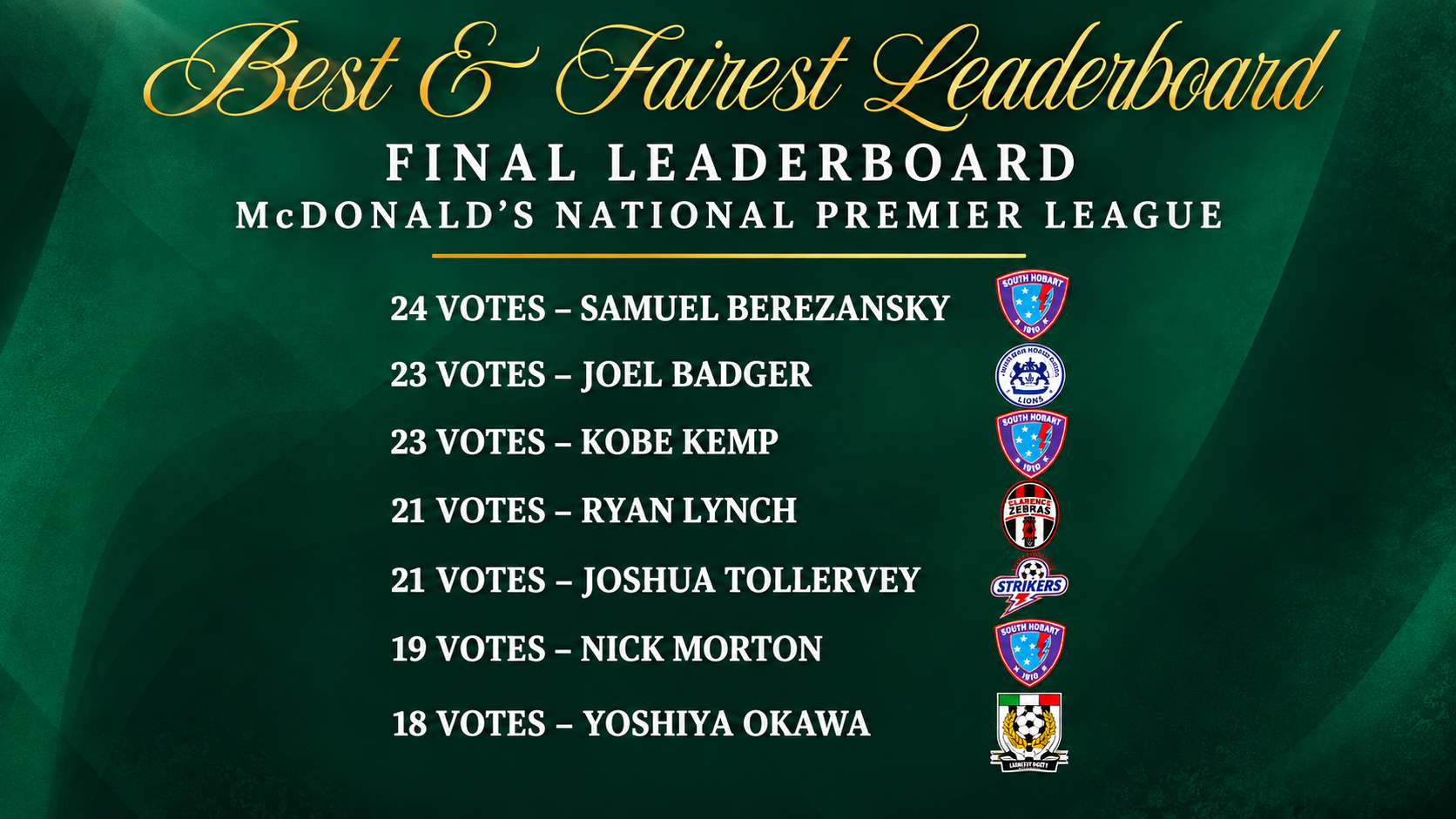
The NPL Best & Fairest votes made me wonder whether the position you play changes your chances of being noticed.
I didn't go to the Football Tasmania awards dinner.
The thought of pantyhose and a dress is fairly horrific these days, particularly as my waist seems to be getting larger rather than smaller.
I like comfort.
Give me trousers, flat shoes and something with a bit of room around the middle and I am happy.
So I stayed home.
But I did get sent photographs of the NPL Best & Fairest leaderboards as the count unfolded.
And they made me think.
Not particularly about who won.
Samuel Berezansky finished on top with 24 votes, one ahead of Joel Badger and Kobe Kemp on 23.
What interested me was who was appearing on the leaderboard and why referees might notice certain types of players more than others.
Because these aren't coaches' votes.
After every NPL match the referee awards 3, 2 and 1 votes to the players they consider the best on the ground.
Eighteen games. 54 votes available across each club's matches, although those votes can go to players from either side.
And when I looked at the final seven, something stood out.
Samuel Berezansky, midfielder.
Joel Badger, attacker.
Kobe Kemp, predominantly an 8 or 10 this season.
Ryan Lynch, attacker.
Joshua Tollervey, winger and attacker.
Nick Morton, attacking midfielder and forward.
Yoshiya Okawa, creative midfielder.
Not a specialist defender amongst them.
Goalkeepers are a slightly different discussion because they have the Golden Glove award. I don't know whether that consciously or unconsciously takes them out of Best & Fairest thinking, so I am not going to use their absence to make an argument.
But defenders?
That is interesting.
They were there early
This isn't as simple as saying referees never notice defenders.
After Round 5, Toby Barton from Devonport was sitting on seven votes and Riverside captain Will Prince was on six, sitting in the middle of a leaderboard headed by Okawa and Nick.
So defensive players were certainly being noticed early, although the leaders even then were attacking and creative players.
As the season went on the attacking and creative players pulled away and the defenders faded from the group entirely.
Which got me thinking about what a referee actually sees during a football match.
Not what I see sitting in the stand or taking photos on the sideline.
Not what a coach sees standing in the technical area.
What does the person physically running around inside the game see?
Are attacking players simply closer to the referee's attention?
A referee has to follow the ball.
They need to be close enough to see tackles, contact, handballs, fouls and everything else happening around the contest.
And who lives around the ball?
The midfielders.
The number 10s.
The wingers cutting inside.
The striker receiving the ball with a defender on his back.
The player being fouled three or four times.
The player carrying the ball through midfield.
The player playing the final pass.
The player scoring the goal.
All of those things demand the referee's attention.
A centre-back can have an outstanding game without doing anything remotely as obvious.
In fact, perhaps the better a defender is, the less there is to see.
He reads the danger early.
He gets into the right position.
He closes the space.
He intercepts the pass before the striker ever gets there.
He tracks a runner and the ball goes somewhere else.
Nothing dramatic happens because he has made sure nothing dramatic happens.
How does that compare in somebody's memory with a winger beating two players and smashing one into the top corner?
Then there is the problem of memory
The referee isn't judging the Best & Fairest while the match is happening.
Their job for 90 minutes is to referee the football match.
Then the game finishes and at some point they have to decide.
Who gets three?
Who gets two?
Who gets one?
I would love to get inside their heads at that point.
Do they already know?
Does one player immediately spring to mind?
Do they think about the goals first?
The midfielder who seemed to be everywhere?
The winger who kept causing problems?
Or the defender who quietly won everything all afternoon?
I also wonder what happens in the referees' room afterwards.
Is there a discussion?
Does an assistant referee say, "I thought number eight was excellent"?
Does someone else say, "What about their centre-half"?
Is it entirely the referee's decision or do the three officials kick names around before the votes are submitted?
I genuinely don't know.
But I would really like to.
Because the way those decisions are made could tell us quite a lot about the eventual leaderboard.
The final seven
The final count from the photographs I was sent was:
Samuel Berezansky 24
Joel Badger 23
Kobe Kemp 23
Ryan Lynch 21
Joshua Tollervey 21
Nick Morton 19
Yoshiya Okawa 18
There are different sorts of footballers in there, so it would be unfair to call them all strikers.
Berezansky is a midfielder.
Kemp has predominantly played as an eight or ten.
Okawa is a creative midfielder.
But there is a common thread.
They are players who become heavily involved in possession and in the attacking phases of the game.
They are visible.
And perhaps visibility matters.
One result needs a little context
There is one result on that final leaderboard that needs explaining.
Nick had 19 votes after Round 15.
At that point the count was:
Samuel Berezansky 21
Nick Morton 19
Ryan Lynch 19
Joel Badger 18
Yoshiya Okawa 18
Kobe Kemp 18
Joshua Tollervey 16
Nick then left South Hobart and Tasmania and didn't play the final three rounds.
So when his NPL season finished he was equal second in the Best & Fairest count, two votes behind Berezansky.
He received no further opportunity to poll and still finished sixth.
Nick is my stepson, so obviously I know him rather better than the other six players on this list. I am not suggesting he would have won. Nobody can know that.
But the numbers are the numbers, and 19 votes from 15 rounds is very good polling.
This isn't just a 2026 thing
I went back through the recent winners.
Kobe Kemp won the award in 2022.
Nick won in 2023 and 2024.
In 2025, Nick, Kobe and Angus Taylor shared it.
Different players, different styles, but again there is a common theme.
They are footballers who spend a lot of time involved in possession, progressing the ball, creating chances or scoring.
That doesn't prove anything about referees.
But it does make the 2026 leaderboard harder to dismiss as a one-off.
And importantly, this is not the Golden Boot. There is already a separate award for goalscorers.
Nor is it the Golden Glove. Goalkeepers have their own category too.
This award is meant to identify the competition's Best and Fairest player.
So why, year after year, do midfielders and attackers seem to be the ones who rise to the top?
And what about the "fairest" part?
That is another interesting layer.
Players can become ineligible through serious disciplinary suspension, so the award is not simply about football ability.
But I wonder whether there is also a more subtle human element.
If a player spends the afternoon arguing with the referee, committing cynical fouls or being difficult to manage, does that stay in the referee's mind when it comes time to vote?
Even if the player remains technically eligible?
Again, I don't know.
But it would be extraordinary if human interaction had no influence at all.
A referee does not experience players as statistics on a page.
They hear them.
They talk to them.
They warn them.
They manage them.
They see how they respond after being fouled, after conceding a decision, after receiving a card.
Perhaps all of that becomes part of the impression.
And then I noticed something else
Look at the clubs represented in that final seven.
South Hobart had Berezansky, Kemp and Nick.
The other four were Badger at Kingborough, Lynch at Clarence Zebras, Tollervey at Devonport and Okawa at Launceston City.
Those four players were all recruited into Tasmanian football from overseas.
That isn't a criticism.
In fact it may say something very positive about the recruitment being done by Tasmanian clubs.
If you are going to bring players halfway around the world, you would certainly hope they make an impact.
And clearly these four did.
But it is another interesting feature of the final leaderboard.
Perhaps clubs tend to use their overseas recruitment on attacking and creative positions because those players are harder to find locally.
Perhaps those recruits arrive with qualities that immediately stand out at NPL Tasmania level.
Perhaps it is just one season and means absolutely nothing.
But once you notice it, it is hard not to wonder.
So do referees favour attacking players?
I don't think we can say that.
The Round 5 leaderboard itself tells us not to.
Defenders were receiving votes.
Referees aren't sitting there thinking, "I am not voting for a centre-back today."
But I do wonder whether the way a referee experiences a match naturally makes some performances easier to recognise than others.
The player around the ball is repeatedly in the referee's line of sight.
The player being fouled is interacting with them.
The player creating chances produces memorable moments.
The goalscorer provides the most obvious moment of all.
Meanwhile the defender who has quietly read the game beautifully for 90 minutes may have done his finest work before anybody else even realised there was danger.
Perhaps these votes don't simply tell us who the best players were.
Perhaps they also tell us which kinds of excellence are easiest to see from the middle of the pitch.
And perhaps that is the most interesting thing about these awards.
A referee watches a different football match to the rest of us.
The coach is looking at structure.
A supporter tends to follow the ball.
A goalkeeper watches the game from behind it.
A parent might spend half the match watching one player.
The referee is inside it, moving with it, talking to the players and concentrating on completely different things.
Then we ask them to finish all of that and tell us the three best footballers on the park.
No wonder the result is interesting.
And now I really want to ask some referees how they do it.