Who's the Star of the Show?
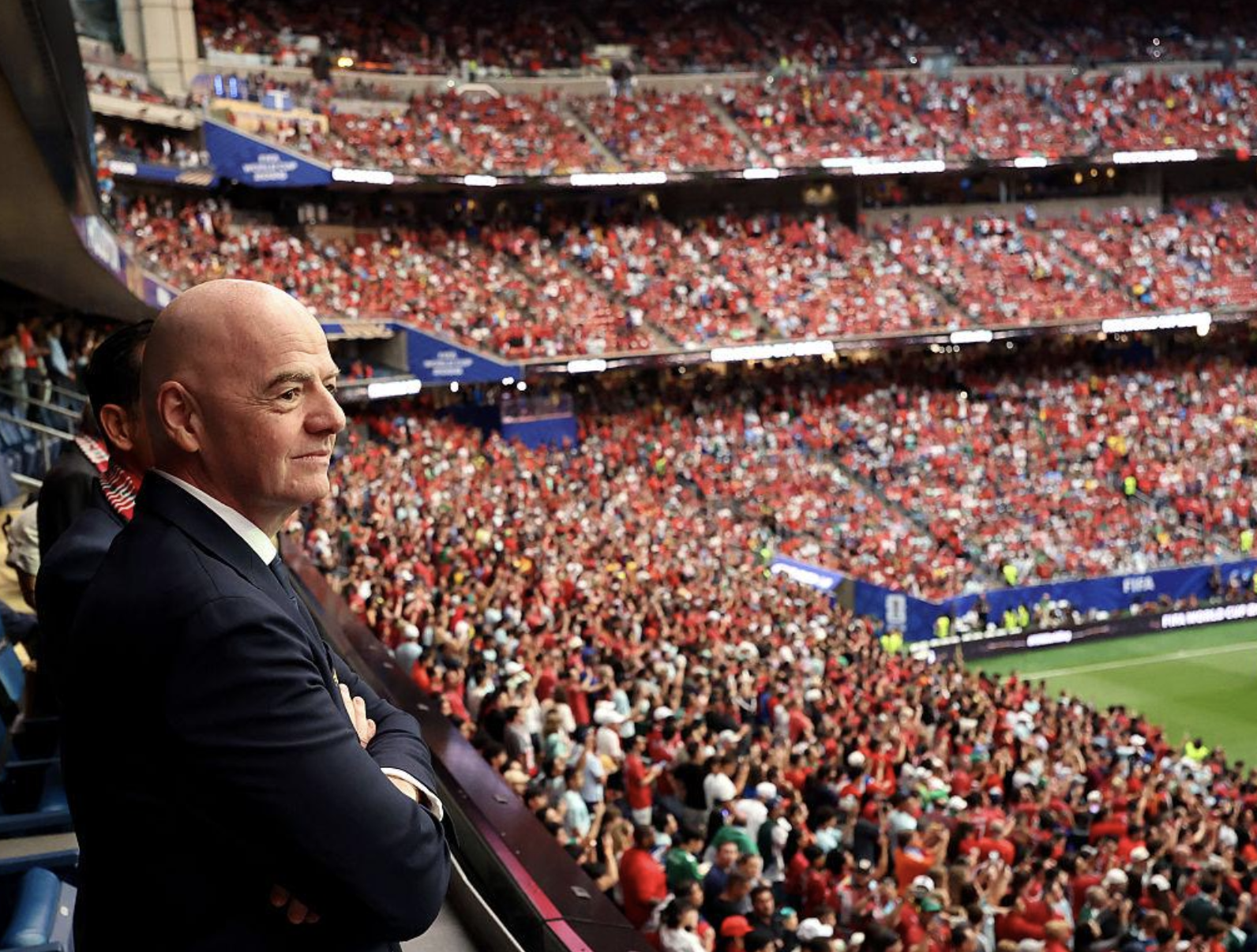
Why does the camera keep finding FIFA President Gianni Infantino?
In a few minutes, Spain and France will walk onto the pitch for a FIFA World Cup semi-final.
Millions of us will tune in.
We’ll be watching Lamine Yamal.
We’ll be watching Kylian Mbappé.
We’ll be watching Rodri.
We’ll be watching Ousmane Dembélé.
We’ll be watching one of the biggest matches in world football.
But here’s something else to watch for.
See how long it takes before the television cameras find FIFA President Gianni Infantino.
You may never have noticed it before.
After tonight, you probably will.
Will it be before the first hydration break?
After the opening goal?
At half-time?
Or perhaps all three.
Once is understandable.
Twice is coincidence.
By the tenth time during a tournament, you begin asking questions.
At first, I thought it was simply clever television.
Now I’m not so sure.
The Ultimate Away Day
While most of us are setting the alarm for 3.00am, making a coffee and hoping the Wi-Fi holds together, Gianni Infantino has enjoyed a rather different World Cup experience.
Breakfast in Mexico City.
Football in Mexico City.
Private jet.
Football in Guadalajara.
Dinner in the VIP lounge.
Repeat tomorrow.
Apparently, this is exhausting.
During the group stage, Infantino regularly attended two World Cup matches in the same day, flying between host cities aboard a Qatar Airways private jet supplied by one of FIFA's major commercial partners.
While supporters compare hotel prices, airline baggage allowances and airport queues, the FIFA President simply compares departure times for the next private jet.
I must admit, this is exactly how I would like to watch football.
Front-row seat.
VIP hospitality.
Police escort.
Private jet waiting on the tarmac.
No queues.
No airport security.
No "your gate has changed."
No trying to remember where you parked the car.
Just another day at the World Cup.
The difference is, I am not asking 211 national football associations to vote for me at FIFA's next presidential election.
By the end of this tournament, Gianni may have earned enough frequent flyer points to attend the 2030 World Cup for free.
Although, somehow, I suspect he won't be flying economy.
Humour aside...
This is where the story becomes serious.
Who is Gianni Infantino?
Giovanni Vincenzo "Gianni" Infantino became FIFA President in 2016 following one of the darkest periods in FIFA's history after the corruption scandals that engulfed the organisation.
A Swiss lawyer of Italian heritage, he previously served as UEFA General Secretary before taking football's most powerful office.
Whether you admire him or criticise him, his influence on the game is undeniable.
During his presidency the men's FIFA World Cup has expanded from 32 to 48 teams, increasing from 64 to 104 matches.
The FIFA Club World Cup has expanded.
Prize money has increased.
FIFA revenues have reached record levels.
Supporters see him as the man who has helped globalise football and increase investment in the game.
Critics argue FIFA has become increasingly centralised around the presidency.
With FIFA's 2027 presidential election approaching, Infantino has confirmed he will seek another term. If successful, he would remain FIFA President until 2031.
The Election Nobody Talks About
While the football has captured the world's attention, another contest is quietly approaching.
The FIFA presidential election.
Unlike a national election, supporters don't vote.
Players don't vote.
Coaches don't vote.
Referees don't vote.
Volunteers don't vote.
Instead, FIFA's 211 member associations each receive one vote.
Australia gets one.
Brazil gets one.
San Marino gets one.
Cook Islands gets one.
Every member association is equal.
That is one of FIFA's great democratic strengths.
It is also why relationships matter.
Recognition matters.
Visibility matters.
A Comfortable Lead
Before campaigning has properly begun, the incumbent already enjoys an extraordinarily strong political position.
Three of FIFA's six continental confederations have publicly endorsed Gianni Infantino's re-election.
That endorsement came well before FIFA's member associations will cast their votes.
In most democratic systems, such an early and overwhelming declaration of support for an incumbent would attract considerable public scrutiny.
In football, it barely rated a headline.
The Confederation of African Football.
The Asian Football Confederation.
CONMEBOL, representing South America.
Together they represent 111 of FIFA's 211 member associations.
More than half.
In politics, that would be described as a commanding head start.
Australia, through Football Australia's membership of the Asian Football Confederation, sits within one of the confederations that has publicly endorsed Infantino.
It also raises an interesting question.
Was that endorsement discussed publicly with Australian football?
Were clubs consulted?
Were coaches asked?
Were volunteers, referees or players invited into the conversation?
Or was it simply accepted as part of confederation politics?
Perhaps those are questions Football Australia should answer.
At the time of writing, no serious challenger has emerged.
That may change.
But for now, the incumbent appears comfortably placed.
The Camera Never Lies... Does It?
This is where the story becomes interesting.
The television pictures seen around the world don't come from SBS.
Or the BBC.
Or Fox.
They come from FIFA's Host Broadcast Services (HBS), which produces the official world feed used by every broadcaster.
FIFA says there is an agreement that each half should include a "dignitary shot".
That could be a head of state.
A celebrity.
A football official.
Or the FIFA President.
FIFA also says broadcasters are not instructed to show Gianni Infantino specifically.
I accept that.
But the outcome remains the same.
Game after game.
Day after day.
Tournament after tournament.
The camera finds him.
A Constitutional Question
To be clear, this article does not suggest any rules have been broken.
Nor does it suggest Gianni Infantino is directing television cameras.
It simply asks whether FIFA's governance arrangements and broadcast practices create the right balance between promoting the office of the FIFA President and keeping the focus where it belongs.
On the football.
Every organisation has an incumbent advantage.
Prime ministers have one.
Presidents have one.
Company CEOs have one.
Sporting organisations are no different.
The holder of the office is naturally more visible than anyone seeking to replace them.
That is understandable.
But should the world's biggest football tournament also become the world's biggest platform for the incumbent FIFA President?
No one is suggesting Gianni Infantino shouldn't attend World Cup matches.
Attending them is part of his role.
The question is different.
When the office itself is repeatedly placed before billions of viewers during football's greatest event, does that create a level of visibility that no potential challenger could realistically match?
After all, there are no televised debates.
No campaign advertising.
No public vote.
FIFA presidents are elected by national football associations.
Relationships matter.
Recognition matters.
Visibility matters.
If the office of FIFA President is repeatedly placed at the centre of the world's biggest football event while its holder seeks another term, asking whether that creates an institutional advantage is not a personal criticism.
It is a governance question.
And governance questions deserve to be asked.
Imagine if, during every Australian federal election campaign, the ABC was expected to show the Prime Minister during every major sporting event.
Not speaking.
Not campaigning.
Simply appearing.
Again.
And again.
And again.
Eventually people would ask whether visibility itself had become part of the campaign.
Why should football be any different?
Football's Biggest Stage
The World Cup has never belonged to FIFA.
It belongs to football.
To the child kicking a ball against the garage door.
To the volunteer marking muddy pitches on a Saturday morning.
To the referee trying to keep twenty-two passionate players under control.
To the coach who has spent decades helping young footballers believe in themselves.
To the supporters who have saved for years to travel halfway around the world for ninety minutes of hope.
And, of course, to the players.
Administrators matter.
Good governance matters.
Strong leadership matters.
But the administrator should never become the attraction.
The office should serve the game.
The game should never serve the office.
Nobody is suggesting Gianni Infantino has broken a rule.
Nobody is suggesting he should not attend World Cup matches.
But when football's biggest tournament repeatedly reminds billions of viewers who the FIFA President is while that same president prepares to seek another term in office, asking questions isn't cynical.
It's responsible.
Football has spent generations telling us that the game belongs to the players, the coaches, the volunteers and the supporters.
Perhaps it is time our television pictures reflected that.
Because football deserves great leadership.
Football deserves transparent governance.
Football also deserves a World Cup where the biggest stars wear boots.
Not business suits.
So the next time the camera leaves the pitch and finds the FIFA President once again, ask yourself one simple question.