Every Player Pathway Begins With a Coach
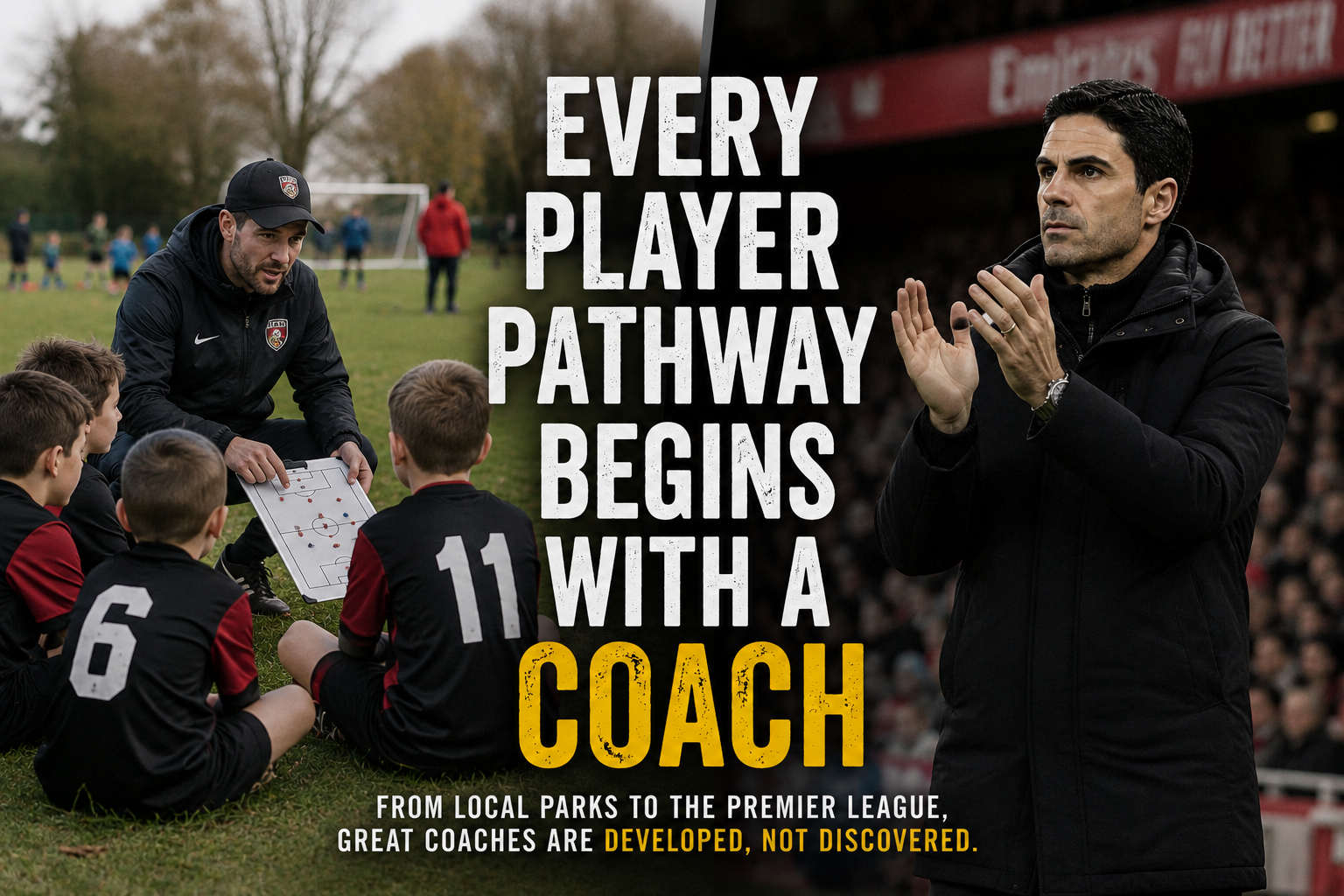
We spend countless hours discussing player pathways. But what about the people standing on the touchline?
The Premier League recently confirmed its 20 managers for the 2026-27 season.
Like most football supporters, I recognised the names immediately. We debate who will challenge for the title, who might be under pressure by Christmas and which clubs have made the smartest appointments.
I found myself asking a different question.
How do you actually become one of only 20 managers in the most watched football league in the world?
Is it simply a reward for being a great player?
Or is there a far more deliberate pathway that develops elite coaches?
The more I researched it, the more fascinating it became.
Not all Premier League managers were superstars
The overwhelming majority played professional football.
But that's where the similarities begin to disappear.
Some were world-class players.
Others forged respected careers in lower divisions.
Some saw their playing careers cut short through injury.
A handful were never household names as players.
Being an elite player, it turns out, is not the ticket to becoming an elite coach.
The superstar pathway
Names like Xabi Alonso, Frank Lampard, Mikel Arteta and Michael Carrick are instantly recognisable.
They enjoyed outstanding playing careers.
Yet none walked straight from the dressing room into a Premier League technical area.
Xabi Alonso learnt his coaching craft with Real Madrid's academy before taking Bayer Leverkusen to an unbeaten Bundesliga title and earning the Chelsea job.
Mikel Arteta spent more than three years learning under Pep Guardiola at Manchester City before Arsenal entrusted him with rebuilding one of England's biggest clubs.
Michael Carrick served an apprenticeship as an assistant before earning his own opportunity.
Their playing careers opened the first door.
Their coaching careers earned every opportunity that followed.
The professional footballer
This is perhaps the most common pathway.
Managers such as Marco Silva, Andoni Iraola, Daniel Farke, Keith Andrews and Roberto De Zerbi all played professionally.
Good players.
Respected professionals.
But they became known as outstanding coaches rather than famous footballers.
Their coaching résumés eventually became stronger than their playing ones.
The academy coach
One trend stood out more than any other.
Modern football increasingly values coaches who understand player development.
Several Premier League managers spent years working in academy football before taking charge of senior teams.
Xabi Alonso began coaching in Real Madrid's academy.
Kieran McKenna built his reputation developing players at Tottenham Hotspur and Manchester United before leading Ipswich Town to successive promotions.
Michael Carrick learnt his craft within Manchester United's coaching structure.
Fabian Hürzeler developed through Germany's youth coaching system before becoming one of the youngest managers in Premier League history.
These weren't glamorous jobs.
They involved countless training sessions.
Developing young players.
Building environments.
Refining coaching philosophies.
Learning how people improve.
The apprentice
Perhaps football's most underrated pathway.
Many of today's managers spent years standing beside experienced coaches rather than standing in front of them.
Watching.
Listening.
Planning.
Learning.
Arteta often speaks about what he learnt from Guardiola.
Others followed similar journeys, quietly refining their own ideas before becoming the person making the final decisions.
Football management has become an apprenticeship.
The student
This may be the biggest change of all.
The modern football coach is expected to understand far more than tactics.
Leadership.
Communication.
Sports science.
Performance analysis.
Psychology.
Recruitment.
Culture.
Data.
Coach education.
Continuous professional development.
The days of simply being an ex-player are disappearing.
Modern football wants educated coaches.
The modern coaching pathway
After looking at all 20 Premier League managers, some common themes became impossible to ignore.
The overwhelming majority played professional football.
Every manager has invested heavily in coach education, with the UEFA Pro Licence representing the highest coaching qualification in European football.
Many began coaching in academies.
Many served lengthy apprenticeships as assistant coaches.
None became Premier League managers overnight.
Every one of them treated coaching as a profession.
None of those managers arrived fully formed.
Every one of them was given opportunities.
Somebody trusted them with an academy team.
Somebody invited them into a senior coaching staff.
Somebody mentored them.
Somebody believed they could become more than they were.
Looking through those pathways made me stop and think.
What does the coaching pathway actually look like in Tasmania?
Then I started thinking about Tasmania
Over the past year I've had the privilege of interviewing many of Tasmania's senior NPL coaches.
Hélder Manuel dos Santos Silva.
Daniel Syson.
Tom Ballantyne.
James Sherman.
Jon Fenech.
Brian Murphy.
Peter Edwards.
Gediminas Krasa.
Every conversation has been different.
Every journey has been unique.
Some arrived from overseas.
Some built careers interstate before making Tasmania home.
Some enjoyed long playing careers.
Others discovered that coaching, rather than playing, would become their greatest contribution to football.
Different countries.
Different football cultures.
Different philosophies.
What struck me wasn't their differences.
It was how much time every one of them had invested in becoming a better coach.
That mirrors exactly what we see in the Premier League.
Then it became personal
This isn't just an academic discussion for me.
It's something my own family has lived.
My son, Max, is 31 years old and holds an AFC A Licence.
He made the difficult decision to leave Tasmania to continue his coaching journey.
Could he have stayed here and coached successfully?
Absolutely.
Could he have continued developing players and contributing to Tasmanian football?
Without question.
But would staying here have accelerated his coaching education?
Would it have exposed him to more full-time high-performance environments?
More experienced mentors?
Different football cultures?
Greater competition?
I don't think so.
So, like many ambitious Tasmanians before him, he packed his bags and crossed Bass Strait.
Not because he wanted to leave.
Because he wanted to grow.
That isn't a criticism of Football Tasmania, our clubs or the people who work tirelessly for the game.
It is simply the reality of living on an island of just over half a million people.
Our football ecosystem is naturally smaller.
Our opportunities are naturally fewer.
But acknowledging that reality leads to another question.
If our most ambitious coaches need to leave Tasmania to continue developing, what can we do to make that journey a little less necessary for the generation that follows?
The people who shape every player
Every Socceroo was coached by somebody.
Every Matilda was coached by somebody.
Every Premier League footballer was coached by somebody.
Long before the bright lights, the crowds and the television cameras, there was a coach standing on a cold training ground helping a young player improve.
That leads me to one fundamental question.
Every footballer has a pathway.
Shouldn't every coach?
Not just through licence courses.
Not just by accumulating enough Continuing Professional Development points to satisfy the next licence renewal.
I mean genuine development.
Mentoring.
Observation.
Constructive feedback.
The opportunity to spend time in elite environments.
To challenge ideas.
To share knowledge.
To learn from experienced coaches.
To keep growing long after the certificate has been framed and hung on the wall.
We ask coaches to invest thousands of dollars in qualifications.
We ask them to dedicate evenings and weekends.
We ask them to keep learning.
But are we providing enough opportunities for that learning to continue once the course is over?
The Premier League's managers weren't developed overnight.
Their coaching journeys took years, sometimes decades, supported by football systems that invested in people as much as results.
We talk endlessly about player pathways.
And we should.
Because every player pathway begins with a coach.
Perhaps the most important pathway in football isn't the one our players walk.
It's the one our coaches walk first.
And perhaps Tasmania's next great football conversation isn't about producing our next Socceroo or Matilda.
Perhaps it's about producing Tasmania's first Premier League manager.