A few Saturday morning thoughts after Socceroos v Brazil
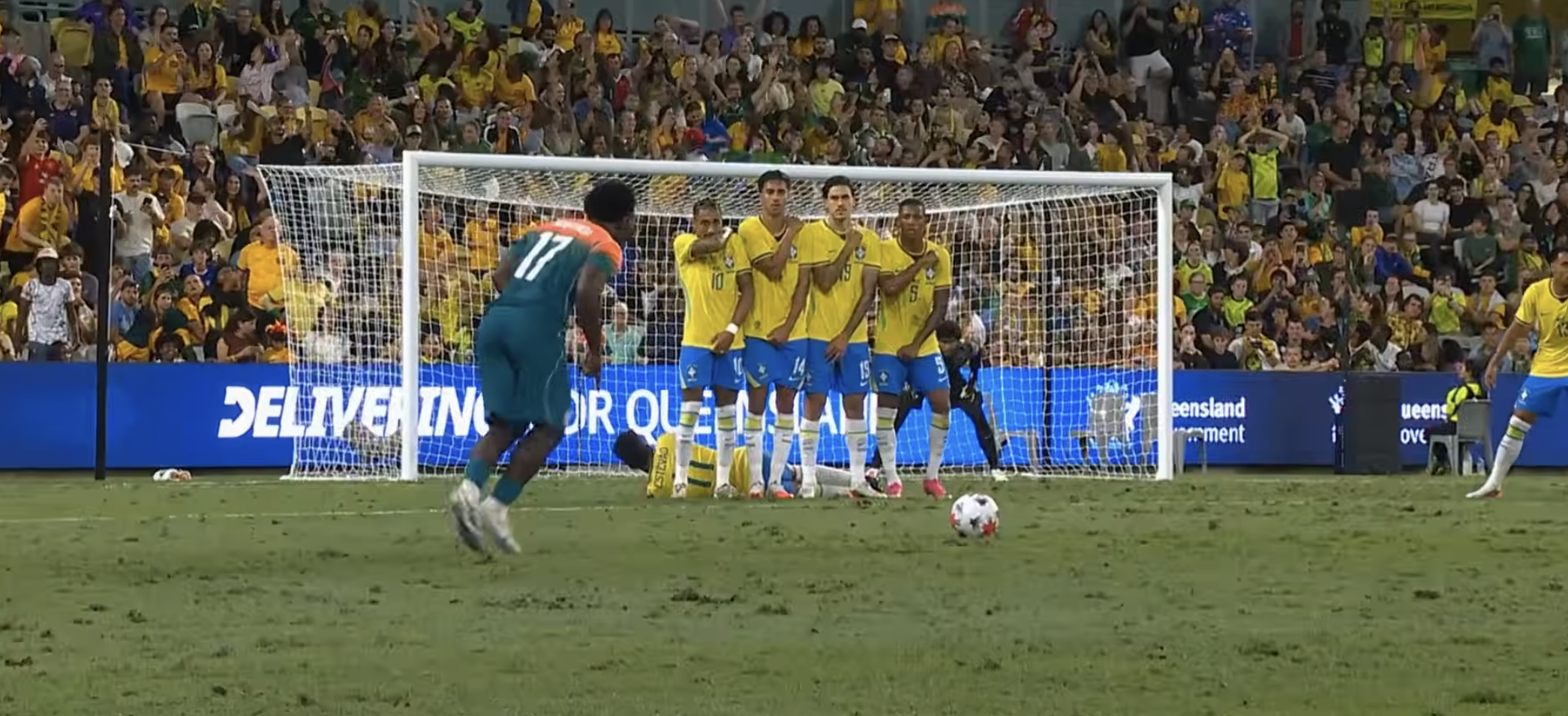
Nestory Irankunda scoring his goal against Brazil in Townsville, with the deteriorating playing surface clearly visible. Screenshot from match broadcast.
A few things rattling around in my head this morning after the Socceroos drew 1–1 with Brazil in Townsville last night.
The game.
Nestory Irankunda.
That pitch.
And somehow Lucas Herrington and transfer fees.
That's generally how my football brain works. One thing leads to another.
First, the football
I didn't quite make it through the whole game.
An 8pm kick-off and my usual ridiculously early start eventually got the better of me. So I watched the first half and caught up with the rest this morning.
And apparently I picked a pretty poor time to go to bed.
Nestory Irankunda produced an absolute cracker of a free kick in the 68th minute to put Australia 1–0 up.
Then Rayan broke Australian hearts with an equaliser in the 95th minute.
So 1–1 against Brazil.
Not bad at all.
Reading through the reports this morning, this doesn't appear to have been one of those results where Australia spent 90 minutes desperately hanging on and somehow escaped with a draw.
Joey Lynch, writing for The Guardian, described it as a "promising, positive performance" from the Socceroos.
Australia were prepared to have a go.
After taking the lead they defended well.
Brazil got frustrated and struggled to find a way through.
Then the quality came.
Raphinha produced a superb delivery and Rayan powered home the header.
Cruel.
But against a Brazilian side containing Vinícius Júnior, Raphinha, Endrick, Estêvão and Bruno Guimarães, there is plenty for Australia to take from it.
£75 million
That name, Bruno Guimarães, sent me down my first rabbit hole this morning.
Arsenal paid Newcastle United £75 million for him just last month.
£75 million.
For one footballer.
It is almost impossible to comprehend those numbers from an Australian football perspective.
And it got me thinking about Lucas Herrington.
Remember that one?
The Lucas Herrington sell-on
Herrington came through Brisbane Roar's academy. Brisbane sold him to Colorado Rapids in 2025 for what the club described as a record fee.
Importantly, Brisbane kept a 20 per cent sell-on interest.
Good business.
Then Colorado offered to buy that sell-on interest back.
Brisbane agreed.
The reported price was around A$560,000.
You can probably guess what happened next.
Herrington went to the World Cup with Australia. His reputation soared. Premier League clubs started circling.
Hull City eventually signed him from Colorado for a reported upfront fee of around A$24 million, with millions more in add-ons.
That 20 per cent suddenly looked rather valuable.
Football360 estimated Brisbane would have banked around A$4.8 million from the Hull deal if they had kept the clause.
Instead they walked away with about A$1.75 million, as well as solidarity payments.
Ouch.
Now, hindsight is a wonderful thing.
Brisbane couldn't possibly have known what was going to happen to Herrington.
There is always value in taking guaranteed money rather than gambling on a future transfer.
And to be fair to the Roar, they have defended the decision publicly. They say Colorado approached them and the offer went through their ownership group as their governance requires.
But surely this is exactly the gamble Australian clubs need to become better at taking.
We keep talking about the financial sustainability of Australian football.
Player development is one of the assets we actually have.
If we develop an outstanding 17-year-old, sell him overseas and he becomes a £10 million, £20 million or £30 million player, shouldn't the Australian club that helped develop him share meaningfully in that value?
Maybe sometimes the best cheque is the one you don't cash too early.
Anyway, that's a discussion for another day.
Back to Brazil.
Nestory Irankunda
What a talent.
We've been waiting to see exactly where Irankunda's enormous potential might take him. Scoring a goal like that against Brazil isn't a bad addition to the CV.
And while we're talking about him, here's a small inconvenient reminder in the middle of all our current arguments about immigration and multiculturalism.
Irankunda was born in a refugee camp in Tanzania to Burundian parents who had fled civil war. He arrived in Australia as a three-month-old baby, grew up here and now wears the green and gold.
Another one of those immigrants spoiling it for the rest of us.
Anyway.
Next rabbit hole.
That pitch
Good grief.
What was going on there?
Even during the first half it looked awful. Uneven, loose and cutting up under the players.
And apparently it got worse.
Several players were slipping as the surface deteriorated through the night.
So this morning I went looking to see whether I was being unfair.
I wasn't.
Joey Lynch, writing for The Guardian, described it as an "ice-rink of a surface".
Carlo Ancelotti wasn't impressed either.
"It was difficult to play on this pitch," he said.
Later he returned to it.
"It was not good, the pitch."
He's managed Real Madrid, Bayern Munich, Chelsea, AC Milan and Paris Saint-Germain.
He's seen a few football pitches.
But here's where it gets interesting.
Tony Popovic actually agreed with him.
"Was it good? No."
But Popovic then made a point that probably deserves a bit more attention.
He said Australia regularly encounters poor pitches, including during World Cup qualifying, and questioned why nobody seems particularly interested when it happens to the Socceroos.
Fair point.
Then he said this:
"We'd love to have carpet as grass to play on like we did at the World Cup. That's a dream for us, but at the moment that's a dream that's not close to reality."
And that troubles me a little.
Why should it be a dream?
I'm not asking for a World Cup billiard table every time the Socceroos play.
But surely expecting a genuinely good football surface for an international involving Brazil isn't an unreasonable aspiration.
Harry Souttar was pretty frank about it too.
"I don't think the pitch was that great, to be honest with you."
Then came the line that really caught my attention.
"We know it's not technically designed for football, so it's going to cut up."
There it is.
A stadium hosting an international football match between Australia and Brazil, but a surface that our own captain acknowledges isn't really designed for football.
Jackson Irvine took the traditional footballer's view.
"It is what it is."
And, yes, the pitch was the same for both teams.
But I've never particularly liked that argument.
Of course it was the same for both teams.
That doesn't make it a good pitch.
And it doesn't answer the bigger question.
Why are we accepting this as normal?
So what happened?
My first thought was that rugby league must have been played on the ground immediately beforehand.
Apparently not.
The Cowboys' last NRL/NRLW double-header at Queensland Country Bank Stadium was on 5 September.
Australia played Brazil on 25 September.
Twenty days.
Almost three weeks.
So naturally I have questions.
What happened to the pitch?
What preparation was undertaken during those 20 days?
Who was responsible for preparing it for international football?
What standard was required?
Who inspected it?
Did Football Australia have concerns?
Did Brazil?
And at what point is someone able to say this simply isn't good enough?
I don't know the answers.
I'd quite like to.
We got Brazil here
And that's really the point.
We got Brazil here.
Not Brazil's C team.
Vinícius Júnior. Raphinha. Endrick. Estêvão. Bruno Guimarães.
Carlo Ancelotti in the dugout.
Townsville packed the stadium and embraced the occasion.
Fantastic.
I strongly support taking games like this outside Sydney and Melbourne. Regional Australia should get to see the Socceroos and the world's great football nations.
But if we're going to do it, let's do it properly.
We want Brazil to come back.
We want Argentina, England, Spain, France, Germany and others to come here.
We want their best players.
And presumably we'd like them to go home talking about the football and the atmosphere rather than the grass.
One last thing
Australia and Brazil do it all again in Brisbane on Tuesday night.
Same teams.
Different stadium.
Different surface.
Although Suncorp Stadium will have hosted an NRL preliminary final only four days earlier.
So there we go.
A 1–1 draw with Brazil.
An outrageous Irankunda goal.
A £75 million Brazilian midfielder.
A reminder of a rather painful Australian transfer decision.
And an international football pitch that looked anything but international standard.
Not a bad collection of Saturday morning football rabbit holes.
I'll be watching Brisbane's grass very closely.