We've been here before: Tasmania's first State League
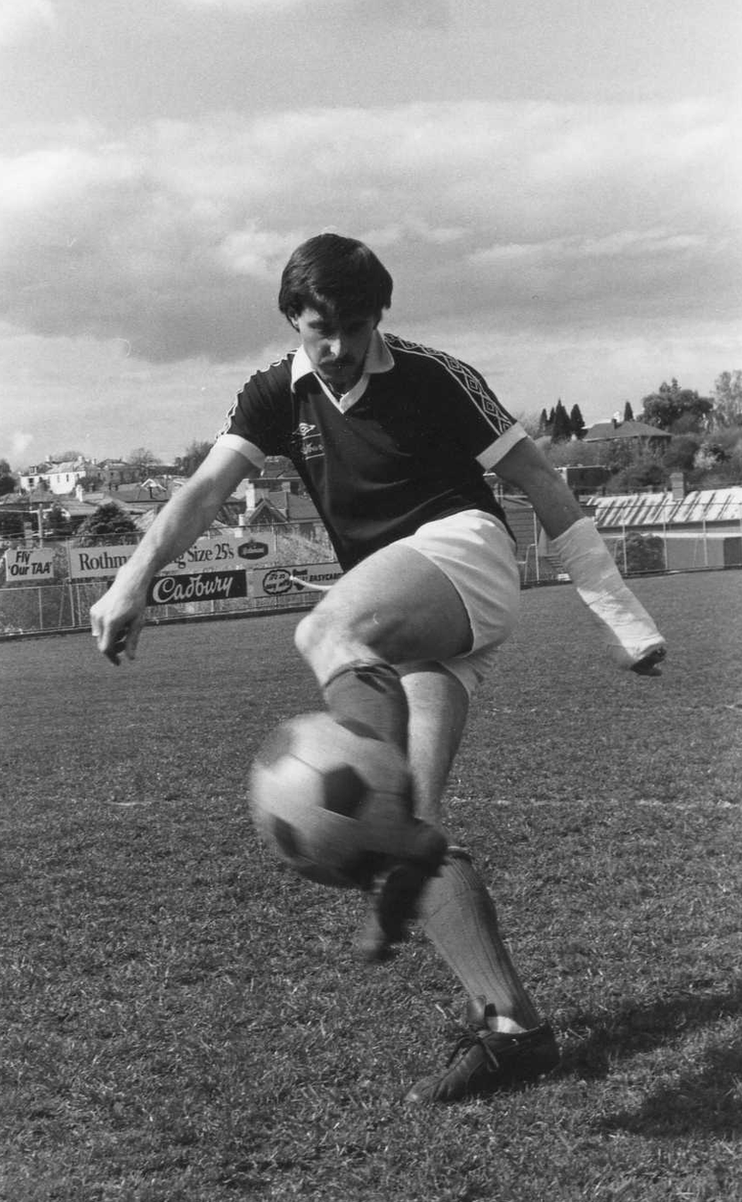
Ian Parker in action for Caledonians at South Hobart in 1981. Photo: Ralph Dymond, via Walter Pless. - Cigarette and chocolate advertising.
Part One: Four seasons and gone
In 1978, when Tasmania's first genuine State League kicked off, I was 20 years old and living in Auckland.
I had left boarding school a couple of years earlier and was discovering that life after school was perhaps a little tougher than I had imagined.
Tasmania?
I am not even sure I could have pointed to it on a map.
My world was New Zealand, work, LP records and music. Rod Stewart, Elton John, the Bee Gees. Grease was everywhere. We bought records, put them on a turntable and listened to an entire side before getting up to turn them over.
There were no mobile phones.
No internet.
No Google.
No social media.
Certainly no way for a 20-year-old woman in Auckland to know that on the other side of the Tasman, Tasmanian football was embarking on an experiment that would still be worth talking about nearly 50 years later.
Tasmania was creating a State League.
I knew nothing about it.
Walter Pless did.
Thank goodness he did.
I should say at the outset that I am no historian.
I have simply become curious.
After all the recent discussion about a seven-team NPL in 2027, only 18 league games, the loss of Riverside, Launceston being reduced to one NPL club and the wider question of whether Tasmania is slowly losing a genuinely statewide competition, I wanted to know whether we had been here before.
So I went looking.
I have worked through as many records as I can find. Walter Pless's extraordinary archive. Old league tables. Club histories. Newspaper reports and the work of people who have spent years documenting Tasmanian football.
I am not claiming to have lived this history or to be an authority on it.
I am simply trying to piece together what happened as accurately as I can and ask what it might tell us about where we are now.
Where records disagree, I will say so.
Where something cannot be established with certainty, I won't pretend otherwise.
But one thing is already clear.
Tasmania has been here before.
Twice, in fact, we have lost a State League.
This is Part One.
It starts in 1978.
Four seasons later, the State League was gone.
Ten teams, and it really was statewide
The first thing that struck me when I looked at 1978 was the composition of the league.
There were ten clubs:
White Eagles
Croatia Glenorchy
Rapid Wrest Point
Hobart Olympia
Caledonians
Devonport City
Launceston Juventus
Ulverstone
George Town United
Launceston United.
Five from the south.
Five from Launceston, the north and north-west.
Each club played 18 league games, home and away against nine different opponents. White Eagles won the inaugural championship, finishing level on points with Croatia Glenorchy but ahead on goal difference.
Now compare that with what is proposed for 2027.
Seven clubs.
Five based in the south.
Launceston City.
Devonport.
That is quite a change in what "statewide" looks like.
And there is another comparison that caught my attention.
The 1978 clubs played 18 league games.
The 2027 clubs are also scheduled to play 18 league games.
Same number.
Very different competition.
In 1978, 18 games meant playing nine different opponents home and away.
In 2027, with only six opponents, 18 games means playing every other club three times.
Is that really the same thing?
We have cut the number of opponents by a third but kept the same number of league matches.
That may suit the format Football Tasmania wants.
But it is hard to argue it offers the same breadth of statewide competition.
Getting into the State League wasn't easy
Another part of the 1978 story sounds surprisingly modern.
Entry was not simply a matter of nominating.
Launceston City's history records that the original proposal was for an eight-team competition. Clubs had to meet criteria covering their ground, facilities, financial position, supporter base and previous football success.
Launceston Juventus was initially rejected.
The club appealed. Volunteers put in a substantial amount of work at Prospect Vale before it was admitted.
Hobart Juventus were excluded because they didn't have an acceptable home ground. This was despite being one of the best-supported clubs in the state.
Croatia Glenorchy even wrote supporting their inclusion.
The Federation still said no.
Nearly 50 years ago, clubs were already being asked to invest in infrastructure and show they were capable of playing at the highest level in Tasmania.
Some things really don't change.
And I don't necessarily think they should.
A premier competition should have standards.
But standards have consequences.
Facilities cost money.
Qualified coaches cost money.
Administration costs money.
Medical and match-day requirements cost money.
Maintaining grounds and clubrooms costs money.
Today we ask NPL clubs to operate at increasingly sophisticated levels.
That is reasonable if the competition supporting those clubs is strong enough.
But that leads me to a question I keep coming back to.
If a community club is asked to meet all the requirements of an NPL licence, what does it receive in return?
In 2027, the answer in league football will be 18 games.
And only nine home league matches.
That matters because home games aren't simply games.
They are spectators.
Canteens.
Bars.
Sponsors.
Functions.
Local interest.
Revenue.
Nine opportunities is not a great many.
And you could lose your place
The first State League also had genuine movement between levels.
White Eagles were the inaugural champions in 1978.
Two years later they finished bottom with only one win and were relegated.
South Hobart won the second-tier competition and entered the State League for 1981.
You could win it.
And you could lose your place in it.
That is interesting when we talk about what the NPL is supposed to be.
If it is a genuine pyramid, movement matters.
But promotion and relegation only work if clubs below the State League actually want to enter it and believe they can afford to.
That issue becomes very important later in this history.
Tasmania wasn't thinking small
By 1980 this was not some sleepy little domestic competition.
It was the Radio Rentals State League, with $5,000 for the winner.
Rapid Wrest Point went through the season undefeated.
Fifteen wins.
Three draws.
Champions.
Around the league were players and coaches who had arrived from England, New Zealand, interstate and elsewhere.
Brian Davidson, a New Zealand international, was with Croatia Glenorchy.
Jimmy O'Donnell had played in the United States.
John Charlton, son of England World Cup winner Jack Charlton, was at Caledonians.
Steve Darby was player-coach at Devonport.
Ken Morton was player-coach at Rapid.
Yes, that Ken Morton.
My husband.
There was even a serious attempt to get Tasmania into the national Philips League.
The proposed Tasmanian Devils needed $100,000.
Only $50,000 could be raised.
The bid died.
Tasmanian football wasn't lacking ambition.
It wanted higher standards.
Better football.
Better players.
A national presence.
Sound familiar?
There is nothing wrong with ambition.
But history suggests ambition has to be matched by a competition structure capable of sustaining it.
Then the warning signs appeared
This is where the first State League became more than an interesting piece of history for me.
Because the language starts sounding familiar.
Travel.
Cost.
Sponsorship.
Sustainability.
A State League in Tasmania is not simply a football competition.
It is also an economic arrangement laid over a difficult piece of geography.
A Hobart club playing another southern club might travel 15 or 20 minutes.
Launceston and Devonport don't have that luxury for most of their State League fixtures.
And vice versa.
The travel issue was there from the beginning.
Launceston United's history records that the club lost many players because some preferred to play locally rather than travel around the state.
By 1980, just three seasons in, Walter was recording:
"financial rumblings within the State League about the cost of running the competition"
That is the sentence that really stopped me.
Three years.
The football was good.
Clubs were recruiting players from interstate and overseas.
Tasmania was dreaming about national league football.
And underneath all of that, people were already worrying about whether the State League itself was affordable.
That feels relevant now.
The geography hasn't changed since 1978.
What has changed is where the NPL clubs are.
With five of seven clubs in the south in 2027, most southern clubs will play most of their football within their own region.
Launceston City and Devonport will not.
That creates an imbalance you can't see just by counting teams.
It is a difference in kilometres.
Hours.
Fuel.
Buses.
Time away from home.
Volunteer workload.
The map matters.
1981 looked terrific on the surface
This is perhaps the most fascinating part of the story.
If you judged the health of the State League purely by its final title race, you might have thought things were going beautifully.
On Sunday 9 August 1981, Brighton ICL Caledonians and Launceston Juventus met at South Hobart with the State League title at stake.
Walter Pless was there reporting for Soccer Action.
He later recalled around 2,000 spectators.
Hundreds had travelled from Launceston.
People were still trying to get in after the match had started.
His memory of the queue is wonderful:
"The queue ran down to the roundabout at the Macquarie Street intersection."
Walter called the match "the perfect finale to the season".
Launceston Juventus had gone through the entire 18-game league season undefeated.
Fourteen wins.
Four draws.
Caledonians had won 15, drawn two and lost one.
Both finished on 32 points.
The surviving records show Caledonians winning the State League on goal difference.
Later recollections disagree on the exact final score. That is one of the little complications of researching football nearly half a century on.
But the important facts are not in dispute.
The title went to the final day.
The two leading clubs finished level on points.
One went the whole league season undefeated.
Around 2,000 people were there.
Northern supporters travelled south in large numbers.
It sounds like exactly what we should want from a State League.
And then there wasn't one.
Four seasons and gone
Walter summed up what happened next in five words:
"The State League then folded."
Tasmania returned to regional competitions in 1982.
Gone.
How does that happen?
Good football wasn't enough.
A close title race wasn't enough.
An undefeated side wasn't enough.
A crowd of around 2,000 for the deciding game wasn't enough.
A genuinely statewide spread of clubs wasn't enough.
Because underneath all of that, the structure was struggling.
That is why I don't think we should judge the health of the current NPL simply by whether the games are good.
They probably will be.
There will be good players.
Good coaches.
Good games.
Someone will win it.
None of that tells us whether the competition is structurally healthy.
This isn't 1981
I want to make this very clear.
I am not saying that because the State League disappeared after 1981, the NPL will disappear after 2027.
That would be ridiculous.
The circumstances are different.
The governance is different.
The money is different.
The clubs are different.
Football itself is different.
But history does not have to repeat exactly to be useful.
Sometimes it simply tells you which things deserve attention.
And the things that come out of Tasmania's first State League are remarkably familiar.
The economics have to work.
The geography has to work.
The clubs have to believe taking part is worth what is being asked of them.
The competition needs proper financial support.
And statewide football needs enough genuine statewide participation to justify the name.
Those aren't criticisms of individual clubs or administrators.
They are structural questions.
And Tasmanian football has faced them before.
Without Walter, we'd be guessing
I also need to acknowledge why we can revisit any of this.
In 1978 I was in Auckland buying LPs and learning about adult life.
Walter Pless was recording Tasmanian football.
The way he worked in those days is extraordinary.
After matches at South Hobart, he would sit in the back seat of his Datsun Bluebird station wagon with a Royal manual typewriter and write separate reports.
One went into the post for Australian Soccer Weekly.
One was delivered to The Mercury.
Another meant a drive to Hobart Airport so his Soccer Action report could travel by air express to Melbourne.
I love that detail.
Not because this series is about Walter.
It isn't.
But without Walter and others who recorded this stuff, we would be relying on memory and folklore.
Instead, we can go back and look.
And when I do, the history makes me think much more carefully about what is happening now.
What Part One leaves me wondering
The first State League began with enormous optimism.
It had ten teams.
Proper statewide representation.
Promotion and relegation.
Talented players.
Big ambitions.
And in its final year, an extraordinary title race.
Four seasons later it was gone.
The lesson isn't that Tasmania should recreate 1978.
It shouldn't.
The lesson is that the things underneath the football matter enormously.
And the comparison that stays with me most is the simplest one.
In 1978 Tasmania had ten State League clubs and 18 games.
In 2027 we will have seven clubs and 18 games.
Nearly half a century apart.
Same number of games.
Fewer opponents.
Far less geographical representation.
And much greater expectations on the clubs taking part.
That doesn't tell us what will happen next.
But it gives us every reason to ask whether we are strengthening Tasmania's State League or slowly making it smaller.
Because one thing the first State League teaches us is this:
A competition can look healthy on a Sunday afternoon while the foundations underneath it are already weakening.
Tasmania learned that in 1981.
It is worth remembering now.
Next: Part Two
Six years without a State League. What happened between 1982 and 1987, why did Tasmania want it back and what did the second attempt look like?