A Licence Is Not a Strategy
Getty images
Over the weekend I read several comments about how far Western Sydney Wanderers FC have fallen.
That struck me.
Because when the Wanderers began, they were everything football people dream about.
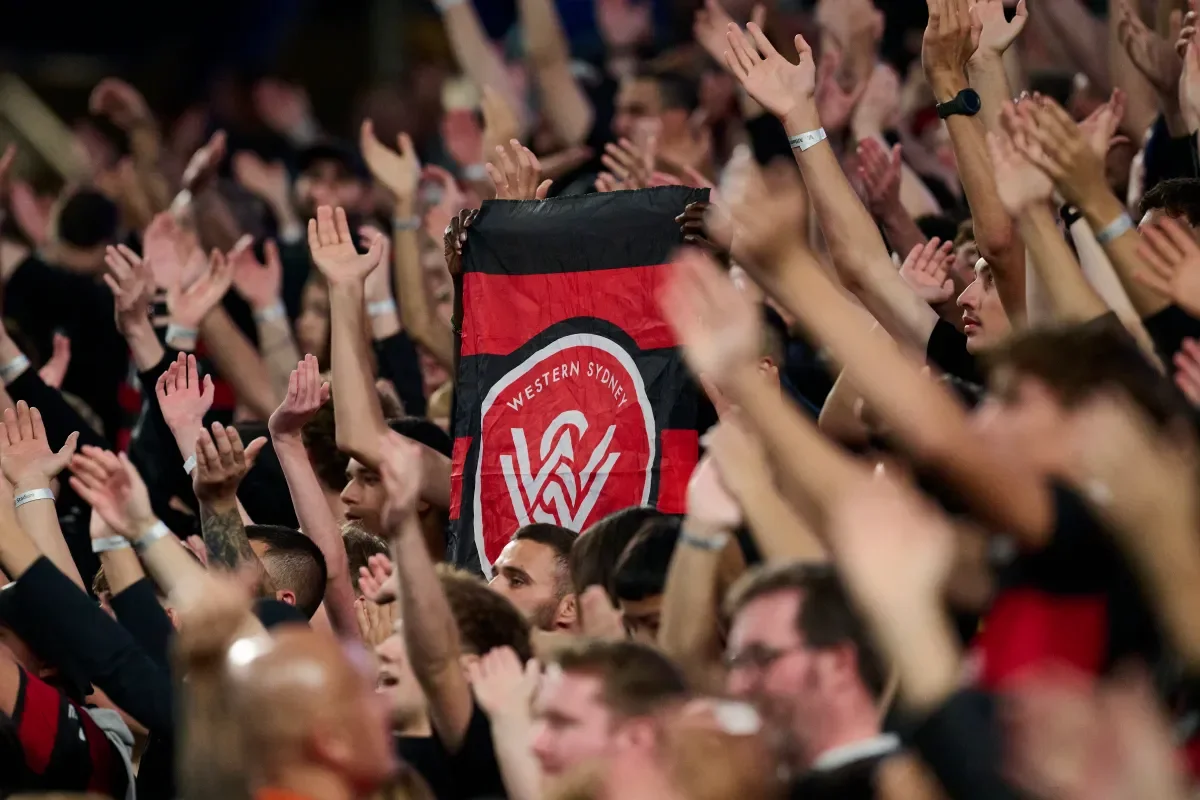
Those early images are still vivid: thousands of supporters walking together to the stadium, red and black everywhere, drums beating, chants rolling through the streets. It felt tribal, alive, authentic, the kind of football atmosphere Australia rarely creates but desperately wants.
This was western Sydney, one of the great football heartlands in the country, and the Wanderers looked unstoppable.
Now the crowds are smaller.
The atmosphere has thinned.
The Sydney Derby no longer feels like the electric event it once was.
So what happened?
And what does that have to do with Tasmania?
Quite a lot, actually.
Because the Wanderers are a reminder of something Tasmanian football urgently needs to understand:
An A-League licence is not success.
It is simply permission to begin.
The contradiction at the heart of Tasmanian football
At the same time Football Tasmania continues to include a Tasmanian A-League club in its strategic ambitions, many of the people actually carrying football in this state are exhausted.
Clubs are stretched.
Junior associations are overloaded.
Volunteers are burning out.
Parents, delegates, registrars, referees and committee members are doing enormous amounts of unpaid labour simply to keep football functioning every weekend.
That is where this debate begins for me.
Not in boardrooms.
Not in strategic vision statements.
But on grounds, in clubrooms, and inside associations where the real work of football happens.
What is an A-League licence, actually?
For readers unfamiliar with how the system works, an A-League licence is simply the right to operate a club in Australia’s national professional competition.
It is granted by the Australian Professional Leagues.
That licence gives you:
entry into the competition,
national exposure,
access to broadcast structures,
commercial opportunities.
What it does not give you:
supporters,
financial stability,
club culture,
long-term sustainability.
That is where public discussion often goes wrong.
People speak as though getting a licence is the achievement.
It is not.
A licence is merely the front door key.
What matters is what kind of house you are opening it to.
I supported Tasmania’s earlier bid, and why that matters
I was a signatory to Tasmania’s serious A-League push during the 2018 expansion process, and I do not regret that.
Because that bid was fundamentally different.
At that time:
there was genuine private capital involved,
wealthy backers supported it,
infrastructure assistance had been offered,
the league was actively expanding.
That was a credible commercial bid.
It was not reliant on asking a financially fragile Tasmanian Government to underwrite a football dream.
That distinction matters.
Supporting that bid made sense then.
What concerns me now is not the idea of ambition itself, but the change in context.
Why the current strategy feels disconnected
Football Tasmania’s strategic plan still includes ambitions such as:
delivering a Tasmanian A-League club,
delivering a Home of Football in Tasmania.
These may sound visionary.
But many of us embedded deeply in clubs and associations do not recall broad meaningful consultation about whether these are truly the game’s highest priorities.
And that matters.
Because Football Tasmania is supposed to represent:
clubs,
associations,
players,
volunteers,
coaches,
referees.
If the grassroots game does not feel ownership over these ambitions, they risk becoming top-down aspirations rather than community-driven priorities.
The proposed Home of Football may well have merit, but it raises the same question: who decided this is the game’s most urgent priority?
What Football Tasmania would say, and why that argument has logic
To be fair, Football Tasmania would likely argue:
elite pathways matter,
an A-League team raises football’s visibility,
flagship projects inspire participation,
major ambitions attract investment.
None of that is irrational.
In fact, all of it has merit.
A successful elite club can inspire young players.
A visible flagship team can energise a sporting landscape.
But those arguments only hold if the base of the game feels healthy and heard.
Without trust from grassroots football, ambition begins to look detached from reality.
The Wanderers warning
That is why the Wanderers matter here.
They had everything:
a major market,
huge supporter energy,
identity,
scale,
momentum.
And still, they are now struggling to hold the intensity that once defined them.
Their decline is proof that launching a club is the easy part.
Sustaining it is the hard part.
If a club in Sydney can lose its atmosphere despite all those advantages, Tasmania should be extremely cautious about assuming a licence alone solves anything.
The deeper structural question: is this even the right model?
The deeper question may not be whether Tasmania should have an A-League club at all.
The deeper question is whether chasing entry into a closed, licence-controlled competition is the right ambition for Tasmanian football.
Unlike most football systems in the world, the A-League remains a closed-shop model.
Clubs cannot earn their place through promotion.
They must be admitted.
That is very different from the emerging National Second Division model, which offers a pathway built far more closely around football merit, club readiness and earned progression.
Tasmania should absolutely be part of national football ambition.
But there is an important difference between:
strengthening clubs so they can rise through open football pathways, and
investing scarce energy into seeking invitation into a closed franchise system.
One approach builds the game from its foundations.
The other depends on being let in.
The grassroots contradiction no one should ignore
Every registration sends money upwards.
Families pay fees.
Clubs collect them.
Associations administer competitions.
Then significant portions flow to:
Football Tasmania,
Football Australia.
That system is accepted because governing bodies are meant to strengthen the game.
They are meant to regulate it, support it and help it grow.
Yet at grassroots level, many clubs and associations experience something very different:
increasing compliance burdens,
rising administrative expectations,
volunteer fatigue,
limited operational support.
Those of us living inside clubs and associations know this reality intimately.
We know how much unpaid labour holds football together.
We know referees are harder and harder to recruit and retain.
And we know how often that work feels unseen.
That is where frustration grows.
Because when grassroots football feels ignored, ambitious elite projects begin to feel less like inspiration and more like displacement.
This is not anti-ambition. It is about sequence.
Tasmania should absolutely have football ambition.
But ambition must be built in the right order.
Before elite expansion comes:
stronger clubs,
stronger associations,
better facilities,
better referee support,
reduced volunteer strain,
better coach education
sustainable pathways.
That is where Tasmanian football’s future is built.
Not by chasing the most prestigious badge first, but by strengthening the structures already carrying the game.
The real question Tasmania should ask
The wrong question is:
How do we get an A-League team?
The better question is:
What must Tasmanian football become before an A-League team would even make sense?
Until the people carrying football in this state feel genuinely supported, chasing admission to a closed national competition is not strategic vision.
It is a prestige project built on foundations that are already under strain.