Changerooms: Not a Luxury, Not Grand Designs
Letter to the Editor - The Mercury 21 January 2026
To the Editor,
The Mercury Newspaper
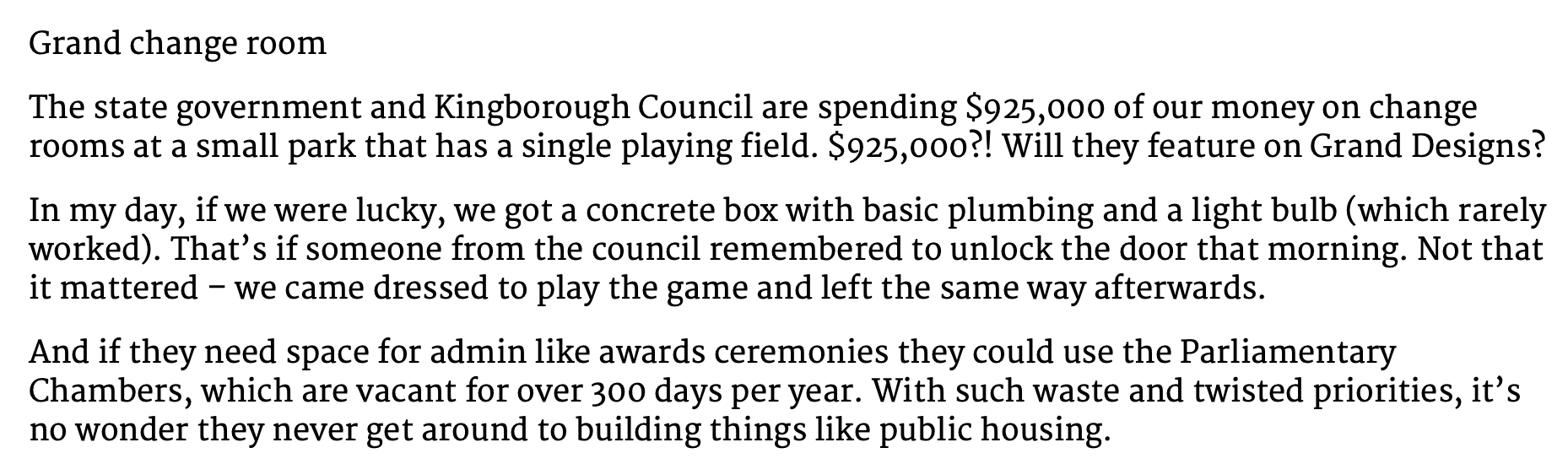
I write in response to the letter published in The Mercury this morning 21 January regarding the cost of upgrading changerooms at a community sporting ground.
In my view, it reflects a narrow understanding of what something as simple as a decent changeroom can mean to the people who use it.
It is not about luxury. It is about belonging.
It is about the quiet message a facility sends to every player, volunteer, coach, parent and referee who walks through the door: you are valued, you matter.
Why would we want our community spaces to send any other message?
For decades in Tasmania, community sport has been expected to “make do”. We have normalised inadequate infrastructure and learned to wear it like a badge of honour.
The truth is, we weren’t tougher. We were simply underprovided for and we got used to it.
A changeroom is not just a concrete box with a light bulb.
It is a public community space. And like any public space, it should meet modern expectations of safety, accessibility and dignity.
That matters for everyone, but especially for women and girls.
We cannot keep saying we want to grow female participation in sport while expecting women’s teams to change in outdated facilities with poor privacy, poor lighting, poor security and little regard for basic comfort.
Many people have no idea how often women and girls have been expected to change in toilets, in cars, or arrive already changed because facilities simply aren’t fit for purpose.
In 2026, sporting facilities must also support child safety and appropriate supervision, not create risk through outdated layouts, poor lighting, and inadequate design.
The same applies to volunteers.
Community sport runs on the backs of volunteers who arrive early, stay late, clean up, lock up, pick up rubbish, comfort children, manage conflict, wash bibs and organise equipment.
The least we can do is provide environments that reflect respect for their time and effort.
And for those who scoff at the cost, I would ask: what do people believe modern public buildings cost?
Construction costs have risen sharply. Compliance requirements are higher. Accessibility standards are non-negotiable. Materials must be durable, vandal resistant, safe and fit for year-round use.
This is not a “Grand Designs” fantasy.
It is what it costs to build properly, once, instead of cheaply, twice.
We rarely see this level of outrage when money is spent on projects that don’t touch community life nearly as directly.
There is also a particular Tasmanian habit of mocking improvement, as though wanting decent public facilities is somehow a character flaw.
Sport is one of the last spaces where Tasmanians still gather across generations, incomes, suburbs and backgrounds.
It gives children routine and belonging.
It builds community identity.
It strengthens wellbeing.
It provides connection, not just competition.
If governments and councils are serious about health, participation and community cohesion, then sport cannot continue to operate out of facilities built for another era, alongside attitudes that suggest we should simply be grateful for whatever we are given.
We should not be mocking changeroom upgrades.
We should be asking why community sport has been expected to tolerate neglect for so long.
Yours sincerely,
Victoria Morton
Hobart
About the author
I’m Victoria Morton. I’ve spent 20 years in Tasmanian football as a volunteer, club leader and advocate.
I’m writing a personal record of what I’ve seen, what I’ve learned and what Tasmania’s football community lives every week.
👉 Read more about me here: About Victoria