Is Bigger Always Better?
From John Aloisi to 64 Teams
I was there.
Sitting with my children.
Two hours of football.
Extra time.
Then penalties.
Every kick seemed to take forever.
Mark Schwarzer made the saves.
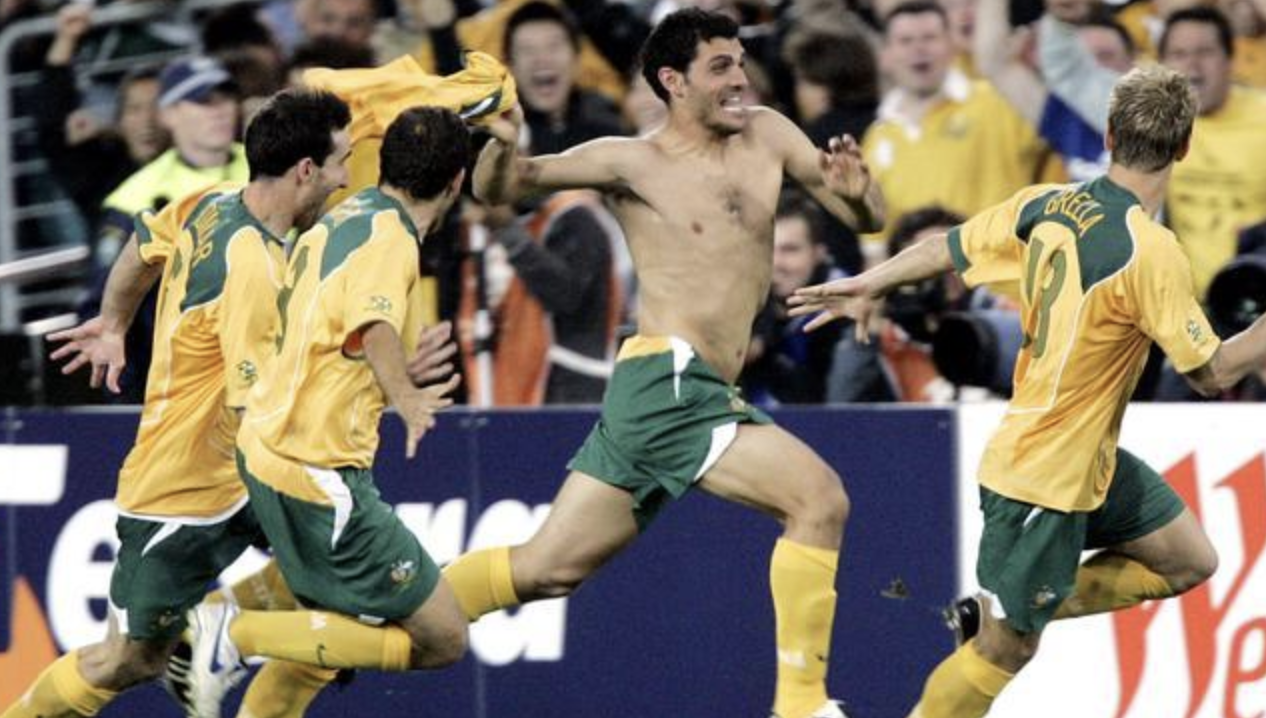
John Aloisi stepped forward.
One swing of his right boot.
The net bulged.
His shirt came off.
The stadium erupted.
We hugged complete strangers.
More than twenty years on I can still picture every moment.
If you're old enough you know exactly where you were that night.
If you're younger find the footage on YouTube. It still gives me goosebumps.
That wasn't just another World Cup qualification.
It was the end of 32 years of waiting.
It was relief.
It was joy.
It was Australian football finally believing we belonged.
Which is why FIFA's latest proposal made me stop and think.
FIFA Doesn't Hang Around
The confetti from the first 48-team FIFA World Cup has barely settled.
Yet FIFA is already exploring another expansion.
This time to 64 teams for the 2030 tournament.
What surprised me wasn't just the proposal.
It was the speed.
FIFA has already invited expressions of interest from consultants to examine the financial sporting and logistical impacts of a 64-team tournament.
The successful consultant is expected to be appointed by 14 August.
The full analysis is due back by 11 September.
That is barely a month for a decision that could fundamentally reshape football's biggest tournament.
Normally you would expect a governing body to let one major expansion settle before considering another.
Instead FIFA appears keen to move on to the next expansion before we've really had time to evaluate the last one.
There's More Going On Than Football
Here's the part that made me raise an eyebrow.
That 11 September deadline doesn't sit in isolation.
Just over a week later, on 19 September, FIFA's member associations are due to vote on something entirely different. Gianni Infantino's plan to sell a stake in FIFA's commercial rights to outside investors, through what's being called FIFA Forward Enterprise.
I wrote about that proposal in more detail a little while back, if you want the full picture.
Its Not Really about the Money
It's a plan that has already drawn strong opposition from UEFA, Concacaf and the Asian Football Confederation.
One senior adviser to Infantino has reportedly resigned over it.
So the timing is worth sitting with.
A major football decision, landing just days before a hugely contested commercial vote.
Maybe that's coincidence.
Maybe a bigger tournament is simply a way to build goodwill and momentum heading into a difficult vote.
I don't know which it is.
But when a governing body moves this fast on one front while fighting a much bigger battle on another, it's fair for supporters to ask what's really driving the timeline.
Football decisions rarely happen in a vacuum. This one certainly doesn't.
Why Uruguay Mattered
For readers who are newer to football let me explain why that night against Uruguay meant so much.
Australia hadn't qualified for a FIFA World Cup since 1974.
For decades we competed in the Oceania Football Confederation.
Winning Oceania wasn't enough.
We then had to face a nation from another continent in a winner-takes-all playoff.
Often that opponent came from South America.
It was one of the toughest qualification pathways in world football.
Many outstanding Australian teams never made it.
The 2005 playoff against Uruguay was brutal.
Two tense matches.
Extra time.
Penalties.
One kick that changed Australian football forever.
Soon afterwards Australia left Oceania and joined the Asian Football Confederation.
The move gave Australia stronger opposition a more logical qualification pathway and regular competition against some of Asia's best nations.
The pathway became fairer.
Not easy.
But certainly fairer.
How Hard Is It Today?
Since joining the Asian Football Confederation Australia has qualified for every FIFA World Cup.
That is an outstanding achievement and a credit to generations of Socceroos players and coaches.
The numbers tell an interesting story.
The Asian Football Confederation has 47 member associations.
For the 2026 FIFA World Cup Asia received eight automatic qualification places plus one intercontinental playoff place.
That means almost one in every five Asian member associations now has a direct pathway to the World Cup with another still getting a second chance.
If FIFA expands to 64 teams many expect Asia to receive additional qualification places although FIFA has not yet announced how those places would be allocated.
That would be fantastic news for developing football nations.
It would also make Australia's pathway to qualification easier again.
The Case For Expansion
There is plenty to like.
More countries would experience football's biggest event.
More players would fulfil lifelong dreams.
More supporters would have the joy of watching their own nation at a World Cup.
Football would genuinely become more global.
More matches also mean more stories.
And I have to admit something.
I really enjoyed the expanded tournament.
Like many people I wondered whether there would be too many one-sided matches.
Instead many of the so-called minnows held their own.
They defended brilliantly.
Played without fear.
Created memorable moments.
Perhaps we underestimated just how much the global standard of football has improved.
That was one of the biggest positives for me.
The Case Against
But there is another side.
The World Cup has never just been about the finals.
It's about qualifying.
The tension.
The pressure.
The heartbreak.
The nights that become part of football folklore.
Scarcity creates value.
It does in life.
It does in sport.
If Australia qualifies almost automatically every four years will qualification still feel the same?
Or will it simply become...
"The World Cup's on again.
Are we ready?"
Sometimes the journey is every bit as important as the destination.
There's also a football argument against rushing this. Critics of a 64-team format have warned it would mean far more uncompetitive matches and could stretch qualifying competitions in some regions to the point of meaninglessness. That's not a small concern for a tournament that prides itself on being the pinnacle of the sport.
Spot Gianni
Of course FIFA President Gianni Infantino would tell us this is exactly why football should expand.
More countries.
More dreams.
More opportunity.
And to be fair there is merit in that argument.
But during the last World Cup I found myself playing a little game.
Spot Gianni.
No matter which match I switched on...
...there he was.
Los Angeles.
Toronto.
Dallas.
New York.
Television directors have an uncanny ability to find him sitting in the grandstand.
If the tournament expands to 64 teams there will be another 16 official team photos to attend.
Or...
Maybe that's the real reason for expansion.
Sorry Gianni.
I couldn't resist.
So Where Do I Stand?
Honestly...
I'm torn.
I loved the expanded tournament.
I enjoyed watching nations we don't usually see on football's biggest stage.
I hope more countries get the opportunity to experience that magic.
But I also remember sitting with my children on that unforgettable night against Uruguay.
I remember the silence before the penalties.
I remember the roar when Aloisi scored.
I remember complete strangers hugging each other as if we'd known one another forever.
Those moments mattered because qualifying was incredibly difficult.
Part of me wants more countries to experience the joy of reaching a World Cup.
Another part wonders whether making the destination easier to reach also makes the journey a little less memorable.
And now there's a third part of me. The part that wants FIFA to slow down and make this decision on its football merits alone, not as a bargaining chip in a much bigger fight over who controls the game's money.
One Final Thought
FIFA has 211 member associations.
Even with a 64-team World Cup almost 150 nations would still miss out.
Perhaps that's the question FIFA has to answer.
Is bigger automatically better?
Or is part of the World Cup's magic the fact that it has always been so difficult to reach?
I don't know the answer.
But I do know this.
I'll never forget sitting beside my children watching John Aloisi score that penalty.
Because sometimes it's not the destination that creates the memory.
It's just how hard the journey was.
Acknowledgement: This article was prompted by recent reporting regarding FIFA's accelerated consideration of a 64-team FIFA World Cup, together with publicly available FIFA information.