Identity Matters: Clarence Zebras Starts a Conversation About the Future
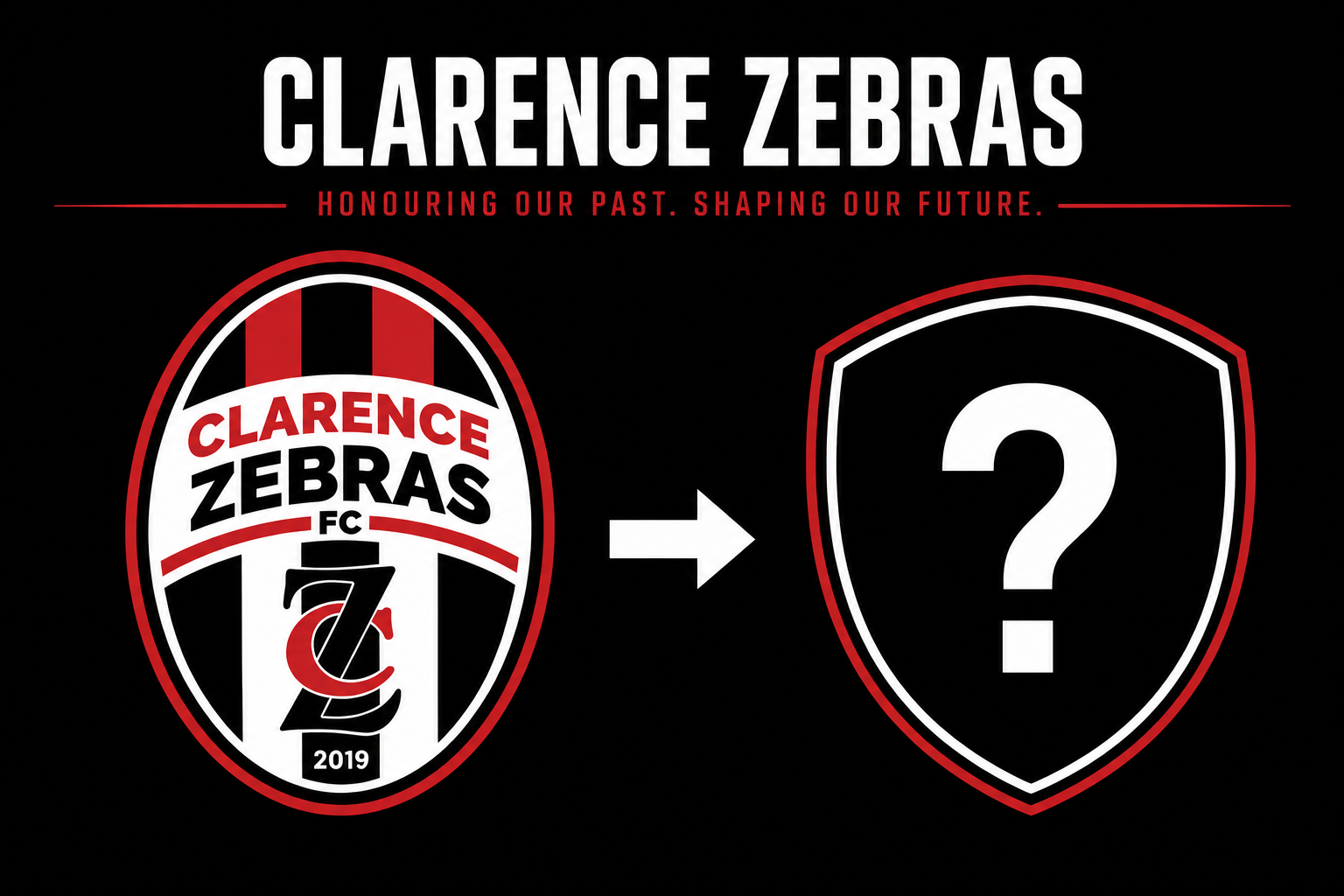
"Honouring our past. Shaping our future."
It's a simple tagline, but it captures one of the biggest challenges any football club will ever face.
If you've spent any time around Tasmanian football over the past year, you'll know this has probably been one of the worst kept secrets in the game.
There has certainly been plenty of chatter that Clarence Zebras were considering the next chapter in the club's identity.
This week, the club confirmed exactly that.
Rather than simply announcing a new direction, Clarence Zebras has launched what it describes as a community-led brand evolution, inviting members, players, volunteers, supporters and sponsors to help shape the club's future.
The consultation seeks feedback on three important aspects of the club's identity:
The club name
The club crest
The club colours and traditional stripes
Supporters are also invited to submit their own crest and playing strip designs.
More Than a Badge
Football clubs don't change their identity lightly.
A club's name, colours and badge are far more than marketing tools. They represent generations of players, volunteers, coaches and supporters. They become part of family history.
For some people, the badge is the first shirt they ever pulled on. For others, it is the crest their parents or grandparents wore before them. Those connections explain why conversations about names, colours and crests often become passionate. They are not really about design. They are about belonging.
Speaking personally, I can only imagine what would happen if someone suggested changing the name of South Hobart FC, Tasmania's oldest continuously operating association football club.
I know exactly which committee member would resign on the spot.
I suspect that idea would go down like the proverbial lead balloon.
Every club is different, but it highlights just how deeply people care about their football clubs.
A Club That Has Already Evolved
Clarence Zebras is itself the product of football history.
The story begins with Juventus Soccer Club, founded in 1956, one of Tasmania's most successful football clubs with a proud connection to the Australian Italian community.
In 1998, as Australian football moved away from ethnic-based club names, Juventus became Hobart Zebras, while proudly retaining the famous Zebras identity.
Meanwhile, on Hobart's Eastern Shore, Phoenix Rovers was established in 1978 before becoming Clarence United in 1998, building its own proud football history along the way.
In 2019, Hobart Zebras and Clarence United came together to form Clarence Zebras FC, bringing together two proud football traditions under one banner at Wentworth Park.
Now, six years later, the club is once again asking its community to help shape what comes next.
Why Identity Matters
Football clubs evolve.
Communities change.
Facilities improve.
Junior participation grows.
New generations arrive while others step back after decades of service.
The challenge for every club is finding the balance between respecting its history and preparing for its future.
What actually defines a football club?
Is it the name?
The colours?
The crest?
Or is it the people who pull on the shirt every weekend?
I'm no longer bound by anyone's rules about what I can and can't say on this.
So I'll say it plainly. Clubs aren't buildings or badges. They're whoever turns up on a wet Tuesday night to unlock the clubrooms.
There may not be a right answer, but there will certainly be plenty of opinions.
Consultation Matters
One thing I do think deserves recognition is the process.
Questions about a club's identity are deeply personal. Rather than simply unveiling a decision, Clarence Zebras has chosen to invite its community into the conversation before deciding its future direction.
That won't guarantee everyone agrees with the eventual outcome, but it does mean everyone has the opportunity to contribute.
Through my role as Tournament Director of the Hobart Cup, I've seen another side of Clarence Zebras.
Wentworth Park is one of our busiest venues. Throughout the tournament, four pitches are alive with football from morning until late afternoon, welcoming hundreds of players, coaches, families and volunteers from across Tasmania and interstate.
Every year the club embraces the event. Their volunteers help create an environment where young footballers simply get to enjoy the game, and that willingness to support football beyond their own club says a great deal about the people involved.
Like every successful football club, much of what Clarence Zebras does happens because volunteers quietly get on with the job.
The Next Chapter
Whether this consultation ultimately results in significant change or simply reinforces the traditions that already exist, it marks another chapter in a football story that stretches back almost 70 years through Juventus, Hobart Zebras, Clarence United and today's Clarence Zebras.
For those with a connection to the club, whether as a current member, former player, volunteer, supporter or family member, this is an opportunity to help shape the next chapter of that story.
The consultation closes on 16 August.
If you have a connection with Clarence Zebras FC and would like to participate, you can find the consultation here:
Whatever the outcome, football people across Tasmania will be watching.
Not because there's a right or wrong answer.
Because every club eventually has to answer the same question Clarence Zebras just asked out loud.
Who are we, and who do we want to be?