Remember March 1, 2024
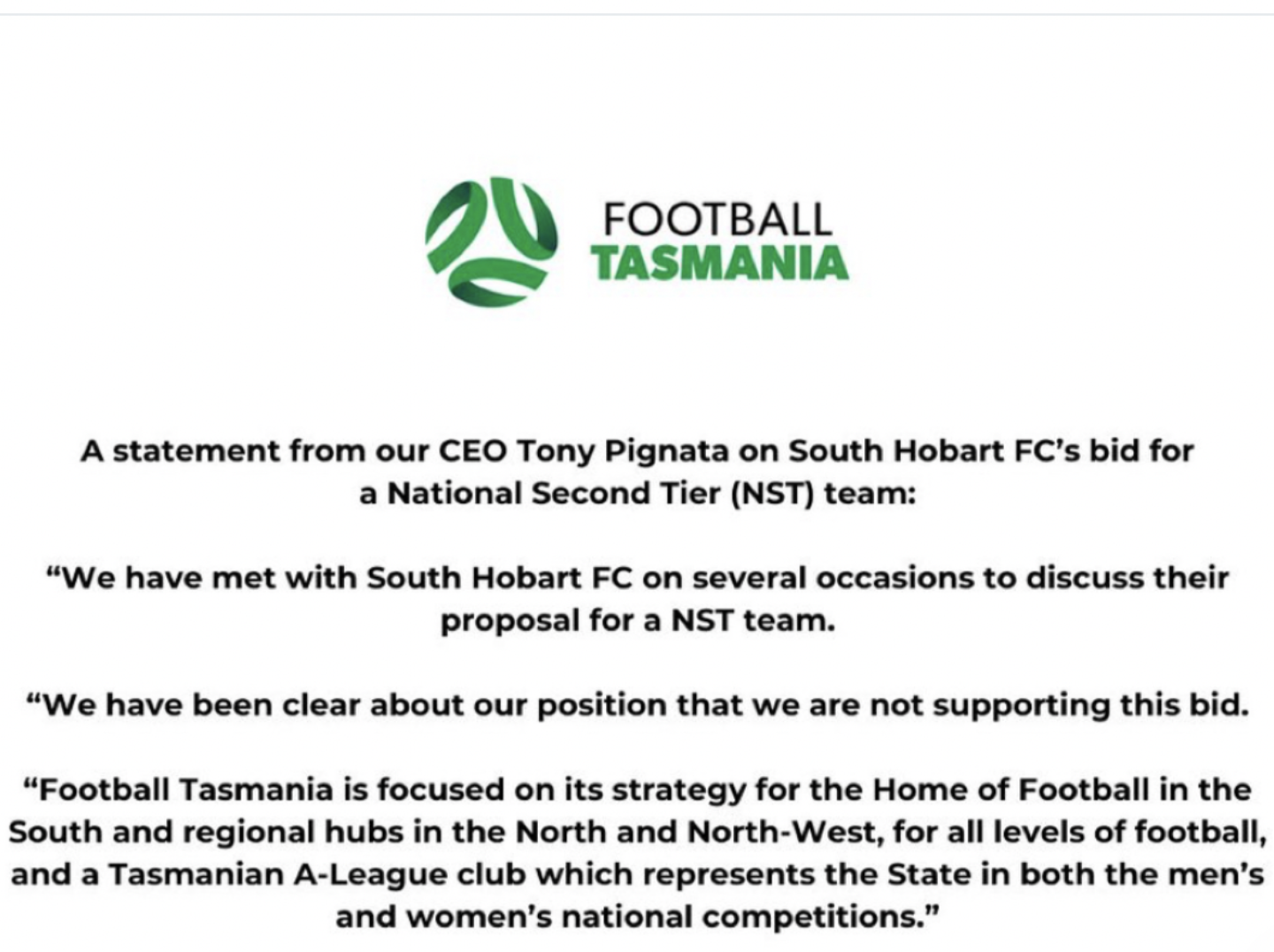
Remember the date.
March 1, 2024.
A day that may ultimately go down as one of the most extraordinary moments in recent Tasmanian football history.
The day Football Tasmania publicly distanced itself from the national ambitions of one of its own member clubs.
Not a rival organisation.
Not a competing code.
Not an external private venture.
One of its own clubs.
After two years of work behind the scenes, South Hobart FC’s pursuit of the National Second Tier was met with this statement from Football Tasmania:
“We have been clear about our position that we are not supporting this bid.”
That sentence travelled far beyond Tasmania.
And people noticed.
Not because everybody suddenly became a South Hobart supporter.
But because football people instinctively believe in ambition.
They believe in clubs striving for more.
They believe in pathways.
They believe in football earning its place.
At the time, Football Tasmania’s position was very clear.
The strategic priority was:
a Home of Football
regional infrastructure
and ultimately an A-League franchise representing Tasmania.
That was the vision.
That was the justification for publicly refusing support for a member club pursuing entry into a national competition.
Fast forward to today.
Now we hear:
“Tasmanian A-League teams are no longer an immediate priority for the organisation.”
Sorry… what?
So the strategic priority that justified publicly distancing the federation from South Hobart’s NST ambitions is now no longer the immediate priority?
Well fuck me.
Because that is not a minor adjustment.
That is a fundamental shift in strategic direction.
And football people are entitled to ask difficult questions about that.
Because this is not just about South Hobart.
It is about governance consistency.
Strategic clarity.
And what role a federation is actually supposed to play.
Are federations there to encourage ambitious clubs?
Or manage them?
Are they custodians of pathways?
Or gatekeepers of preferred models?
Because over the past two years, the messaging has often felt less like:
“How do we help football grow?”
and more like:
“How do we control the direction football grows in?”
What followed the March 1 statement was remarkable.
The backlash was not limited to South Hobart people or Tasmanian football supporters.
Journalists.
Historic clubs.
NST advocates.
Respected football voices from around Australia openly questioned why a member federation would publicly distance itself from one of its own clubs pursuing national ambition.
That reaction mattered.
Because it showed this was never viewed simply as a local Tasmanian disagreement.
It became symbolic of a much larger football debate about:
aspiration
club identity
football pyramids
and whether federations exist to encourage ambitious clubs or control the direction ambition is allowed to take.
And perhaps that is why the statement still lingers today.
Because football people can understand neutrality.
They can understand:
“We are not funding this.”
“We are focused elsewhere.”
“We are not directly involved.”
What many struggled to understand was:
“We are not supporting this bid.”
Those words mattered.
Especially to the many volunteers, supporters, administrators and football people who had spent years working quietly behind the scenes trying to build something ambitious from Tasmania.
To many involved, it felt like two years of grassroots football work being publicly dismissed by the very federation meant to represent the game.
The irony now is impossible to ignore.
Because if the A-League franchise strategy is suddenly no longer the immediate priority, then the obvious question becomes:
Why was it important enough to publicly distance the federation from South Hobart’s NST ambitions in the first place?
That question is not going away.
Nor should it.
Because football deserves consistency.
Football deserves honesty.
And ambitious clubs deserve better than being treated like political inconveniences for daring to dream bigger than the system expected them to.