Seatgate: We Now Know How Clubs Applied. We Still Don’t Know How They Knew
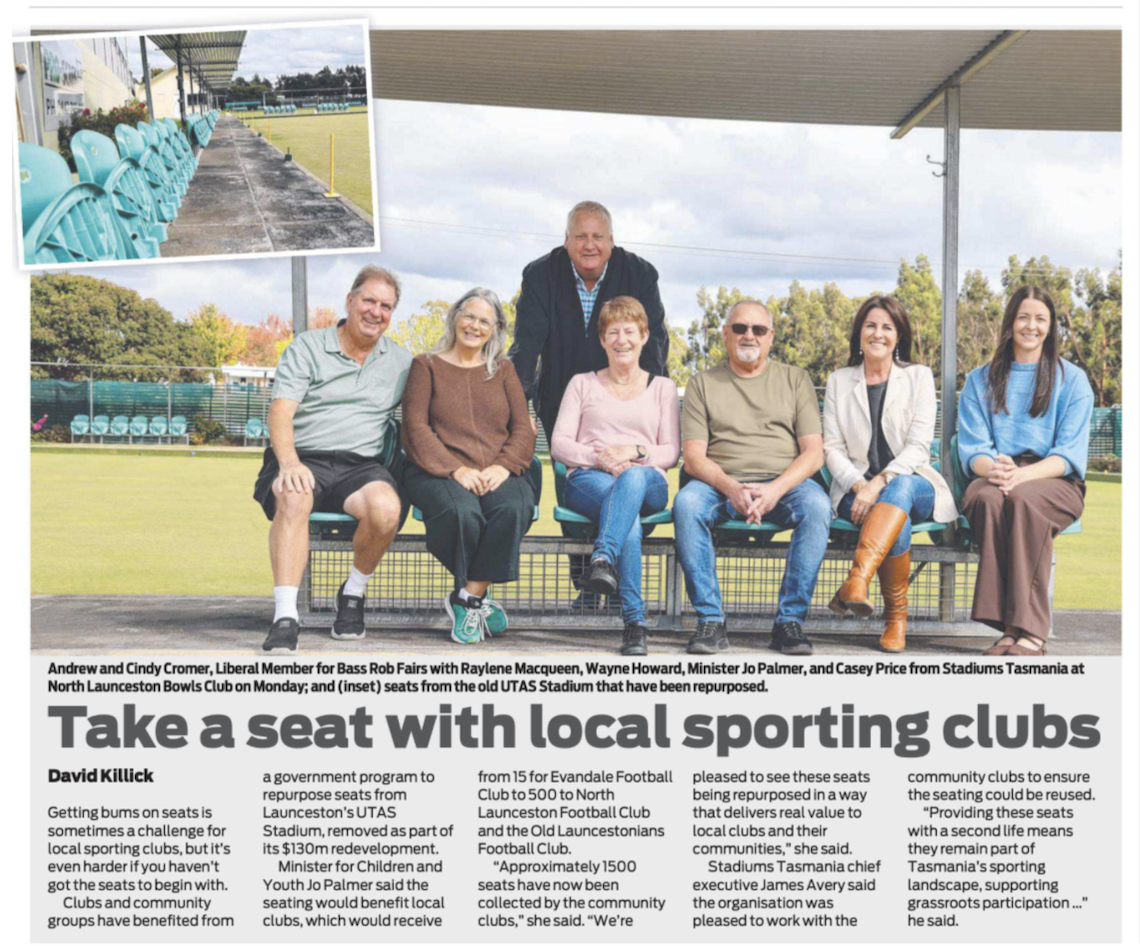
After I wrote recently about the redistribution of 1,500 seats from UTAS Stadium to 15 northern Tasmanian sporting clubs, a football volunteer from the north, Josh Perry of Rosevears, sent me something useful.
He had written directly to Jo Palmer’s office asking about the process.
The response from Jo Palmer’s electorate office was polite, prompt and helpful.
And it clarified one important point.
The clubs applied through Stadiums Tasmania.
That answers one part of the question.
But not the most important part.
What Has Been Confirmed
Jo Palmer’s office has now made clear that this was not a selective allocation process.
Clubs were not hand-picked.
They applied.
That matters, because it confirms the distribution itself appears to have been fair.
The government’s original statement, that every club that applied received what they asked for, now makes practical sense.
So let us be clear.
This is not a story about favouritism.
It is not a story about AFL clubs doing anything wrong.
And it is not criticism of Jo Palmer’s office, which responded transparently.
What Still Has Not Been Answered
The central question remains untouched:
How were clubs told the seats were available?
That is the missing link.
Because unless we understand how the opportunity was communicated, we still cannot answer why no northern football clubs appear on the list.
Not:
Launceston City FC
Not:
Launceston United FC
Not:
Riverside Olympic FC
Nor the many Championship, community and social football clubs across the north that would also have benefited.
Clubs where spectators still stand on sidelines.
Clubs where parents bring folding chairs from home.
Clubs where even a small bank of seating would make a real difference.
The Missing Link
The application pathway is now clear.
The communication pathway is not.
Was there:
a public expression of interest?
direct email contact to clubs?
notice through governing bodies?
circulation through AFL Tasmania?
circulation through Football Tasmania?
Those details matter.
Because if the opportunity was widely circulated and football clubs simply did not act, that tells us one story.
If it was circulated unevenly, that tells us another.
At the moment, we do not know which is true.
This Is About More Than Allocation
The seats themselves are not the controversy.
Reusing them is a good idea.
Giving them to community sport is a good idea.
The issue is not where they ended up.
The issue is whether all sports had equal opportunity to know they were available.
That is a very different question.
And a very important one.
An Uncomfortable Possibility
There is another possibility too.
Football clubs may well have known.
And simply not acted.
If that is the case, then this is not a government problem.
That is a football problem.
And perhaps that is the harder conversation.
Because missing out through exclusion is frustrating.
Missing out through inaction is something else entirely.
So Where Does This Leave Us?
We now know:
clubs applied through Stadiums Tasmania
the allocation process itself appears fair
Jo Palmer’s office has clarified that much
What we still do not know:
who was told
how they were told
whether all sports received equal notice
Until that piece is answered, the story is incomplete.
Because in this case, the real issue is not the seats.
It is the silence around how clubs were invited to claim them.
The Question Still Stands
So the question remains simple.
Who was told, and how?
Because until that is answered, football still cannot know whether it missed out because it was absent from the room, or because it never knew the door was open.
Continue Reading
Sometimes the most revealing part of a process is not the allocation itself.
It is how quietly the opportunity was announced.