The Draw Is Over. Now The Real Work Begins
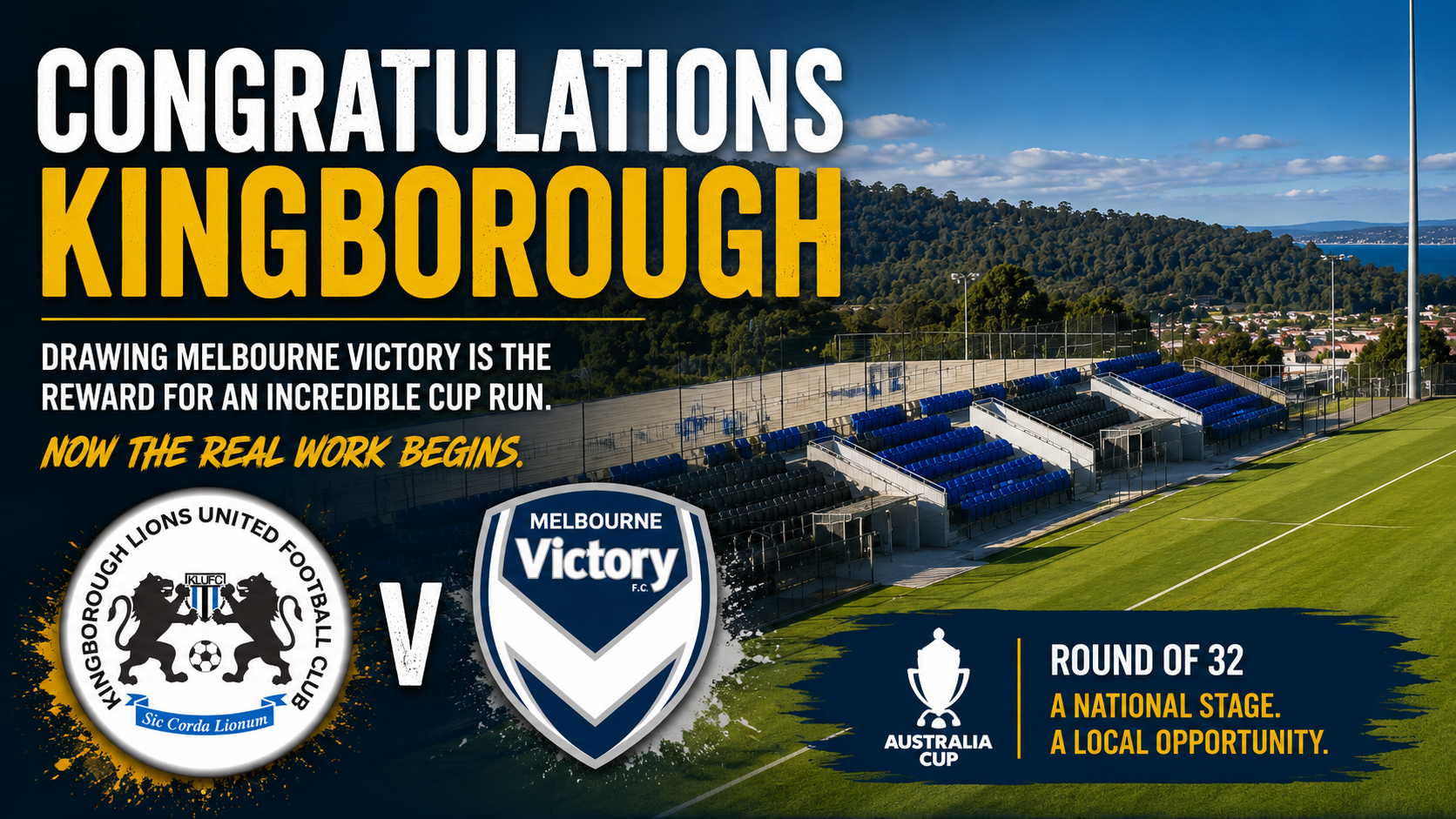
First things first, congratulations to Kingborough Lions United.
Drawing Melbourne Victory is exactly the sort of tie clubs dream about when they enter the Australia Cup.
It will bring attention, excitement, a strong crowd and another opportunity to showcase Tasmanian football on a national stage.
The players should enjoy it.
The supporters should enjoy it.
The club should enjoy it.
But having been involved in several Australia Cup campaigns with South Hobart over the years, I can tell them something else.
The draw is the fun part.
The following morning is when the real work begins.
From 777 Clubs To 32
This year a record 777 clubs entered the Australia Cup.
After months of qualifying matches, only 32 remain.
Kingborough are one of them.
Less than five per cent of the original field are still standing.
That achievement should not be overlooked.
The Australia Cup remains one of the few competitions in Australian sport where a community club can earn the right to host one of the country's biggest professional clubs.
There are no invitations.
There are no wildcards.
You qualify by winning matches.
How The Competition Works
The Round of 32 is where the A-League clubs enter the competition.
The draw is completely open.
There are no seeds.
No conferences.
Anyone can draw anyone.
If a Member Federation club is drawn against an A-League club, the Member Federation club receives hosting priority.
That is why Melbourne Victory will travel to Tasmania rather than the other way around.
If scores are level after ninety minutes, extra time is played.
If they are still level after extra time, penalties decide the winner.
There are no second chances.
Lose and your campaign is over.
Win and you move on.
The Competition Has Changed
One interesting feature of today's competition is that everybody goes into the same draw.
That was not always the case.
In the early years of the competition, Football Australia protected a number of A-League clubs by matching them against each other before the wider draw took place.
The result was fewer A-League clubs available for Member Federation clubs to draw.
At South Hobart we often felt that the ideal scenario was to draw another Member Federation club in the first round.
Win that match and suddenly your chances of drawing an A-League club in the next round improved significantly.
There was always a balance between protecting professional clubs and creating opportunities for community clubs.
The modern open draw feels much closer to the spirit of what the Australia Cup was designed to be.
Home Draws Are Not Always At Home
This is one of the biggest misconceptions about the competition.
People assume that if you are drawn at home, you play at home.
That is not always the case.
South Hobart qualified for the national rounds four times.
Yet we never played a single Australia Cup match at D'Arcy Street.
We didn't have lights that met the competition requirements.
Our "home" matches were played elsewhere.
We hosted Marconi at Blundstone Arena.
We hosted Tuggeranong United at KGV.
We hosted South Melbourne at KGV.
We travelled away to Sydney United 58.
South Hobart supporters used to celebrate the draw.
Those of us organising the match would celebrate for about ten minutes before asking the same question.
"Right. Where are we actually going to play it?"
Supporters Celebrate. Administrators Check Their Calendars.
Supporters see a home draw and think they have won the lottery.
Administrators see a home draw and immediately start checking their calendar.
An away draw is relatively straightforward.
Book flights.
Book accommodation.
Turn up and play.
A home draw is something entirely different.
The Australia Cup is a national competition.
It is also a national broadcast product.
The moment the draw is completed, clubs begin working through venue requirements, security plans, media requirements, broadcasting arrangements, operational meetings and compliance obligations.
The emails start arriving very quickly.
Usually before the excitement from the draw has completely worn off.
Home Draws Are Not Always The Jackpot
The reality for South Hobart was that despite qualifying multiple times, we either lost money or only just broke even on our Australia Cup campaigns.
That wasn't because the competition itself was flawed.
It was because we couldn't play at D'Arcy Street.
Our home ties were relocated to larger venues to meet competition requirements and once venue hire and additional operational costs were factored in, the numbers simply didn't stack up.
Other clubs have had very different experiences.
Devonport have been able to host Australia Cup matches at Valley Road and have enjoyed the benefits that come from bringing large crowds into their own facility.
Kingborough may find themselves in a similar position.
If the match can be played at a venue they control and manage effectively, hosting Melbourne Victory could prove to be a significant opportunity both financially and for the club's profile.
Every club's circumstances are different.
There Is No "Warm Up Out The Back"
One thing I learned quickly through South Hobart's Australia Cup experiences is that the standards are understandably strict.
Professional clubs are entitled to appropriate facilities.
Match officials are entitled to appropriate facilities.
Broadcasters have requirements.
Sponsors have requirements.
Football Australia has requirements.
There is no telling Melbourne Victory to warm up behind the clubhouse because there happens to be some spare grass there.
There is no improvising television camera positions on match day.
Everything is planned.
Everything is assessed.
Everything is documented.
This is not local league football.
For one night, your club becomes part of a national competition.
And all of that starts long before the first whistle.
Why Cupsets Happen
One of the fascinating quirks of the Australia Cup is that state league clubs are often in the middle of their season when these matches are played.
The A-League clubs are frequently still in pre-season.
On paper the professional clubs have stronger squads.
In reality the state league clubs can be fitter, sharper and carrying the confidence that comes from playing competitive football every week.
That is one reason the Australia Cup produces so many memorable upsets.
The Midweek Challenge
Another thing many people don't realise is that Australia Cup matches are always played midweek.
That creates a unique challenge.
Players still have jobs.
Volunteers still have jobs.
Club officials still have jobs.
Supporters have work and school the next morning.
People finish their working day and then help stage a national football event.
The players are not full-time professionals.
Most of the volunteers are not paid.
Yet the event is expected to operate at a professional standard.
That is one of the remarkable things about the Australia Cup.
For all the professionalism on display, much of the competition is still powered by volunteers.
For One Night, You Become Event Managers
For most of the year football clubs worry about results.
For an Australia Cup tie, clubs suddenly become event organisers.
You are hosting Football Australia.
You are hosting broadcasters.
You are hosting match officials.
You are hosting the visiting club.
You are hosting media.
You are hosting sponsors.
And you are often hosting a crowd several times larger than normal.
Parking.
Security.
Catering.
Signage.
Entry points.
Toilets.
Traffic management.
Everything changes.
Why It Is Still Worth It
Reading all this, you might wonder whether hosting is worth the effort.
Absolutely.
For one night a local football club becomes part of the national football conversation.
Players who train after work get the chance to test themselves against professionals.
Volunteers who normally operate in the background help deliver a national event.
Supporters get to experience something special.
Communities get to showcase themselves.
That is the reward.
One thing I learned from South Hobart's Australia Cup journeys is that every club secretly wants a glamour tie.
What they really hope for is a glamour tie they can successfully host.
Kingborough have earned this opportunity.
They should enjoy every minute of it.
Because while Melbourne Victory will dominate the headlines, the real story is that a club from southern Tasmania has fought its way through a field of 777 clubs and earned the right to host one of Australia's biggest football brands.
Last night Kingborough supporters celebrated drawing Melbourne Victory.
This morning the planning began.
That, in many ways, is the Australia Cup.
Equal parts dream and logistics.
And all the better for it.