The Gentlemen’s Working Group For Women’s Football
Or: The Chosen Ones, Part II
A few women have contacted me privately since my earlier piece about “The Chosen Ones.”
Not angrily.
Not dramatically.
More with that familiar tone women in football often develop over time.
Half amused.
Half exhausted.
Entirely unsurprised.
Because what struck them was not necessarily the individuals selected for the new working group.
It was the blindness of the selection itself.
The unconsciousness of it.
The complete inability to look at a room shaping the future of women’s football and think:
“Hang on a minute.
Does this perhaps look slightly insane?”
That is the fascinating part.
Not some secret anti-women agenda conducted under candlelight in the Football Tasmania offices.
Just institutional muscle memory.
Football governance instinctively recreating the same kinds of rooms it has always created.
And then acting startled when women quietly point it out.
A Proud Historical Tradition
To be fair, men explaining women to women is hardly new territory historically.
Men decided whether women could vote.
Men decided whether married women should continue working.
Men debated reproductive rights.
Men decided whether women could own property.
Men decided what constituted “appropriate female behaviour.”
Men once banned women’s football entirely because apparently the female body might collapse somewhere around the edge of the penalty box.
And now:
men form strategic working groups to determine the future direction of women’s football.
Progress truly is a magnificent thing to witness.
The Modern Football Administrator
Modern football absolutely adores women’s football.
It loves:
Women and Girls strategies,
participation targets,
Matildas branding,
government grants,
empowerment messaging,
diversity panels,
inclusive pathway graphics,
and LinkedIn posts containing phrases like:
“creating meaningful opportunities.”
Football is extremely comfortable promoting women’s football.
It is still slightly less comfortable surrendering control of it.
That is the awkward little detail sitting quietly underneath all of this.
Because every now and then football accidentally reveals that beneath the glossy messaging and strategy documents, the actual decision-making structures still look suspiciously like the organising committee for a suburban bowls club raffle in 1986.
Every major Matildas tournament is also traditionally followed by approximately six weeks of deep institutional respect for women’s football.
The Summoning Of The Chosen Ones
One of football governance’s great traditions is the mysterious emergence of “representatives.”
Nobody is ever entirely sure how it happens.
Perhaps smoke appears from the Football Tasmania offices.
Perhaps a sacred governance scroll is consulted.
Perhaps robes are involved.
Perhaps Gary simply knows a bloke.
Regardless, the chosen representatives emerge to shape the future direction of women’s football.
Women themselves remain somewhat optional to the process.
And again, the remarkable thing was not that men were involved.
Men absolutely should be involved in women’s football.
The remarkable thing was that apparently nobody assembling the room stopped for even three seconds and thought:
“This may look slightly ridiculous.”
That is the blindness women keep describing to me.
Not hatred.
Not exclusion.
Recognition.
Immediate recognition.
Because institutions tend to reveal themselves most honestly in what they do automatically.
Without reflection.
Without pause.
Without anybody saying:
“Perhaps we should rethink this before publishing the email.”
The Optics Olympics
What makes all this even more extraordinary is the timing.
Because Australian sport is currently under enormous pressure around gender equity, governance standards and female representation.
National sporting organisations are increasingly expected to demonstrate genuine diversity in leadership structures as part of modern governance expectations and Australian Sports Commission funding pressure.
Which makes football’s ongoing ability to accidentally assemble rooms full of men discussing women’s football genuinely magnificent satire.
You honestly could not script it better.
At precisely the same moment Football Australia is under pressure around board composition and governance expectations, football somehow still keeps producing committees that look like the annual general meeting of a trout fishing association.
One hilariously controversial observation floating around football circles recently suggested that perhaps half the Football Australia board could simply identify as women to guarantee Sports Commission funding.
Apparently this would also assist with governance compliance.
Modern football administration truly is innovative.
Football loves appearing progressive.
Structural change is where everybody suddenly requests another consultation paper.
The Official Women’s Football Working Group
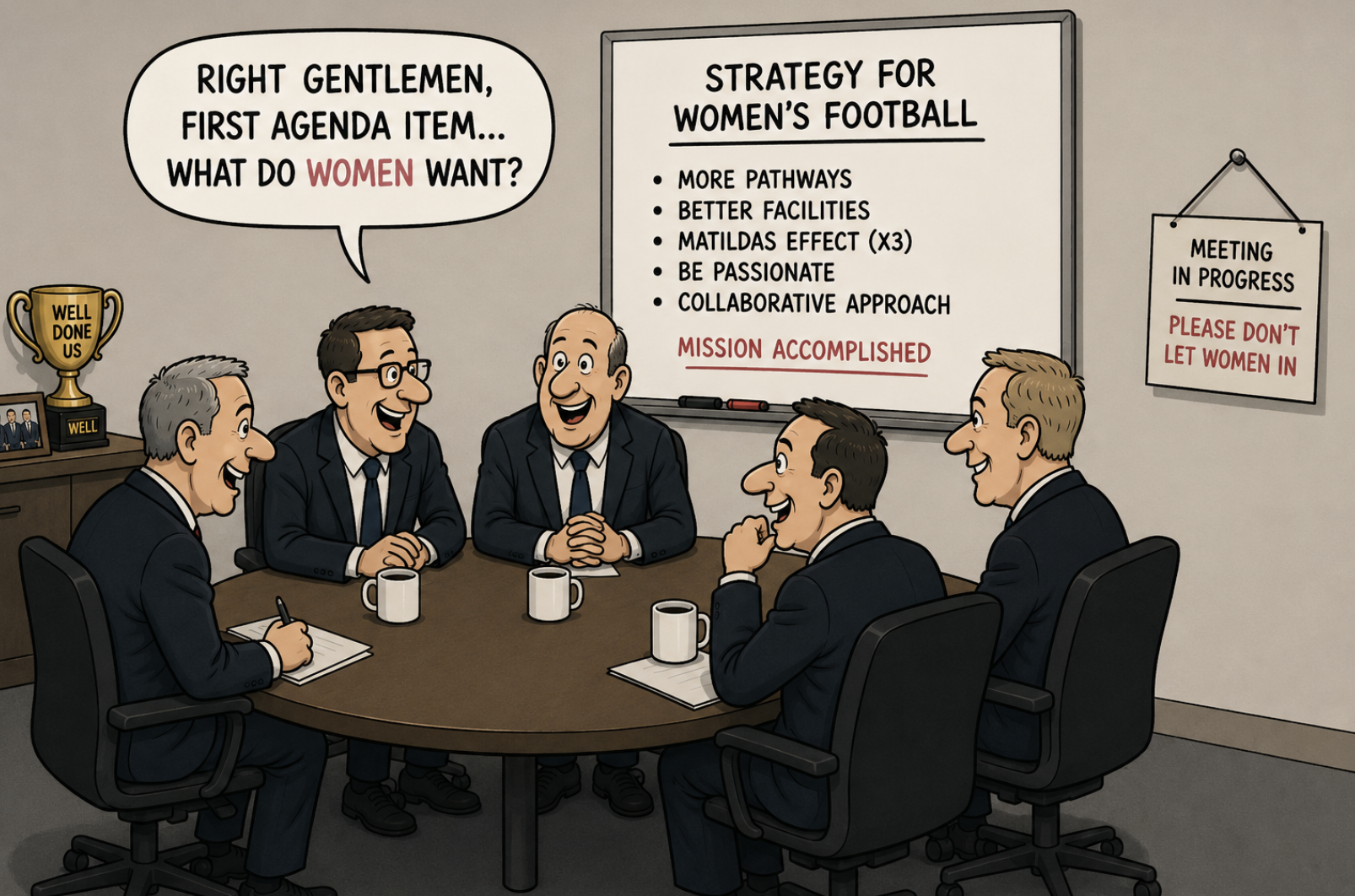
You can almost picture the opening meeting.
“Right gentlemen, first agenda item:
What exactly do women want?”
A thoughtful silence.
Barry adjusts his glasses.
“Well personally, I think they’d probably like pathways.”
The room nods thoughtfully.
Another breakthrough for women’s football.
Barry then proposes facilities.
The room agrees this is advanced thinking.
Minutes recorded.
Action item noted.
The meeting is declared a tremendous success despite the absence of actual women.
Stakeholder engagement outcomes are considered highly satisfactory.
A diversity outcome is noted in principle.
Terms Of Reference
Draft Terms Of Reference For The Advancement Of Women’s Football
Women’s football shall be fully supported in principle.
Female perspectives may be considered where operationally convenient.
At least one woman may be consulted once major decisions have already been made.
The phrase “Matildas effect” must appear no fewer than three times per meeting.
Any woman expressing structural concerns shall immediately be described as “passionate”.
Governance discussions shall remain collaborative, respectful and overwhelmingly male.
Female lived experience may be acknowledged retrospectively.
The group is expected to consult women once the strategic direction of women’s football has already been strategically directed.
Football reserves the right to congratulate itself extensively for all progress achieved.
The Familiar Room
And honestly, this is not even really about Tasmania.
That is the revealing part.
Football all over the world still occasionally produces rooms that look remarkably familiar.
Men talking.
Women listening.
Everybody acting slightly confused about why women sometimes feel disconnected from decision-making.
Not because anybody intended harm.
That is almost what makes it worse.
Because football governance keeps quietly telling on itself.
Not in speeches.
Not in Women and Girls strategies.
Not in empowerment campaigns.
In who gets invited into the room before everyone else even knows there is a room.
Women’s football continues to grow rapidly.
Women’s influence over women’s football appears to be progressing at a slightly more traditional pace.
A working group will no doubt be formed to investigate this further.