The Good, The Bad and The Ugly
Getty Images
At our house in North Hobart, we have loved almost every minute of this World Cup.
In fact, I think we watched nearly every minute of every game live. We may have missed a couple of those brutal 1.00am kick-offs, but not many.
For 39 days, the World Cup became part of the rhythm of our home.
We watched in our pyjamas and warm dressing gowns, with coffees in hand and the heater going, while players from every corner of the world gave us something to talk about, argue about, laugh about and occasionally swear about.
When the rest days arrived, we were genuinely at a loss.
What were we supposed to do?
Go to bed at a sensible hour?
Have a normal conversation?
It has been a tremendous World Cup.
There have been wonderful teams, extraordinary young players, brilliant goals, surprises, heartbreak and all the magnificent chaos that only a World Cup can provide.
So, before I get to the good, the bad and the ugly of the final, thank you.
Thank you to the nations of the world for bringing 39 days of football into our living room.
Thank you to the players who gave us so much.
And thank you, SBS.
Yet again, you delivered the World Cup to Australian football supporters and made it feel as though the whole tournament belonged to us too.
All 104 matches were shown live and free in Australia. That matters. At a time when more and more sport disappears behind subscriptions and increasingly expensive streaming services, SBS continues to understand that the World Cup belongs to everyone. (SBS Australia)
From a warm living room in North Hobart, in our pyjamas and dressing gowns, we loved it.
Just wow.
And then came the final.
The good.
The bad.
And the very, very ugly.
The Good
Spain won the World Cup.
More importantly, football won the World Cup.
Spain wanted the ball.
They wanted to move it, protect it and use it.
They wanted to find spaces, create chances and win the match by playing football.
Argentina spent much of the final trying to ensure that a game of football did not break out.
Spain kept coming.
They dominated possession and created 20 shots. Argentina defended desperately, disrupted constantly and survived until the 106th minute, when substitute Ferran Torres finally scored the goal that made Spain world champions.
It was fitting that the winner came from the bench.
Spain did not merely have an excellent starting eleven. They trusted their entire squad. They believed that if they continued playing, continued moving Argentina around and continued searching for the opening, eventually the game would reward them.
It did.
Then there was Rodri.
Rodri, marry me.
What a footballer.
He controls games without appearing to rush. He sees danger before it develops, finds space before anyone else notices it and makes incredibly difficult things look ridiculously simple.
Some players dominate matches by running faster than everyone else.
Rodri dominates them by thinking faster.
He was awarded the Golden Ball as the best player of the tournament, and rightly so.
Spain also trusted youth.
Lamine Yamal was still only 19.
Pau Cubarsí, who was named the tournament’s best young player, was also 19.
Teenagers playing in a World Cup Final.
Think about that.
While Argentina were holding tightly to the legends of their past, Spain were putting the future of their football onto the biggest stage in the game.
And the young players did not look frightened.
They looked as though they belonged there.
That is not luck.
It is not a golden generation appearing from nowhere.
It is the result of a football culture that develops players properly, trusts them and gives them meaningful opportunities.
Spain did not win because they were older, tougher or more experienced.
They won because they were braver.
The Bad
Argentina were awful to watch.
There is no polite way to say it.
This was Argentina.
The defending world champions.
A country with some of the most talented footballers on the planet.
Yet they produced almost no attacking ambition in regulation time.
Their plan appeared to be to defend, disrupt, frustrate, foul and hope Lionel Messi might somehow manufacture one last miracle.
There is nothing wrong with defending.
There is nothing wrong with tactical discipline.
There is nothing wrong with recognising that the opposition is technically superior and adjusting accordingly.
But at some point, surely, a team in a World Cup Final must attempt to win the football match.
Argentina appeared far more interested in preventing Spain from winning it.
That is different.
And it raises an uncomfortable question.
At what point do you stop thinking about the legend and start thinking about the game in front of you?
Lionel Messi is one of the greatest footballers who has ever lived.
Possibly the greatest.
His place in football history is untouchable.
He has played in six World Cups, broken records across generations and achieved almost everything it is possible for one footballer to achieve.
But history cannot press a defender.
Reputation cannot make a run in behind.
Sentiment cannot provide the energy required to lead the attack for nearly two hours in a World Cup Final.
Messi was 39.
At times, he looked it.
That is not an insult.
It is time.
It catches every player eventually, including the greatest ones.
We have seen a similar conversation around Cristiano Ronaldo.
Respect for a magnificent career can gradually become confused with an obligation to keep constructing the team around the player.
The question is not whether Messi deserved to be at the World Cup.
Of course he did.
The question is whether Argentina’s reverence for him prevented them from making the decisions most likely to win the final.
Could a younger and quicker forward have stretched Spain’s back line?
Could fresh legs have pressed Spain’s defenders?
Could Argentina have offered more of an attacking threat had they stopped waiting for one final piece of Messi magic?
We will never know.
What we do know is that Argentina offered almost nothing going forward until very late in the match. Spain finished with 20 attempts and ultimately got the reward their ambition deserved.
The defending world champions played not to lose.
Eventually, they lost.
Then came the half-time show.
For fuck’s sake.
The World Cup Final does not need to become the Super Bowl.
It does not need Madonna arriving in a vehicle.
It does not need the Muppets, although I liked the muppets a lot.
It does not need a procession of international celebrities performing pieces of songs while millions of football supporters wonder when the football might begin again.
Madonna is as old as I am, FFS!
One song?
Fine.
A short performance?
No problem.
But this sprawling, overproduced collection of celebrity appearances felt like FIFA desperately trying to prove that the biggest football match in the world was not entertaining enough on its own.
Wayne Rooney called the show “crap”.
For once, Wayne spoke for all of us.
Football already has drama.
It already has music.
It has supporters singing in the stands, players waiting in the tunnel, national anthems, nerves, anticipation and the knowledge that the next 45 minutes might change someone’s life forever.
That is the show.
Stop trying to improve it.
The Ugly
The match itself became increasingly unpleasant.
Argentina’s approach had been physical and combative throughout, and Enzo Fernández was eventually sent off as the world champions finished with ten players.
There were also confrontations after the final whistle.
Losing a World Cup Final must be devastating.
I understand the emotion.
I understand the anger.
I understand that players have spent their entire lives preparing for a moment that has suddenly disappeared.
What I do not understand is allowing disappointment to become aggression.
That is not passion.
It is not competitiveness.
It is not evidence that someone cares more than everyone else.
It is poor behaviour.
Argentina had spent much of the evening trying to drag Spain into a battle rather than defeat them in a football match.
When they finally lost, some of them appeared unable to accept that Spain had beaten them by doing the thing Argentina had largely refused to do.
Play football.
But even that was not the ugliest part of the evening.
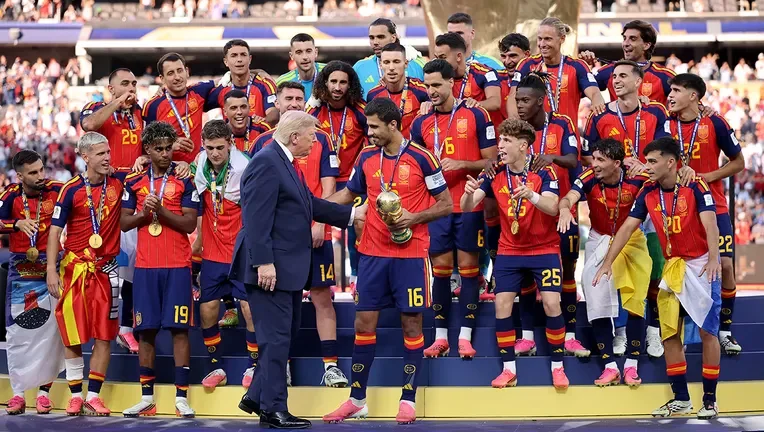
Then came the trophy presentation.
Donald Trump walked onto the stage alongside Gianni Infantino.
Fine.
He is the president of the main host nation.
Present the trophy.
Shake hands.
Congratulate the winners.
Stand for the official photograph.
Then leave.
Instead, Trump remained on the podium as Spain prepared to lift the World Cup. Eventually, even Gianni Infantino appeared to realise the moment belonged to the players, gesturing for Trump to move towards the back of the group before the celebrations began.
That should never have been necessary.
The trophy lift belongs to the players.
It belongs to the people who trained, travelled, tackled, scored, sacrificed, suffered and won.
It does not belong to politicians.
It does not belong to FIFA executives.
It does not belong to visiting dignitaries who want to appear in the photograph.
The players had earned that moment.
This is where FIFA increasingly loses sight of what makes the World Cup special.
The administrators are not the stars.
The politicians are not the stars.
The celebrities are not the stars.
The half-time performers are not the stars.
The players are the stars.
Hand them the trophy.
Shake their hands.
Then leave the stage.
It should not be complicated.
Unfortunately, FIFA under Gianni Infantino appears determined to make everything around the World Cup bigger, louder, longer and more commercial.
A 48-team tournament.
A Round of 32.
More matches.
More content.
More sponsors.
A Super Bowl-style half-time show.
Celebrities everywhere.
Politicians on the podium.
Infantino in every camera shot.
More spectacle.
More FIFA.
The World Cup does not need more FIFA.
It needs more football.
The Final Thought
Despite everything surrounding it, the football eventually delivered the right winner.
Spain trusted the ball.
Spain trusted young players.
Spain trusted their bench.
Spain trusted that courage and football would eventually overcome fear and obstruction.
Argentina trusted survival.
FIFA trusted spectacle.
Donald Trump trusted that every camera was really there for him.
Only Spain’s trust was rewarded.
The best football team won the World Cup.
Then everyone else tried to make the moment about themselves.
Back in North Hobart, the television has finally gone quiet.
There will be no next match to plan around.
No alarm to set.
No reason to be sitting in front of the television in our dressing gowns at some ridiculous hour of the morning.
For 39 days, the world came into our living room.
We saw brilliant footballers, unfamiliar nations, extraordinary supporters, young stars emerging and old legends saying goodbye.
We complained about the kick-off times.
We complained about the referees.
We complained about FIFA.
We certainly complained about the half-time show.
But we watched.
Almost every minute.
And we loved it.
Thank you, football.
Thank you, SBS.
See you in four years.