The Man in the Middle
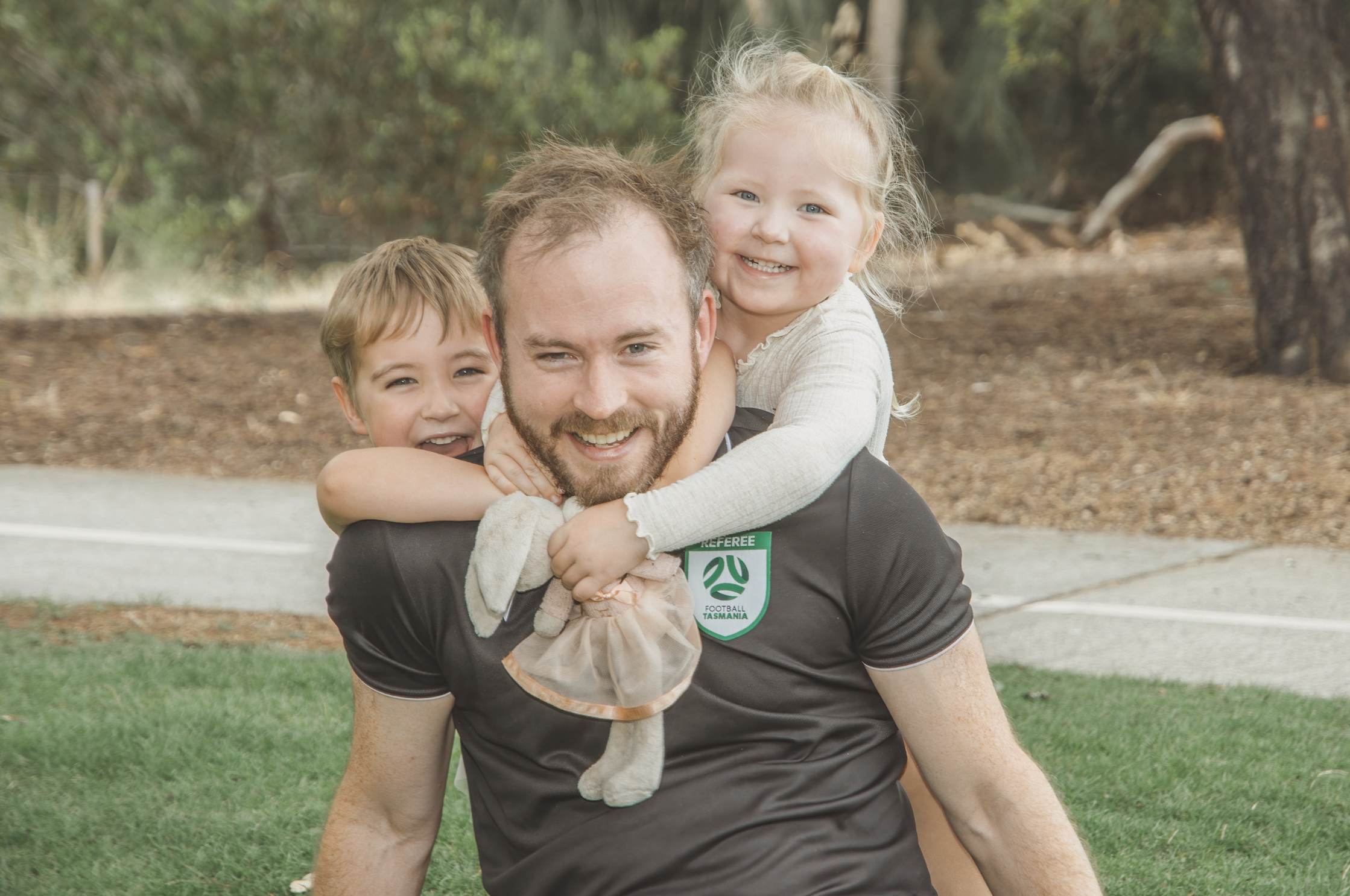
Brenton Kopra with his beautiful children - photographed by Nikki Long
There are people in football you think you know.
Players. Coaches. Presidents. The loud ones. The visible ones.
And then there are referees.
You see them every week. You have opinions about them, usually strong ones. But if we’re honest, most of us wouldn’t recognise them at the supermarket, wouldn’t know what they do for work, wouldn’t know anything about their lives away from the pitch.
Brenton Kopra is one of the most recognisable referees in Tasmanian football. Eight-time Referee of the Year, the last five back-to-back, a detail he quietly corrected when he sent his answers through.
And yet, like most referees, he’s largely unknown.
Growing up competitive, but quiet
Brenton grew up in South Hobart before moving up the hill to Ridgeway, a place he still describes as a little hidden away. His parents are still there.
He and his younger brother were heavily into sport, playing a wide range of games and spending hours at both houses in the backyard, football, both codes and cricket. Summers were often spent at the family shack on Bruny Island, where they would play cricket in the neighbour’s backyard for days on end.
They were competitive then, and still are now. A workplace strengths assessment years later simply confirmed it, his number one trait came out as “Competition”.
Away from sport, he was a quiet kid who did well at school. Despite that, he built strong friendships, many of which have lasted from primary school through to college. These days those friendships look a little different, less time at the pub, more time catching up at kids’ birthday parties.
The people who shaped him
He points first to his parents.
A lot of his personality traits and principles come from them. He and his brother both picked up their love of sport from their dad, who always focused more on enjoying the game than worrying about winning or losing, something he admits didn’t always stick at the time. From that upbringing came high standards, a willingness to take on challenges, and a strong sense of fairness.
In refereeing, his early influences came from those around him. He started a couple of years after Ivan Jozeljic and Adrian Lockley, and in his first seasons they would referee together at Northern Suburbs juniors at Weily Park. He looked up to both of them and learned a lot from them. Adrian’s refereeing career was cut short by injury, but he moved into coaching and still picks up things Brenton can work on when he watches his games. He also speaks about it being great to see Ivan back refereeing after taking time away.
He has always learned best by watching others, taking note of what they do well and applying it. As he progressed into assistant refereeing at senior level, he learned from the leading referees at the time, particularly Kim Barker and the way he managed players, while also taking aspects from Ivan, Craig Phillips and Sean Collins.
A decision that wasn’t meant to be big
Refereeing wasn’t a plan.
He started at 14 because a mate was doing the course, and he went along with him. It was also the first time he had worked to earn money.
The shift came a few years later. In his third season, he was selected to attend the boys youth national championships in Coffs Harbour. He found himself well behind many of the other referees at the tournament in terms of development, some of whom were refereeing in the A-League a season or two later. That experience stayed with him. It was probably the first time he started to take refereeing more seriously.
At 18, after finishing college, he took a gap year, working for six months to save before travelling to Europe for another six. In the half-season before he left, he made his debut as a referee in the Southern Premier League, which was the top level in Tasmania at the time, and managed eight or nine senior matches while still playing a level or two below.
While in England, he saw a number of Chelsea matches, including one against Manchester United at Old Trafford. Chelsea were well beaten, but what stayed with him was the atmosphere, close to 70,000 United supporters, loud and hostile to both the opposition and the referees.
It was there that the shift became clear. He realised there was no chance he would become a professional footballer, but that refereeing at that level might be possible.
When he returned home and started university, something had to give. A night job made it difficult to commit to training as a player, so he made the decision to focus solely on refereeing. He did return to playing a few years later, spending some seasons with Peninsula Pirates in the social leagues, and has continued to play futsal on and off with the same group of mates he has had since his teenage years.
Letting the game breathe
Having played the game shaped how he referees, but he is careful not to make it a simple answer. It helps in different ways depending on how long someone has played and at what level.
For him, it influenced his approach early. When he started refereeing, he tried to officiate in the way he would have wanted to be refereed as a player. He disliked referees who gave too many free kicks and interrupted the game unnecessarily, and that fed directly into his natural style of allowing the game to flow where possible.
He also recognises that players who come into refereeing after longer careers at higher levels often have an advantage early. They tend to read the game more quickly, move more naturally around the pitch, understand team tactics, and have a better feel for how to manage players.
The night it became real
His first real “this is serious” moment came a little later.
He had made his Southern Premier League debut in 2008, but that had come quickly, after only refereeing his first reserves match the week before due to a shortage of referees. After returning from Europe in 2009, he spent most of that season and the start of 2010 back in the reserves before working his way into regular senior appointments.
In the final round of the 2010 season, he was assigned Hobart Zebras against Olympia.
The stakes were clear. Olympia had one of the biggest supporter bases in the league but were battling relegation. The night before, Taroona had picked up a point, leaving Olympia needing at least a draw to stay up.
He remembers people wishing him luck in a way that suggested they were glad it wasn’t them in the middle. He also remembers seeing Olympia coach Chris Hey in the car park at KGV, visibly nervous, as they wished each other well.
The game itself was frantic. Played on a freezing night, at a relentless pace, players were going down with cramp from around the hour mark. Olympia led twice, Zebras pegged them back twice.
As Olympia supporters began calling for the final whistle, he looked at his watch and realised there were still eight or nine minutes to play because of stoppages. Using a traditional stopwatch at the time, he admits he didn’t really have a clear sense of how long had elapsed, only that there was still plenty left. He also remembers thinking that if Zebras scored a late winner, there might be a riot.
In the end, it finished 2–2. Olympia survived. Fans flooded the pitch and set off fireworks after the final whistle.
Looking back now, he sees things he would do better. But at the time, it gave him confidence that he could handle the pressure and expectation of senior football, and it remains one of his career highlights.
He also notes, quietly, that it is good to have promotion and relegation back in the NPL.
Pressure, instinct, and staying in the moment
Pressure is not something he feels he has had to learn.
Even at school, he was someone who thrived in exams, and in his working life colleagues often comment on how relaxed he seems when deadlines are tight or problems need solving.
His approach to refereeing follows a similar pattern. Preparation during the week is thorough, building an understanding of both teams, their tactics and potential flashpoints. But in the lead-up to a game, he deliberately switches off.
The night before and the morning of a match are about staying relaxed and arriving mentally fresh. He keeps that approach through the warm-up, only really switching on when giving final instructions to his refereeing team and walking out.
He believes that if you spend the whole morning thinking about the game, you can tire yourself out mentally before it even begins.
Once the match starts, it becomes rhythm. Movement, communication and decision making, often instinctive rather than overthought.
When it comes to big decisions, he leans on something he was told early in his development. A referee coach once said that he performs best when he does not overthink things, and that has shaped how he approaches decision making.
He describes himself as instinctive. In many situations, he sees something once and has an immediate sense of the correct decision.
Not every decision is that straightforward. Some fall into grey areas of interpretation, or occur when the referee is not perfectly positioned. In those moments, the approach becomes more methodical, working through the relevant laws and, importantly, using the input of the other officials.
The key, he says, is trusting that process and not second guessing yourself simply because the moment feels big.
For penalties, his focus is always on the defender. Attackers will try to sell contact, but the decision comes down to whether the defender’s actions were reasonable and whether an infringement has actually occurred.
For discipline, the challenge is different. After heavy tackles, players and crowds will often apply pressure, particularly at higher levels where teams actively try to get key opponents cautioned early. His instinct is to use cards as a last resort. The more frequently they are used, the less impact they have.
Instead, he is constantly asking himself whether there is another way to manage the situation.
To maintain concentration, particularly after big decisions, he relies on simple triggers, movement and voice. By focusing on those fundamentals, he is able to bring his attention back to what is happening in front of him, rather than dwelling on what has already happened. Without that reset, referees can easily compound mistakes by losing concentration and carrying one decision into the next.
The work no one sees
He believes one of the biggest misunderstandings about refereeing is how little of the job people actually see.
Most players and supporters remember only a couple of key moments in a match, a penalty, a red card, a decision that goes one way or the other. But the role extends well beyond those moments.
During the week there is physical training, online coaching sessions, match preparation and review.
Before a game, there are instructions to the officiating team, the warm-up, and a range of small but important tasks, checking match balls, pitches, team sheets and player equipment, all of which help ensure the game runs smoothly.
During the match itself, movement, communication with the other officials, and management of players are all happening constantly under the surface.
In his view, the best referees are the ones who do all of those things well, so that when the key moments arrive, they are in the best possible position to make the right decision.
Managing people, not just decisions
His approach to managing players is built on respect and trust.
He aims to be respectful in how he deals with players, with the expectation that respect is given in return. When that line is crossed, whether it is directed at him or at the game itself, he responds strongly.
For him, managing players is about being human. It is about building relationships, not just during the 90 minutes of a match, but before and after as well.
Having played the game himself, he understands what he describes as “white line fever”, the frustration and emotion that comes with wanting to win.
He believes modern players respond best to referees who show understanding, explain decisions, and use empathy where appropriate. Combined with consistency in decision making, that builds trust.
When players trust the referee, they are more willing to let him deal with situations when they feel wronged. Without that trust, they are more likely to take matters into their own hands.
There is also a practical reality in a league like Tasmania’s. You see the same teams regularly, so it is important to leave what happens on the pitch each week behind and move on.
Criticism, and not taking yourself too seriously
His approach to criticism is grounded in something simple.
He takes the job seriously, but not himself too seriously.
He describes himself as calm in stressful situations, and one of the things he consciously does during matches is remind himself to smile when things get intense. Sometimes a smile, a laugh, or even just a look can take the edge out of a situation.
He also enjoys it. The challenge, the difficult moments, and the fact that he has a front row seat to the game. At times, he says, it is important to remember that it is just a game and that he is out there to enjoy it.
He is realistic about the role. He knows he will never leave a game with two completely happy teams. If everyone agreed on every decision, there would be no need for a referee at all.
With experience, criticism becomes more predictable. At junior level, it might come out of nowhere. At NPL level, he says you can assume that most decisions will be questioned by someone.
The key is being able to shut that out and stay focused on what comes next, the next decision, and the one after.
When it goes wrong
Not every memory is a positive one.
He points to one match in the national NPL finals series, around 2014, as the worst game he can remember.
Pre-match, he had planned to referee in his natural style and let the game flow, but he admits he stuck to that approach too doggedly when the early signs suggested he needed to step in more strongly.
The game escalated. He never felt fully in control, with multiple melees across the 90 minutes.
He then compounded that by overthinking a relatively straightforward decision late in the match and getting it wrong. The one saving grace, he says, was that it did not affect the outcome.
It is one of the few times he has been genuinely disappointed with his performance in a big game.
What made it harder was that it was the final match of the season, leaving months to reflect on it.
The lessons from that game have stayed with him.
Read the signs early and referee the game in front of you, not the one you planned.
Trust your instinct, rather than overthinking decisions that do not need it.
They are points he still emphasises in his pre-match instructions to his assistant referees and fourth official today.
The games that test you
He sees two distinct types of difficult matches.
The first are the physical battles, where tackles keep flying in and the game takes on a life of its own. He talks about matches where cards stop working as a deterrent and the refereeing team can feel like passengers in a war between the teams.
One example that stands out is an early NPL match between Devonport and Olympia. A night game that escalated into a fight in the second half, with two red cards and around ten yellow cards. Those types of matches are less common now, something he attributes partly to changes in the game and partly to his own development as a player manager.
More often now, he finds the most difficult matches are not the most physical, but the ones with the highest stakes. Games at the top end of the table where the tension is constant.
In those matches, the challenge is different. There may be fewer heavy tackles, but there is a constant stream of verbals, players lobbying for decisions, pushing for opponents to be cautioned, and creating confrontations after almost every challenge.
They are the games where you come off the pitch feeling like you have been working the entire time, even if it might not look that way from the stands.
Staying grounded
He is not someone who tends to carry games with him after the final whistle.
He says his wife can rarely tell whether he has had an easy or difficult match.
Part of that comes down to having multiple outlets. Between family life, work, refereeing and running, there is always something else to focus on.
That does not mean the game is forgotten.
Like most referees, he reviews key incidents as soon as possible and, if the match was particularly busy, will often watch the full game back. If he wants a second opinion, he will send clips to Nathan, and there is also a group chat among NPL referees where videos are shared and discussed.
It is a process of understanding decisions, learning from them, and then moving on.
Moments that matter
One of the moments he is most proud of came recently.
Last year, he made his debut as referee in the national rounds of both the Australia Cup and the Australian Championship.
But for him, it was not just about the level. It was about who he shared it with. On both occasions, the entire officiating team was Tasmanian, something he believes is rare, if not the first time in a long time at that level.
Those matches were shared with Tom, Claire, Josh and Nathan, a group he says had spoken about the possibility beforehand and would love the opportunity to experience again.
The Australian Championship match carried another milestone. It was the first time both of his children had been in the crowd watching him referee, even if part of the occasion involved them sneaking off to the playground next door.
Finding the humour
He admits there have been plenty of moments over the years.
He does not take himself too seriously, and if something is genuinely funny, he is more than happy to laugh.
One example stands out. During a match, while opposition players were complaining about decisions, one player kept walking past him saying things like, “you can’t let them talk to you like that”, something that sounds supportive, but is often just an attempt to influence the referee.
Later in the game, that same player lost the ball and wanted a free kick. When it was not given, he grabbed his opponent, who broke free and started moving up the field. As Brenton followed play and called “advantage”, the player, still frustrated, ran alongside him yelling, “f**k you Kopra!!!”.
A few minutes later, once things had settled, they both laughed about it.
Another moment that stayed with him came from Beau Blizzard, who, late in a match at South Hobart with his team leading in stoppage time, walked past and sighed loudly, “I didn’t want to get drunk tonight”.
Still chasing something
What still drives him is simple.
The possibility that there is still something more.
He is still hopeful of refereeing in the A-League one day. As he puts it, the door feels slightly ajar, and he is doing everything he can to try and stick his foot in it.
He is realistic. He knows he is not getting any younger, but believes that if he can stay fit, healthy and keep improving, there is no reason he cannot continue to develop well into his 40s.
There have been some opportunities in recent years, and he feels the current direction of refereeing in Australia suits his natural style. He was pleased with his performances when given the chance and is focused on closing the remaining gaps so that if another opportunity comes, he is ready to take it.
He also understands the pathway. A decade ago, after time in the national referee talent programs, he reached the point where those who had not progressed were sent back to their member federations to continue developing and prove they were ready to step up.
From Tasmania, that is not easy. The level of football is different, and the gap to the A-League is significant. Many referees step away at that point.
He made a different decision. To keep going, as long as he still enjoyed it, and to keep challenging himself to improve.
But the reality around him has changed.
His children are getting older. Weekend sport is coming. Travel demands have increased, with more northern teams and a largely southern-based referee panel.
The season itself is long, stretching from NPL friendlies in January through to national competitions in November or December, before it begins again.
For now, that balance is manageable, because the goal is still there.
But he is clear.
If that door closes, it is something he will have to reassess.
Why he still walks out
Away from football, life is centred around family.
He speaks about how much he enjoys fatherhood and the time they spend together, and describes his wife Ella as his best friend, someone he has always shared most of his interests with.
Sport is not always one of them, although there is one exception. After taking her to a Tasmania JackJumpers game in their first season, they are now regulars, and he jokes that she is more invested than he is.
Running has also become a big part of his life. What started as a way to stay fit for refereeing has grown into something more, with events like the Gone Nuts 100km in Stanley, the Cradle Mountain Run, Bruny Ultra and the Kunanyi Mountain Run becoming regular challenges in recent years.
But it is still football that draws him back.
Not just the big games, but the variety and unpredictability of it all.
In Tasmania, he says, referees are lucky to work across a wide range of teams and venues, often in some of the most picturesque settings in the country. And no two weeks ever feel quite the same.
One week might be a Southern Championship match at Warrior Park, a freezing night, a handful of spectators, and one of the best goals he has seen in a seven-goal game.
A few days later, it might be the biggest match of his career in front of 2,000 people in the Australia Cup.
Or a night at Clare Street in driving rain, struggling to stay on his feet and handing spare tops to a young assistant referee at half time to keep them warm.
Or a trip to Launceston, combining a match with a day out with family and catching up with people like Ross Logan.
It is that mix, the challenge, the unpredictability, and the people, that keeps him coming back.
Not just for the biggest games, but for everything in between.
The people we don’t see
We spend a lot of time in football talking about players and coaches.
We don’t spend much time talking about referees like this.
Not as people.
Not as parents, workers, competitors, and individuals trying to balance ambition with life.
Brenton Kopra has spent years in the middle of the game, often only noticed when something goes wrong.
A quiet kid from South Hobart who followed a mate into refereeing and never really left.
Still competitive. Still improving. Still chasing something just out of reach.
And still, every weekend, walking onto a pitch with a whistle in his hand, exactly where he wants to be.