The Night Before The Reveal - It’s All Going Pear Shaped at FA HQ
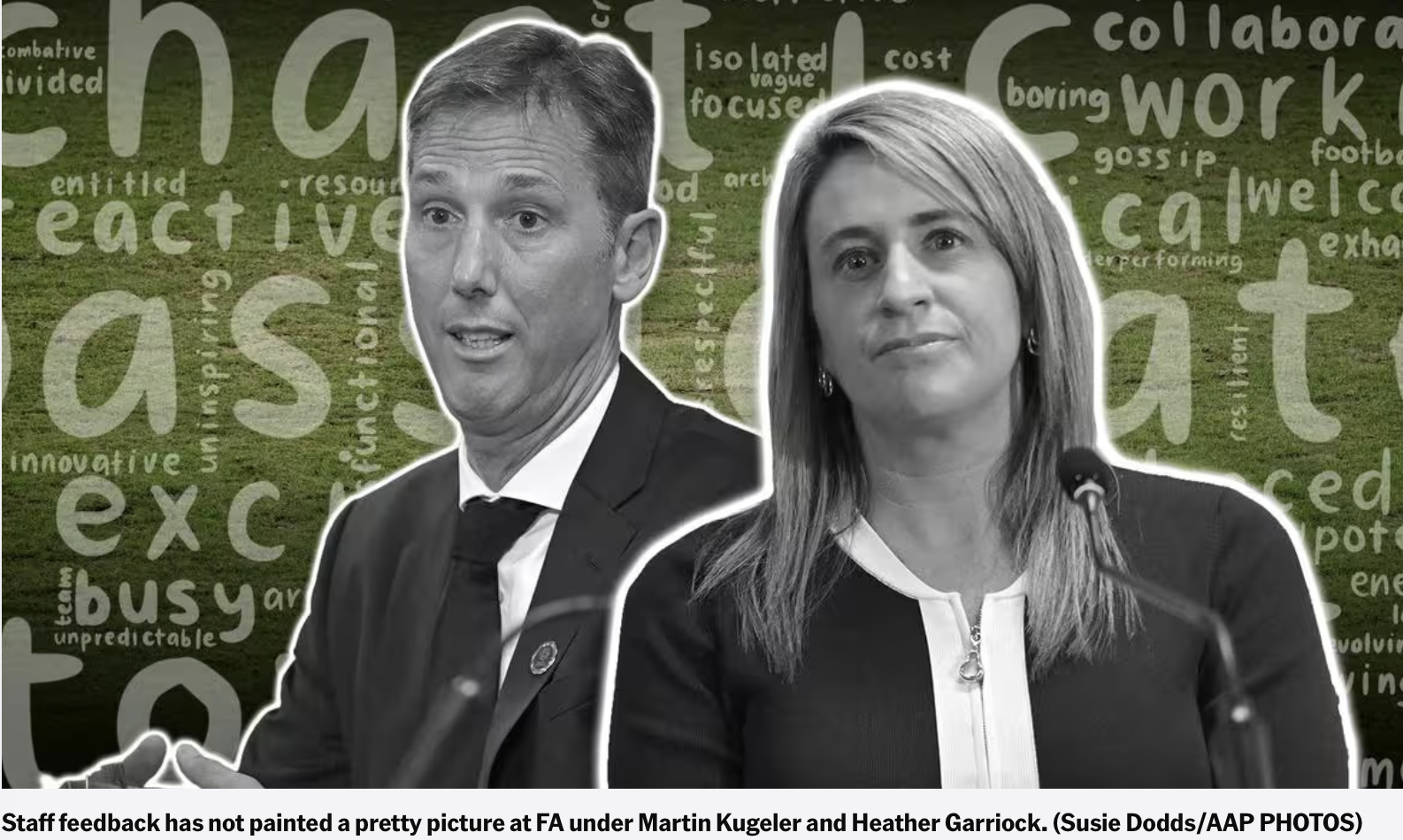
On the eve of Football Tasmania’s AGM, where the great reveal of our glorious leader for the next four years will finally occur, things at Football Australia HQ are going decidedly pear shaped.
And whether people like it or not, that matters to all of us.
Because while Tasmanian football often feels consumed by its own local politics, personalities and power struggles, the reality is that Football Australia still sits above the entire structure:
governance,
pathways,
funding,
national strategy,
participation systems,
and ultimately the broader direction of the game.
And right now the national governing body appears to be under extraordinary pressure.
Which means whoever emerges tomorrow night as Football Tasmania’s leader will immediately step into one of the most turbulent periods Australian football governance has faced in years.
The Headlines Keep Coming
Over the past fortnight the headlines have come relentlessly.
A reported $15.3 million loss.
More than 20% of staff facing redundancy.
Questions around APL debt arrangements and governance influence.
Three Football Australia board candidates withdrawing before election.
And now reports of an internal culture review describing Football Australia as “toxic, chaotic and negative”.
This is no longer just a football finance story.
It is starting to look like an organisation under pressure:
financially,
culturally,
politically,
and structurally.
And perhaps the most concerning part of all is that none of this feels entirely new.
Australian football has an extraordinary ability to repeatedly arrive at moments of:
crisis,
restructure,
governance reform,
“alignment”,
fresh leadership,
and promises of a reset.
Only for the same tensions to eventually reappear in slightly different forms.
At some point the game has to ask itself a very uncomfortable question:
Why does Australian football keep circling back to instability despite periods of enormous opportunity?
“Toxic, Chaotic and Negative”
The details emerging from the reported internal review are especially confronting.
Staff reportedly described Football Australia as:
hierarchical,
bureaucratic,
egotistical,
gruelling,
and unprofessional.
There were allegations of:
favouritism,
low psychological safety,
avoidance culture,
“meetings about meetings”,
and decisions made on “opinion not evidence”.
Whether entirely fair or not, it paints the picture of an organisation struggling internally while simultaneously trying to project stability externally.
And honestly, there is something deeper sitting underneath all this.
The language now coming from different parts of Australian football increasingly sounds exhausted.
Not simply frustrated.
Exhausted.
Journalists.
Supporters.
Former officials.
Fans.
Administrators.
Grassroots volunteers.
Different people with very different agendas are all starting to circle around similar themes:
politics,
fragmentation,
distrust,
blurred accountability,
and power struggles.
That usually means something bigger is happening.
The Voting Blocks
And now, right in the middle of all this turmoil, comes the Football Australia AGM.
The governance mechanics matter here.
A lot.
Because Football Australia’s Congress is ultimately controlled through voting blocs:
Member Federations,
A-League clubs,
the Women’s Council,
and the PFA.
The Member Federations collectively still hold the majority voting power.
Which suddenly makes tomorrow’s Football Tasmania AGM feel even more significant.
Because whoever takes over locally immediately inherits influence within one of the most important voting blocs in Australian football.
And right now the pressure around those voting blocs is intensifying rapidly.
Following the withdrawal of Mark Schwarzer, Christine Holman and Cathy McGuane, the remaining Football Australia board candidates now all appear aligned with A-League interests.
That has triggered growing public debate around the future balance of power inside Australian football.
Will the Member Federations continue to collectively hold the line against growing professional game influence?
Or are we watching the gradual consolidation of A-League influence inside the national governing body itself?
Because if Football Australia is simultaneously posting massive losses, cutting staff and facing scrutiny around financial arrangements linked to the professional game, ordinary football people are inevitably going to ask difficult questions.
Grassroots football families already pay enormous registration costs.
Community clubs fight constantly for facilities and funding.
Volunteers hold the game together every weekend.
So when headlines emerge suggesting millions linked to the professional game have become the subject of settlements, restructures or financial “clarifications”, people naturally start questioning where the priorities of the game truly sit.
That is no longer some abstract governance discussion.
It sits right at the centre of where Australian football may be heading next.
Who Actually Controls The Game?
And hanging over all of it remains the unresolved question Australian football never quite seems able to answer cleanly:
Who actually controls the game?
The unbundling of the A-Leagues was supposed to create clarity and independence between the professional game and the governing body.
Instead, the lines increasingly appear blurred.
And beneath all of that sits another tension Australian football still seems unable to resolve cleanly:
Who is the game actually being governed for?
The whole football pyramid?
Grassroots participation?
The professional leagues?
Commercial growth?
National teams?
Community football?
Too often Australian football feels like a sport trying to be:
a community game,
an elite pathway,
a commercial entertainment product,
a FIFA bureaucracy,
and a social institution
all at the same time.
That creates constant tension.
The Biggest Sport, Yet Constantly Fragile
This is perhaps the strangest contradiction of all.
Football is the biggest participation sport in the country.
The Matildas transformed the sporting landscape.
Participation continues to grow.
Governments want to invest.
Football is culturally stronger than it has been in decades.
Yet institutionally the game often feels remarkably fragile.
That is extraordinary.
Most sports decline culturally before they decline institutionally.
Australian football sometimes appears to be doing the reverse:
culturally growing,
while institutionally wobling underneath it.
That should probably concern everyone involved in the game.
Why This Matters In Tasmania
For ordinary football people this can all feel very distant from muddy boots, volunteer coaches, canteens and Sunday mornings.
But governance matters.
Because eventually governance decisions shape:
registration costs,
development pathways,
facilities,
investment,
competitions,
and the overall direction of the game.
Tomorrow night Tasmania will get its own answers about who will lead the local game for the next four years.
But nationally, Australian football still appears to be searching for much bigger ones.
And right now, the warning lights inside Australian football are flashing everywhere.