The World Cup Is Over. The Violence Isn't.
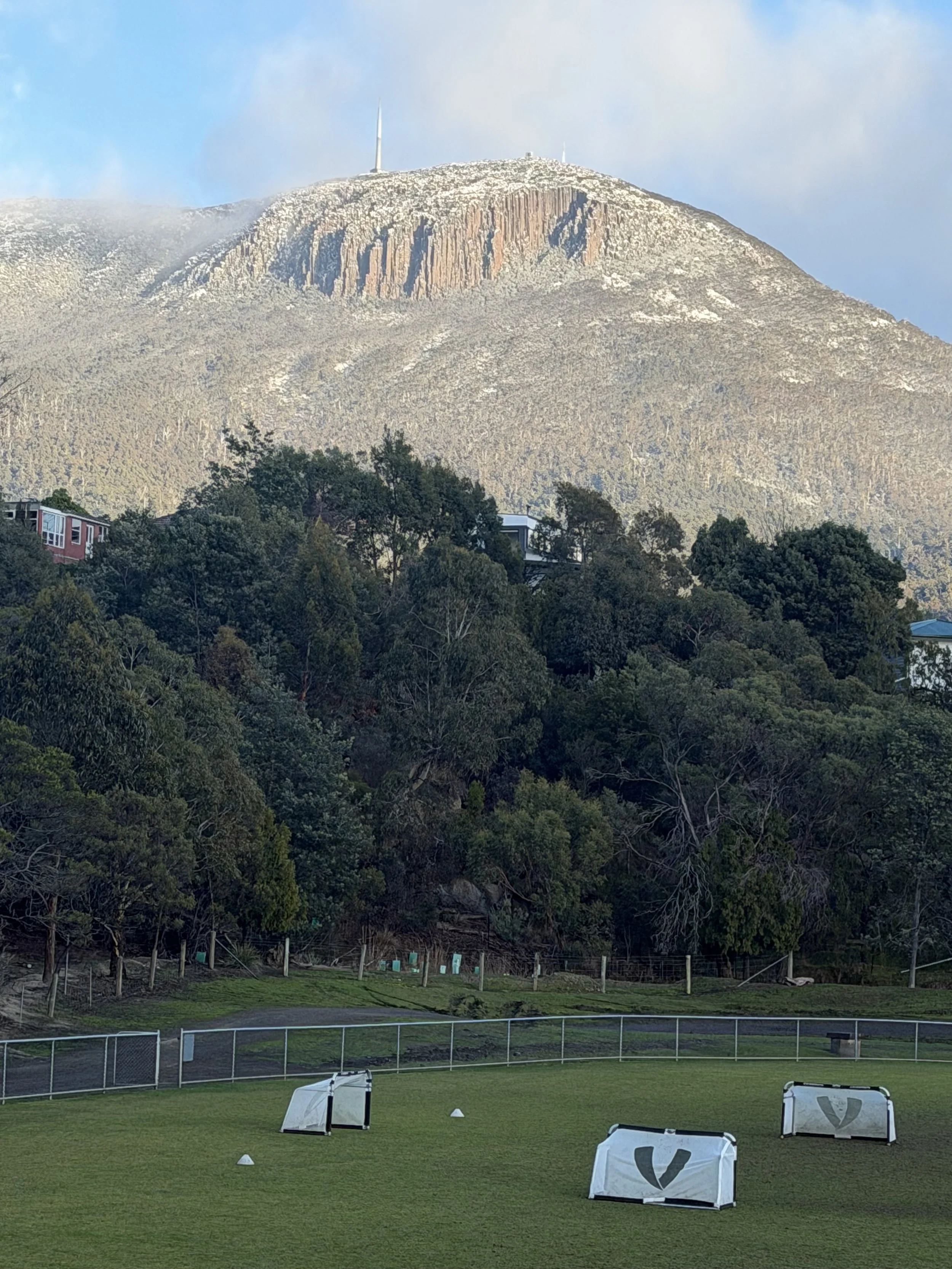
The final day of our school holiday football clinics finished much the way a Hobart winter often does.
The children barely noticed the cold.
They were too busy playing.
High above Wellesley Park, kunanyi / Mount Wellington wore a fresh blanket of snow while dark curtains of rain slowly rolled across the mountain towards us.
Every few minutes I found myself looking up, watching another squall make its way across the city.
My phone told me it was 3°C.
It felt colder than that.
The children, of course, wanted one more game.
They always do.
Parents began arriving one by one, collars pulled up against the wind, hands buried deep in pockets.
They looked towards the mountain too, wondering whether we could squeeze in just a few more minutes before the weather finally caught us.
We did.
Then, perhaps five minutes earlier than planned, we called everyone in.
The footballs were packed away.
The bibs were collected.
Wet boots disappeared into the backs of cars.
Another school holiday clinic was over.
I drove home to North Hobart, cold and wet.
Inside, I peeled off another layer of winter clothing, turned on the shower and stood beneath the hot water.
It was one of those simple moments most of us barely notice.
Warm.
Dry.
Safe.
How lucky am I, I thought.
Then another thought quietly entered my mind.
Not everyone gets to go home feeling safe.
Somewhere, A Woman Is Still Cold
As I stood beneath that hot water, I thought about how easily I had escaped the cold.
I had driven home.
I had walked through my own front door.
I had turned on the shower.
Warmth was waiting for me.
Safety was waiting for me.
Then I thought about the women for whom home is not the safest place at the end of the day.
Somewhere tonight, a woman may be sitting in a parked car with her children, trying to keep them warm through another freezing winter night because returning home feels more dangerous than staying where they are.
Perhaps she left in a hurry.
Perhaps she packed only what she could carry.
Perhaps the children are asking when they can go home.
Perhaps she does not know what to tell them.
Perhaps she is wondering where they will sleep tomorrow night.
And perhaps the man who forced them out is still inside the house.
Warm.
Dry.
Comfortable.
Watching television.
Sleeping in his own bed.
We often call him her partner.
I do not think we should.
A partner does not make a woman afraid to enter her own home.
A partner does not threaten her.
A partner does not control her money, her movements, her friendships or her phone.
A partner does not force her and her children into a car in the middle of winter.
He may be her husband.
He may be her boyfriend.
He may be the father of her children.
But he is not behaving as a partner.
Standing beneath that shower, I realised something that should never depend on luck.
Every woman should be able to go home knowing she is safe.
Here We Go Again
Within the space of just a few days, Australia woke to another unbearable reality.
Four more females were allegedly killed by males known to them.
Lavanya Chappa.
A 39-year-old mother whose two children were inside the family home when she died.
Jana Armstrong.
Thirty years old.
A young mother whose four-month-old son will now grow up without her.
Layla Jeffery.
Just 13 years old.
A little girl with her whole life ahead of her.
And an unnamed 17-year-old Yolŋu girl from the Northern Territory.
Another young life cut short before adulthood had even begun.
They are no longer able to tell their own stories.
So today, I have written about them instead.
Because they were never simply four headlines.
They were daughters.
One was a mother.
Some were sisters.
Some were friends.
All were loved.
All had futures.
All should still be here.
By the middle of July, Counting Dead Women Australia had recorded 27 women allegedly killed across Australia during 2026.
Twenty-seven.
It is just a number until you stop and imagine twenty-seven empty seats around twenty-seven family dinner tables.
Twenty-seven birthdays that will never be celebrated again.
Twenty-seven families trying to understand how someone they loved is never coming home.
Here we go again.
We have become accustomed to hearing the words.
Another woman.
Another family.
Another vigil.
Another promise that this time things will change.
The language almost writes itself now.
That should frighten us.
Because violence against women rarely begins with murder.
It begins much earlier.
With control.
With intimidation.
With jealousy disguised as love.
With isolation.
With threats.
With coercive control.
With a woman slowly becoming afraid inside her own home.
It grows when warning signs are ignored.
It grows when controlling behaviour is excused.
It grows when we ask why she didn't leave before we ask why he believed he had the right to frighten her.
And each time another woman is killed, we mourn.
We hold vigils.
We make speeches.
We promise to do better.
Then the news cycle moves on.
Until another name is added to the list.
Before the World Cup, We Knew
Before the FIFA World Cup began, I wrote an article with a title I wish had never been necessary:
The World Cup Is Coming. Support Services Are Preparing.
It wasn't written because football causes domestic violence.
It was written because experience, research and frontline services told us exactly what they expected to happen.
As millions of people around the world prepared to enjoy football's greatest tournament, domestic violence organisations, police and emergency services were preparing for something very different.
They were preparing for an increase in demand.
Not because football creates violent men.
Not because a missed penalty or a controversial refereeing decision suddenly transforms an ordinary man into an abuser.
But because major sporting events can become occasions where existing patterns of abuse intensify.
The tournament simply becomes another opportunity.
Another excuse.
Another trigger.
The violence was already there.
The control was already there.
The fear was already there.
Football did not create it.
It merely became part of the backdrop against which it unfolded.
That distinction matters.
It matters because blaming football lets perpetrators avoid responsibility.
The responsibility belongs to one person.
The man who chooses to abuse.
Before a single match had been played, support services knew they would likely become busier.
Police knew they would likely receive more call-outs.
Refuge workers knew more women and children might need somewhere safe to sleep.
Counsellors knew more frightened voices would be heard at the other end of the telephone.
Think about that for a moment.
While many of us were debating formations, predicting winners and setting our alarms for 3.00 am kick-offs, there were people quietly preparing for the darker side of what major sporting events can bring.
That should make every football supporter stop and think.
Because the people working on those front lines were not guessing.
They were preparing.
And tragically, they had good reason to.
The Statistics Were Never Just Statistics
The World Cup is over.
The football has finished.
The stadiums have emptied.
The trophies have been lifted.
Now comes the opportunity to ask an uncomfortable question.
What happened away from the football?
In the United Kingdom, police, prosecutors and domestic violence organisations had spent weeks preparing for an increase in abuse during the tournament.
They were not speculating.
They were planning for something they had seen before.
When the tournament ended, the figures confirmed why.
Across England and Wales, 384 football-related domestic abuse incidents were recorded during the World Cup, the highest total reported for a men's major international tournament.
Domestic abuse accounted for around 17 per cent of all football-related incidents reported during the competition.
Those numbers should concern all of us.
But they should never become the whole story.
Statistics do not answer the phone in fear.
Women do.
Statistics do not hide in bathrooms waiting for shouting to stop.
Children do.
Statistics do not sleep in cars on freezing winter nights because home no longer feels safe.
Families do.
Behind every number is a person whose life has been turned upside down.
A woman wondering whether tonight will be worse than yesterday.
A child learning far too young that raised voices can mean danger.
A police officer knocking on another front door.
A refuge worker trying to find one more bed that doesn't exist.
A counsellor listening to another frightened voice.
These are not numbers on a spreadsheet.
They are human beings.
And while it is tempting to focus on whether the number was 384, or whether incidents rose by this percentage or that percentage, we risk missing the point entirely.
One incident is too many.
One woman living in fear is too many.
One child believing violence is a normal part of family life is too many.
The figures matter because they remind us that this is not an isolated problem.
They reveal a pattern.
A pattern that police expected.
That prosecutors expected.
That support services expected.
And that is perhaps the most confronting statistic of all.
The people working on the front line knew what was coming before the tournament even began.
Football Didn't Cause This
Let me be absolutely clear.
Football did not cause these women to be abused.
Did not cause these children to grow up in fear.
Did not create violent men.
And if England had won instead of lost, if Australia had gone further, or if there had been no World Cup at all, these men would still have been responsible for their own behaviour.
That matters.
Because every time we blame football, alcohol, bad refereeing, a missed penalty or a heartbreaking defeat, we shift the focus away from the only person responsible.
The perpetrator.
Sport does not create domestic violence.
It exposes it.
It can provide another occasion when existing patterns of coercive control, intimidation and violence escalate.
But the violence already existed.
The controlling behaviour already existed.
The belief that one person has the right to dominate another already existed.
Football simply becomes another excuse.
And excuses are dangerous.
Because they allow society to say, "He just got carried away."
No.
He made a choice.
Millions of people watched every minute of the World Cup.
Millions celebrated.
Millions were disappointed.
Millions argued with referees, questioned substitutions and complained about VAR.
The overwhelming majority then hugged their families, congratulated the opposition, turned off the television and went to bed.
They did not assault their partner.
They did not threaten their children.
They did not destroy their home.
That is because football was never the problem.
The problem is men who believe they have the right to control, intimidate or harm the people closest to them.
If we are serious about ending violence against women, then we must stop looking for something else to blame.
The match is not responsible.
The stadium is not responsible.
The television broadcast is not responsible.
Football is not responsible.
The man who chooses violence is responsible.
Every single time.
Football Can Help Change It
If football didn't create this problem, why should it be part of the conversation?
Because football has something incredibly powerful.
Influence.
Every week, thousands of boys pull on football boots.
They listen to their coaches.
They watch their teammates.
They copy the behaviour of senior players.
They learn how to win.
They learn how to lose.
They learn how to treat officials.
They learn how to treat opponents.
And whether we realise it or not, they are also learning how men behave.
Every training session.
Every team talk.
Every handshake.
Every conversation.
Grassroots football is about much more than developing better footballers.
It is about developing better people.
When coaches teach respect, accountability and self-control, they are teaching lessons that extend far beyond the touchline.
When clubs create environments where girls and women feel respected, valued and safe, they are shaping the culture of the next generation.
When senior players challenge sexist language, bullying or controlling behaviour instead of laughing along, they are leading.
That matters.
Because football reaches communities that governments, schools and campaigns sometimes cannot.
It reaches families every weekend.
It reaches children at an age when values are still being formed.
It reaches fathers, sons, brothers and mates.
Football has never had the power to solve domestic violence on its own.
But it absolutely has the power to influence the culture in which the next generation grows up.
That is why I will continue writing about this.
Football has given me a platform.
I intend to use it.
If one coach decides to speak to his players about respect.
If one father reflects on the example he sets at home.
If one young man understands that strength is self-control rather than dominance.
Then every word has been worthwhile.
Awareness will not solve domestic violence on its own.
But silence never has.
Football has given me a voice.
I hope to use it well.
Governments Build What They Value
I have spent most of my adult life in football.
I have volunteered thousands of hours.
I have celebrated grand finals, championships and cup victories.
I have fought for better facilities, better pitches and better football infrastructure because I genuinely believe our game deserves them.
Football matters.
It brings communities together.
It gives children friendships that last a lifetime.
It teaches teamwork, resilience and belonging.
I will always believe football is worth investing in.
But there is something even more important.
The safety of women.
The safety of children.
We are often told there isn't enough money.
Not enough for emergency accommodation.
Not enough for counselling.
Not enough for prevention programs.
Not enough for specialist police.
Not enough for children's recovery services.
Yet governments somehow find billions of dollars when something becomes a priority.
We have seen governments prepared to borrow heavily and make difficult financial decisions to fund major infrastructure projects, including sporting stadiums.
That tells us something.
Not that stadiums are unimportant.
But that when governments decide something matters, they find a way.
Surely protecting women and children deserves the same determination.
Surely no woman escaping violence should be told there is no refuge bed available.
Surely no child should spend another night sleeping in the back seat of a car because there is nowhere safe to go.
Governments are ultimately judged not only by the infrastructure they build.
They are judged by the people they protect.
One day, no one will remember how many seats a stadium had.
But the women whose lives were saved because help arrived in time...
The children who grew up free from fear...
Those are the investments that define a nation.
That is not an argument against football.
It is an argument for priorities.
This Should Never Be Normal
By the time you finish reading this, another football season somewhere in the world will have kicked off.
Children will pull on oversized boots for the first time.
Parents will stand on cold sidelines with a coffee in their hands.
Coaches will set out cones before the sun comes up.
Referees will volunteer their weekends.
Supporters will argue about selections, celebrate victories and lament defeats.
Football will continue doing what it has always done.
Bringing people together.
My hope is that it can also help bring about change.
Not because football is responsible for violence against women.
It isn't.
But because football has the reach, the influence and the people to help build something better.
A generation of boys who grow into men who understand that strength is not measured by power over someone else.
That respect is not weakness.
That love is never control.
That home should be the safest place in the world.
Every World Cup eventually ends.
The cheering stops.
The stadium lights are switched off.
The television broadcasts come to an end.
The shirts are folded away until next time.
But for too many women and children, the fear continues long after the final whistle.
That should trouble every football supporter.
It should trouble every Australian.
As I stood beneath that hot shower on a freezing Hobart afternoon, I realised something that should never depend on luck.
I was grateful to be warm.
Grateful to be dry.
Grateful to be safe.
No woman should have to rely on good fortune to experience those simple things.
They should be ordinary.
They should be expected.
They should be guaranteed.
Because every woman deserves to go home knowing she will be safe.
Every child deserves to fall asleep without fear.
Until that becomes our reality, I will keep writing about it.
Not because I believe football caused the problem.
But because I believe football can help become part of the solution.
Because awareness matters.
Because conversations matter.
Because silence has never protected a single woman.
And because one day, I hope every woman can stand beneath a hot shower at the end of a cold winter's day, grateful only for the warmth...
...not for the fact she made it home alive.
If you or someone you know needs help
If you or someone you know is experiencing domestic, family or sexual violence, help is available.
1800RESPECT
1800 737 732
Lifeline Australia
13 11 14
In an emergency, always call Triple Zero (000).