19 November 2026 · 10 min read
There was a time when watching football required a television, a comfortable chair and a willingness to get up at three in the morning.
These days you need a spreadsheet, half a dozen passwords, several streaming subscriptions, a functioning credit card and preferably a second income.
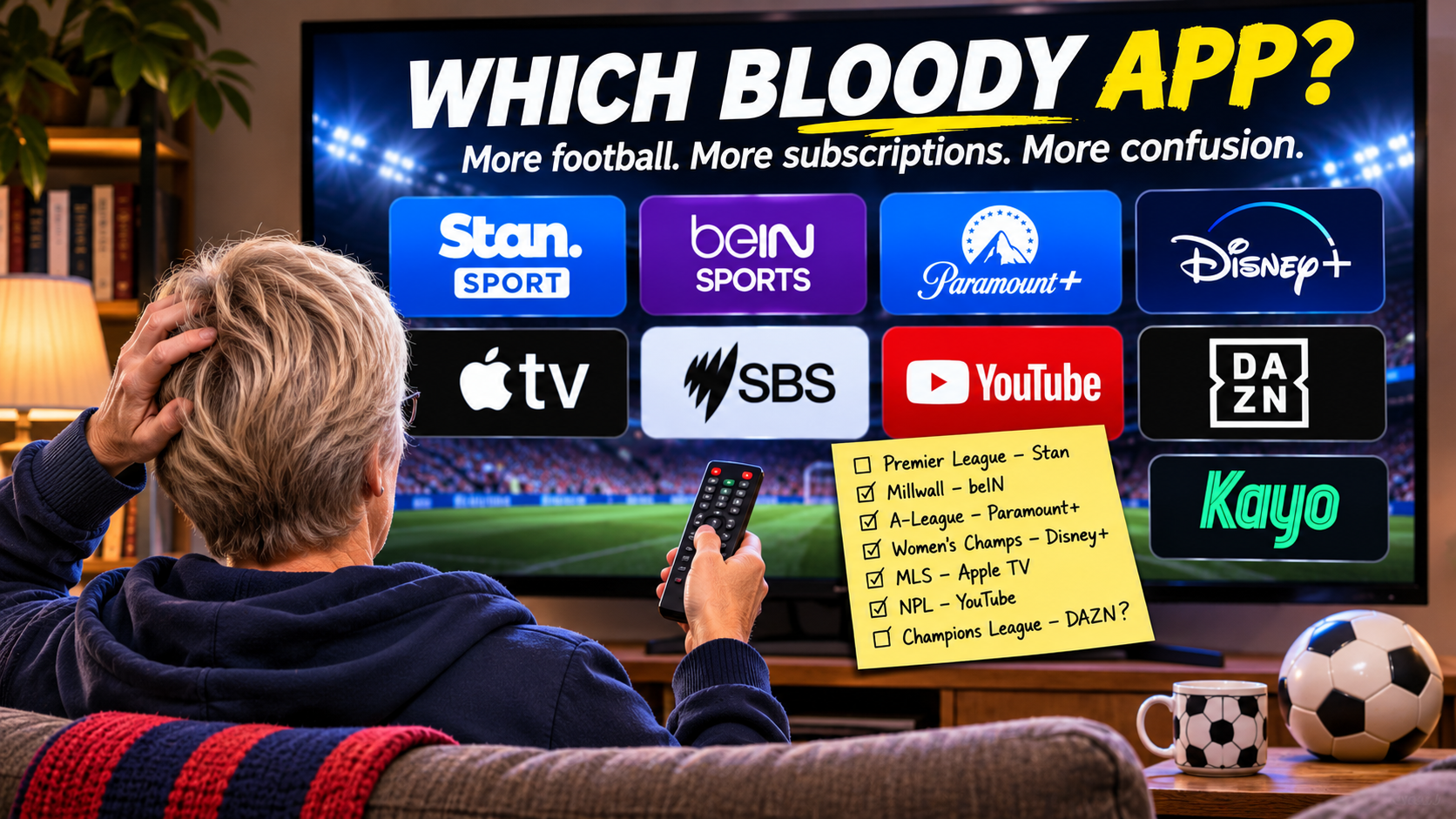
We have a rather large television in our house. And as I get older, I increasingly find myself standing in front of it, not daunted by the size of the screen but completely bewildered by which bloody app I'm supposed to open.
Is this one on Stan? beIN? Paramount? YouTube? Disney? Apple TV?
Or have the broadcasting rights changed again while I wasn't looking?
It wouldn't be the first time, and certainly won't be the last, that I've asked AI which platform is showing the football I want to watch.
I can generally tell you what competition a club plays in, who manages it and whether they've been promoted or relegated.
Ask me where to watch them, however, and apparently I require technological assistance.
And now, just when I thought I had a reasonable handle on things, along comes another broadcasting shake-up.
DAZN, Disney and Another Reshuffle
On 18 November, the Brisbane Times reported that Stan Sport was set to lose the Australian broadcasting rights to three major UEFA men's club competitions at the end of the 2026–27 season.
The Champions League.
The Europa League.
And the Conference League.
DAZN, the international sports streaming company that now owns Foxtel and Kayo, is reportedly in line to secure the Champions League from 2027–28.
Meanwhile, Disney is expected to acquire the Europa League and Conference League.
Stan Sport, however, is retaining the English Premier League, having secured those rights through to the 2033–34 season.
Importantly, these are reported outcomes of broadcasting negotiations, rather than final announcements explaining exactly where Australians will watch the matches and how much they'll pay.
The Twitterati, of course, knew all this weeks ago.
If your club plays in the Premier League, you'll need Stan.
If it qualifies for the Champions League, you might need DAZN, Kayo or Foxtel, depending on how DAZN decides to package it.
If it's playing Europa League football, you could find yourself heading to Disney.
And if it gets knocked out of Europe altogether, at least you'll have one less subscription to worry about.
Disney, Football and the Princesses
I must admit that Disney and European football don't quite belong together in my head.
Disney is where my granddaughter Mabel goes for princesses, fairy tales and a little magic.
The Europa League seems an unlikely addition to that particular collection.
But perhaps I need to move with the times.
Football has always had its fairy tales, although these days the princes tend to arrive in helicopters, earn several hundred thousand pounds a week and occasionally refuse to track back.
I'll adapt.
I just hope somebody tells me which button to press.
So Where Exactly Is All the Football?
I decided to investigate the Australian football broadcasting landscape.
That was probably a mistake.
It turns out that watching football requires considerably more research than I had anticipated.
Here's the major Australian streaming landscape as it stands in November 2026.
Where to Watch Football in Australia — November 2026
Stan Sport — $29.99 per month
Premier League, Champions League, Europa League, Conference League, FA Cup, Women's Super League, selected NWSL, J.League and K League.
beIN Sports — $16.99 per month
EFL, Carabao Cup, La Liga, Bundesliga, Serie A, Ligue 1, Scottish Premiership, UEFA Nations League and more.
Paramount+ — $12.99 per month
A-League Men and Women, Socceroos, Matildas, 2027 Women's World Cup, Asian Cups, AFC club competitions and selected Australia Cup matches.
Disney+ — $17.99 per month
UEFA Women's Champions League, and potentially the Europa League and Conference League from 2027–28.
Apple TV — $15.99 per month
Major League Soccer, included in the standard subscription.
SBS — FREE
Men's World Cup, Australian Championship and other football.
YouTube — FREE
NPL, WPL, local competitions, selected cup matches and other football.
Stan Sport includes the cheapest $9.99 base subscription and the $20 Sport add-on. Paramount+ and Disney+ prices are for their Standard plans.
TOTAL FOR ALL FIVE PAID PLATFORMS: $93.95 per month, or $1,127.40 per year.
And that isn't necessarily the complete picture.
There are specialist international services, club television channels and various streaming arrangements depending on the competition.
You can access beIN through different services, including its own app and other subscription platforms.
And, just to make things interesting, holding the rights to a competition doesn't necessarily mean showing every match.
Some broadcasters select particular fixtures. Others have restrictions on simultaneous matches. And some competitions appear on one platform for part of the tournament and another platform for the later rounds.
The Australia Cup is a good example, with coverage shared between Paramount+, Network 10 and free online services depending on the stage and fixture.
At least we have plenty of choice.
Apparently.
Let's Add Up the Damage
Suppose you're a particularly enthusiastic football supporter and want access to all five of those major paid platforms.
Stan Sport: $29.99.
beIN Sports: $16.99.
Paramount+: $12.99.
Disney+: $17.99.
Apple TV: $15.99.
Total: $93.95 a month.
Or $1,127.40 a year.
For watching football.
On your own television.
Using your own electricity and internet connection.
Of course you don't have to subscribe to everything.
You can cancel between seasons, take an annual plan or decide certain competitions aren't worth the money.
But we're football supporters.
The entire problem is that we want to watch football.
And this doesn't include whatever arrangements emerge for the Champions League in 2027–28.
For illustration, adding a separate Kayo Standard subscription at its current $29.99 monthly price would take that hypothetical total to $123.94 a month.
That's $1,487.28 a year.
It isn't a prediction. The new arrangements aren't confirmed, and existing packages may include some of that football.
But it shows how quickly following several competitions adds up.
And we haven't even counted Netflix, Prime Video or whatever else the household is paying for.
Perhaps we should start selling tickets to our lounge room.
The EFL. Now That's Football.
One subscription I wouldn't willingly give up is beIN Sports.
We love the English Football League, particularly the Championship.
The history, the grounds, the supporters, the possibility of promotion and the ever-present threat of relegation.
And, of course, Millwall.
Millwall is compulsory viewing in our house.
Our grandson, baby Hughie, is already destined to become another generation of Millwall supporters.
Some families pass down property. Others pass down jewellery.
Ours apparently passes down a lifelong emotional commitment to a football club that has never been particularly interested in making life easy for its supporters.
Hughie will be well prepared for disappointment.
The Championship is a wonderful competition. Unpredictable, competitive and full of clubs with big histories and supporters who have endured just about everything football can throw at them.
And then there's Wrexham.
The Hollywood effect is impossible to ignore.
Ryan Reynolds and Rob McElhenney have helped transform a Welsh football club into an international entertainment property, and Wrexham seems to get plenty of attention from broadcasters.
It turns out the story around a football club can be almost as valuable as the football itself.
Unfortunately, beIN doesn't show every Championship fixture. When matches clash, we don't necessarily get the game we'd prefer.
Which is another oddity of paying to watch a competition.
You can pay for the service and still find your team isn't being shown.
The Old Firm and the Rest of Europe
beIN also brings us Scottish football, including the Old Firm derby between Celtic and Rangers.
Now there's a football fixture.
History, rivalry, extraordinary atmosphere and enough hostility to power a small city.
Whether you support either club or neither, it's one of those matches that reminds you why football matters so much to people.
Then there are the major European domestic leagues, the Carabao Cup, UEFA Nations League internationals and South American club football.
And a handful of club channels offering interviews, replays and archive content, although not live Premier League matches.
That's a lot of football for one subscription.
The biggest problem might be finding enough hours in the day to watch it all.
The Magic of the FA Cup
Then there's the FA Cup, currently on Stan Sport.
For me, one of its great attractions isn't necessarily watching the Premier League giants.
It's watching them visit the smaller clubs.
Those wonderful little boutique grounds, packed grandstands, supporters practically on top of the pitch and the occasional playing surface that looks as though it hosted a cattle sale earlier in the week.
The possibility of a giant-killing.
A part-time footballer who spends his week at work suddenly finding himself defending against somebody earning more in a month than he makes in several years.
And, every now and then, the smaller club wins.
It's magnificent.
The FA Cup reminds us that football isn't simply a collection of wealthy clubs and international television contracts.
There's a whole football pyramid underneath them.
And occasionally, gloriously, the pyramid bites back.
That's worth staying up for.
Paramount, the A-League and MobLand
We still subscribe to Paramount+.
In theory, that gives us access to every A-League Men's and Women's match, Australian internationals, major AFC competitions and selected Australia Cup matches.
The men's Asian Cup, incidentally, has been postponed from its original early-2027 dates to December 2027 through January 2028 because of the security situation in the Middle East. The new dates still need FIFA's approval.
Every match will be on Paramount+.
So that's another adjustment to the football diary.
In practice, we don't watch nearly as much A-League football as we once did.
I find myself getting a little bored watching the same teams play each other over and over again.
It's not necessarily a reflection of the standard of football. There are good players, good matches and plenty of people working hard to improve the competition.
But the closed nature of the league, without promotion and relegation, takes away something I particularly enjoy about football.
The jeopardy.
The prospect of a smaller club climbing through the divisions, or an established club paying the price for years of poor decisions.
The English football pyramid has that.
The A-League doesn't.
Perhaps it's simply personal preference, but it affects how much of the competition we watch.
Fortunately, Paramount+ also has MobLand.
Now there's a good reason to keep the subscription.
Nothing quite like an organised crime drama to justify paying for a football competition you've largely stopped watching.
And Women's Football?
If you thought women's football might escape this broadcasting maze, think again.
The A-League Women is on Paramount+.
England's Women's Super League is on Stan Sport.
The UEFA Women's Champions League is on Disney+.
Selected American National Women's Soccer League matches are on Stan.
The Matildas and major Australian women's internationals are covered through Paramount+ and Network 10.
Local women's football can often be found through federation broadcasts and YouTube.
Then there's next year's Women's World Cup in Brazil, which will be on Paramount+ and Network 10.
Every match on Paramount+.
Every Matildas match free on 10.
Small mercies.
When Korean Football Saved Us From Ourselves
I remember during COVID, when football competitions around the world had shut down and there was precious little live sport to watch.
Then South Korea's K League started playing again.
The now-defunct Optus Sport picked up the Australian broadcasting rights in 2020, and suddenly we had football back on our television.
There were those vast, cavernous stadiums, completely empty of spectators.
No singing, no chanting, no roar from the crowd.
Just the echo of players shouting instructions to one another, their voices carrying around the deserted stands.
It was eerie.
Football without its soundtrack.
I can't pretend we were lifelong followers of the K League. I doubt we could have named more than a handful of players.
But there we were, watching Korean football because it was football, it was live and, after weeks of sporting deprivation, that was quite enough.
No crowds. No atmosphere. No idea who half the players were.
But football nevertheless.
And, remarkably, back then we knew exactly which app to open.
Stan Sport now carries the K League, along with Japan's J.League.
The football survives.
The streaming services come and go.
Thank Goodness for SBS
There is, however, some genuinely good news.
SBS has secured the Australian broadcasting rights to the 2030 men's World Cup.
Every match. Live. Free.
After its coverage of this year's tournament, SBS will once again give Australians something increasingly unusual in international sport.
A major competition that doesn't require another monthly subscription.
SBS also shows the Australian Championship, with Thursday night and Saturday matches on SBS and the rest streaming free on SBS On Demand and Football Australia's YouTube channel.
And the Australia Cup mixes Paramount+ with free coverage on 10.
Free football matters.
Particularly for families, young supporters and people who simply cannot afford another subscription.
It would be a sad day if watching the world's biggest football tournament became something reserved for those who could pay.
Sometimes the best football subscription is the one that doesn't exist.
Sometimes the Best Football Is Much Closer to Home
We also watch a lot of local and interstate football.
YouTube has become an important part of that.
We can watch Nick playing and Max coaching at Northcote in Victoria, even though we're sitting at home in Tasmania.
Being able to follow family members playing and coaching interstate is wonderful.
And it's free.
Which is a little odd, when you think about it.
We pay $93.95 a month to watch footballers we've never met.
Nick and Max cost us nothing.
Across Australia, NPL and women's competitions are also available through various online broadcasting arrangements.
For supporters who can't get to matches, families interstate and people who simply enjoy local football, that coverage is worth a great deal.
Would we pay a few dollars a month to keep watching Nick and Max if some of that money went back to the clubs?
Absolutely.
But that's a question for another blog.
I Think I'll Need Some Sticky Notes
At this rate, I'm going to need a dedicated reminder system just to watch football.
Perhaps a tagged reminder in my AI of choice.
Where is Millwall playing this weekend, what time is kick-off in Tasmania, and which of my bloody subscriptions do I need to open?
Or perhaps I'll go old-school and surround the television with Post-it notes.
Premier League: Stan.
Millwall: beIN.
A-League: Paramount.
Women's Champions League: Disney.
MLS: Apple TV.
NPL: YouTube.
Champions League: check again next season.
It seems rather extraordinary that the technology designed to make watching football easier has become so complicated that I need another piece of technology to explain how to use it.
And yet, for all my complaining, I wouldn't go back.
We have never had access to so much football.
We can follow competitions that would have been almost impossible to watch a generation ago.
We can watch women's football from around the world, discover obscure leagues, enjoy great rivalries and follow our own family playing and coaching interstate.
That's wonderful.
The conundrum is that greater access has brought greater cost and considerably more confusion.
We have more football than ever, more ways to pay for it, and somehow still can't always find the bloody game.
Perhaps the solution is to turn off the television occasionally and go to an actual football ground.
At least there, I know where the match is being played.
Although knowing the way football is going, somebody will make me download an app to get through the gate.