We've been here before: the State League returns
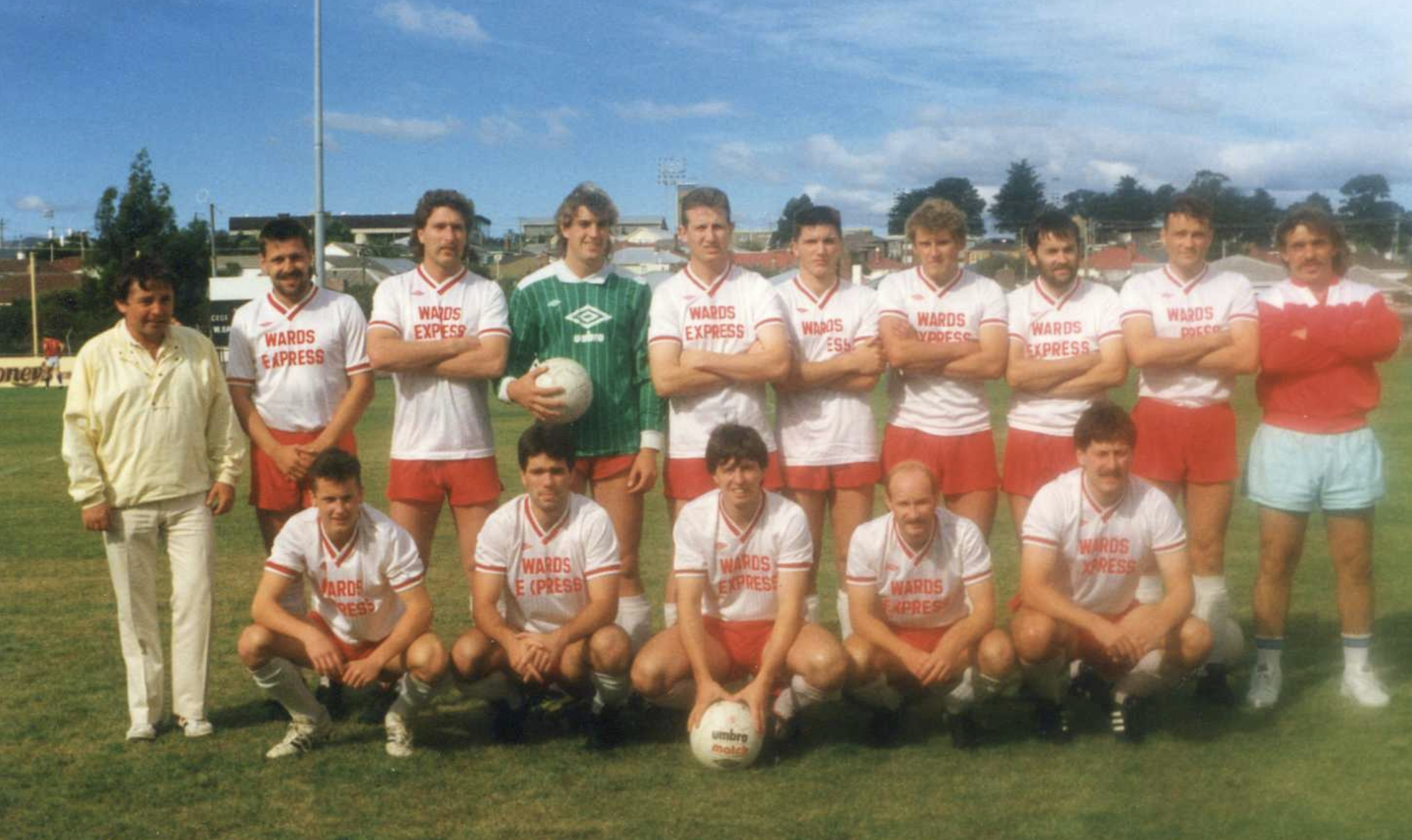
White Eagles, State League champions in 1989, during their dominant run of four consecutive titles from 1988 to 1991. Photo: Walter Pless archive.
Part Three: 1988 to 1999
Australia was celebrating its Bicentenary.
Bob Hawke was Prime Minister. Sydney was buzzing.
I was 29, turning 30, living in Glebe and working at the Sydney Theatre Company's Wharf restaurant.
I even went to a few Swans games at the SCG.
The year before I had seen Crowded House at the Hordern Pavilion, which feels very late-80s Sydney to me now.
But football, the real type, was still nowhere on my horizon.
No children yet to introduce me to the game.
No South Hobart.
No Morton's Soccer School.
Certainly no thought that decades later I would be sitting here trying to unravel the history of Tasmania's State League.
Meanwhile, in Tasmania, the State League was coming back.
Ten clubs and genuinely statewide again
After six years of regional football, Tasmania returned to a full State League in 1988.
Ten clubs entered.
White Eagles.
Olympia.
Hobart Juventus.
Croatia Glenorchy.
Caledonians.
Launceston Juventus.
Launceston Matric.
George Town United.
Devonport City.
Ulverstone.
Five from the south and five from the northern half of Tasmania.
That is worth remembering.
This was not a Hobart competition with a couple of northern clubs tacked on.
It was genuinely statewide.
Each club played 18 league games, home and away against nine different opponents.
And there was something else new.
Three points for a win.
Launceston City's history records that 1988 was the first time the three-point system had been used in Tasmania.
It was still relatively unusual around world football at the time.
So this was not simply a recreation of 1978.
Tasmanian football was trying something new again.
White Eagles wasted no time
There is a lovely symmetry to what happened next.
White Eagles had won Tasmania's first State League in 1978.
Ten years later they won the first season of the second one.
They finished 14 points clear of Olympia in second, with Launceston Juventus third.
They would go on to win four consecutive State League titles from 1988 to 1991.
That is an extraordinary period of dominance and Walter Pless has written extensively about what a strong era it was for the club.
But while White Eagles were providing stability at the top, the competition underneath them was already moving.
And this, I think, is the real story of the second State League.
The revolving door starts almost immediately
George Town United played in the revived State League in 1988.
Then withdrew.
One season.
Gone.
I have not yet found a reliable contemporary source that tells me exactly why.
So I am not going to invent one.
But the fact itself matters.
Tasmania had just rebuilt its State League with ten clubs and genuine statewide representation.
Within a year, one of those clubs had left.
Then there was Launceston.
Launceston Matric had only just come up from the Northern Premier League for the 1988 season.
A year later they merged with Launceston United.
Launceston United's own history describes the combination as something of a marriage of convenience. One club had the ground, the other had the players.
That tells you something.
Clubs were already combining resources to make top-level football work.
The combined club lasted only briefly in the State competition before returning to northern football.
Launceston United would be back later in the decade.
The league continued.
But the membership kept changing.
Strong clubs were leaving too
This is the part that really interests me.
It would be easy to assume that clubs left the State League because they were not good enough.
The history does not support that.
Ulverstone withdrew after the 1993 season.
Then went back north and won the Northern Premier League in 1994 and again in 1995.
Two of their players, the Conkie twins, were recruited by Morwell Falcons in the National Soccer League in 1996.
Ulverstone were not disappearing because they could not compete.
They could.
They simply were no longer in the State League.
Summer football
There is something else that happened at almost exactly the same time.
The State League moved to summer.
The National Soccer League had already done it in 1989.
Football Australia says the national league moved to make better use of grounds, take advantage of warmer weather and night games, and bring in more families.
Crowds went up.
Tasmania decided to follow.
The 1993/94 State League was trialled as a summer competition to put more people through the gate and to line up with the national calendar.
That sounds very familiar now.
The A-League plays in summer and does not have to fight the AFL every weekend for grounds, crowds and attention.
Tasmania tried its own version of that idea more than thirty years ago.
And 1993 was a strange year.
The State League played a shortened winter season of just 14 games, finishing in August.
Then in November a brand new summer season kicked off.
Two State League seasons in one calendar year.
White Eagle's president Frank Bansel called it "new and uncharted territory, but it has the potential to be a great success."
Ulverstone played in the winter part of 1993.
They were not there for the summer.
I have not found anything that says the switch was the reason.
But the timing is hard to miss.
The first summer season ran through to April 1994.
The Grand Final was played at night at KGV in front of a large crowd.
The second summer season ran from November 1994 to June 1995.
Then in 1996 the State League went back to winter.
So did it work?
In some ways, yes.
One person involved at the time later recalled that gate numbers were up and the bar and barbecue made a profit.
That is a recollection rather than an official figure, but it fits what the experiment was meant to do.
So why stop?
The same account gives three reasons.
The media coverage everyone hoped for never really came.
Players tried to play two seasons a year.
And club volunteers burnt out from being on duty twelve months of the year.
That last one rings true.
Winter football never stopped. The regional leagues kept going.
Devonport's captain Snow Compagne played the summer State League, then went straight back to Ulverstone for the winter of 1994 and won the Northern League with them.
Great for him.
Exhausting for the people running the clubs.
Anyone who has spent time on a club committee will understand that.
Summer football was not a failure.
It just sat on top of everything else rather than replacing it.
And that is a lesson worth remembering.
Devonport
Devonport may be one of the most important examples in this entire series.
They topped the State League in 1992.
Again in 1993.
In those years topping the table did not automatically make you state champion. There was a playoff, and Devonport lost to Glenorchy Croatia in 1992 and Hobart Juventus in 1993.
Then came the first summer season.
Devonport went through it unbeaten.
They finished 14 points clear of Launceston Juventus and then beat White Eagles 3-2 in the Grand Final.
And then they did not enter the next summer season.
One of the strongest clubs in Tasmania.
Not a club at the bottom.
Not a club being relegated.
The best.
Gone.
Launceston Juventus then signed some of the players from Devonport's championship side.
Devonport returned in 1996, the same year the State League went back to winter.
They finished runners-up that year.
Runners-up again in 1997.
Top of the State League in 1998.
And after that season they withdrew again.
This time the reason is on the record.
Devonport's own history says they were forced to withdraw because of the increasing cost of travelling to and from Hobart every second week.
That is important.
Because it tells us something that goes well beyond football ability.
A club can be strong enough to win the competition and still decide that participating in it does not stack up financially.
That should sound familiar.
The issue was not whether the north could play
By the late 1990s, the State League was becoming increasingly southern.
But northern football itself was not becoming weak.
Quite the opposite.
Riverside Olympic's decision is even more interesting because they already knew exactly what State League football involved.
They had been in the competition in 1997, finished bottom and dropped back into the Northern Premier League.
A year later they won 17 of 18 games, scored 138 goals, beat Launceston United 3-0 in the promotion playoff and then declined promotion.
They had been there before.
They had earned their way back.
And they still said no.
I have not yet found the contemporary record explaining exactly why.
I would love to.
The question was never whether Riverside were good enough.
It was whether they wanted to be in the competition.
Same clubs, new names
Before we get to 1999, a quick word on names, because they changed a lot in the late 1990s.
In the mid-1990s Soccer Australia pushed clubs to drop ethnic-based names.
In Tasmania, the changes came through in 1997.
White Eagles became New Town Eagles.
Croatia Glenorchy became Glenorchy Knights.
Hobart Juventus became Hobart Zebras.
Olympia became Olympic.
Launceston Juventus became Launceston Zebras in 1997 and then Launceston City in 1998.
That last one matters for this story.
Launceston Juventus and Launceston City are the same club.
And as far as I can tell, they were the one northern club that stayed in the State League for all twelve seasons.
Everyone else came and went.
And that brings us to 1999
By 1999 Launceston City was the only northern club left in the State League.
Just think about how far the competition had shifted.
In 1988 it began with five southern clubs and five from the northern half of the state.
Eleven years later there were nine clubs.
Eight were southern.
Launceston City stood alone.
And here is the part that surprised me most.
The decline was not slow.
In 1997 there were still four northern clubs in the State League.
Devonport.
Launceston City.
Launceston United.
Riverside.
Two seasons later there was one.
And yet northern football remained strong.
Riverside.
Devonport.
Ulverstone.
Launceston United.
George Town.
Burnie.
Somerset.
Northern Rangers.
There were plenty of football clubs.
There were good football clubs.
They just were not in the State League.
That is a very different problem.
The problem was not finding northern teams capable of playing at that level.
The problem was keeping strong northern teams inside the statewide competition.
Launceston City nearly won the whole thing
There is an irony here too.
Launceston City did not just make up the numbers in 1999.
They went into the final match of the season needing only a win to be champions.
University had already won their game the day before and sat two points clear.
Launceston City travelled to Wentworth Park to play bottom side Clarence United.
Clarence had won just one game all season.
They won their second that day.
University became champions for the first time.
So the only northern club left came within one result of winning the competition.
Then the State League itself disappeared.
Again.
Why?
This is where I keep coming back to the same themes.
Travel.
Money.
Whether clubs were getting enough out of the competition to justify the cost.
Whether statewide participation was worth it.
We do not have a perfect documentary explanation for every withdrawal.
George Town's reason remains unclear to me.
Ulverstone's exact reason remains unclear.
I still want to know precisely why Riverside declined promotion in 1998.
But when you stand back and look at the pattern, it becomes difficult to ignore.
Strong northern and north-western clubs repeatedly moved out of the State League.
Some returned.
Some did not.
Some dominated regional football instead.
Devonport gives us the clearest example because their own history specifically identifies the cost of regular travel to Hobart.
And that is why this history matters now.
A competition can be good and still not be sustainable
I think this is one of the things I have learned from researching these first three parts.
We tend to talk about competitions as either successful or unsuccessful.
It is rarely that simple.
The second State League produced very good football.
White Eagles won four straight titles.
Devonport became one of Tasmania's strongest clubs.
Launceston Juventus, later Launceston City, was rarely far from the top.
There were strong players, good coaches and memorable matches.
The league lasted twelve seasons.
That is hardly failure.
But underneath it, clubs kept moving.
Withdrawing.
Merging.
Returning.
Choosing regional football.
Declining promotion.
Even the season moved, from winter to summer and back again.
The league existed.
Stability was another matter.
And then it ended
After the 1999 season, the State League was disbanded.
And here is the bit I find almost funny.
By early 2000, clubs were already asking for it back.
The Mercury reported that the presidents of all eight southern-based State League clubs, together with Metro-Claremont, asked Soccer Tasmania to bring back statewide competition.
Soccer Tasmania said no.
One of the arguments was that any future State League needed proper proportional representation from north and south if it was going to attract appropriate sponsorship.
There we are again.
Statewide representation.
Money.
Sponsorship.
Sustainability.
The same questions.
It was not just soccer
It is worth remembering that the other code was wrestling with the same thing.
Tasmania's Australian rules statewide league shrank through the late 1990s as clubs struggled with travel, crowds and money.
It collapsed at the end of 2000.
Two codes.
Same island.
Same distances.
Similar problems.
What does this period tell us?
For me, the biggest lesson from 1988 to 1999 is not that the State League failed.
Nor is it that regional football was better.
It is that a State League only works if clubs believe being in it is worth the cost.
Tasmania began this second attempt in 1988 with ten clubs and genuine statewide balance.
By 1999 it had nine clubs and only one from the northern half of the state.
That transformation did not happen because northern football suddenly stopped producing good teams.
It happened while strong northern clubs were thriving outside the State League.
And that is the part I cannot get past.
Ulverstone could compete.
Devonport could dominate.
Riverside could win almost every game it played.
Yet all of them, at different times, were outside the statewide competition.
The problem was not finding good northern teams.
It was persuading good northern teams that the State League was worth being in.
That is a very different question.
And it feels remarkably relevant now.
The uncomfortable Devonport parallel
There is one historical detail I suspect we will come back to later in this series.
Devonport were one of Tasmania's best teams in the 1990s.
They withdrew from statewide competition more than once.
Their own history says the 1998 withdrawal came down to the cost of travelling to Hobart every second week.
Nearly thirty years later, Tasmania is again trying to make a statewide competition work with Devonport as an important part of it.
And once again the practical questions are there.
Travel.
Cost.
How many games.
How many home games.
What clubs get back for what they spend.
I am not going to jump ahead of the story yet.
But I think that history is worth keeping in the back of our minds.
From five northern clubs to one
Perhaps the simplest way to tell the story of the second State League is this.
1988:
Five southern clubs.
Five from the northern half of Tasmania.
1999:
Eight southern clubs.
One northern club.
Then the State League was gone.
That is some journey in eleven years.
And once again Tasmania returned to regional football.
This time it would be a much longer absence.
The next State League would not arrive until 2013.
And by then, I most definitely knew what football was.
That is Part Four.