What a Washout Actually Looks Like
One washed-out round. Two people awake before dawn. And what happened next.
3am.
Emma is awake.
Rain absolutely pouring. Wind howling outside.
Her first thought?
I wonder how many games are going to be washed out today.
5am.
She messages me.
It is pouring down her way too.
We agree there will be closures.
We just do not know how many yet.
The morning starts before the sun does
I get up and get dressed quickly because I know I am going to be busy in the wee small hours.
I drive to Wellesley Park, thinking I will set myself up in the clubhouse with my laptop.
About 6.30am.
Before I have even opened the laptop, I know Wellesley is unplayable.
I communicate that to Football Tasmania rosters and to South Hobart, whose home ground it is.
Then I wait.
Emma, meanwhile, is up checking her phone.
Nine forfeits already.
The reasons vary.
Some teams do not want to travel because they are worried their ground will close.
Some little ones do not want to play in the wind and rain.
Some teams simply do not have enough players because that happens on any given weekend, regardless of weather.
Emma starts messaging opposition delegates, letting them know and trying to keep everybody updated.
Her own team group chat starts too, with parents wondering whether they are playing.
At the same time, Emma and I are messaging back and forth.
Just the two of us, trying to look after a competition involving nearly 4,000 kids.
Waterlogged pitches.
Puddles everywhere.
The question keeps coming back.
Is it safe?
The avalanche
There is a severe weather warning for damaging winds.
The rain is expected to ease around 9am.
Maybe we will lose the early kick-offs.
Maybe the wind will clear some of the water.
Maybe the grounds will drain.
There is still hope.
Then it starts.
Sorry, our ground is closed.
And the forfeits keep coming.
We cannot keep up with sending them through to the opposition.
Too many.
Too fast.
There is no way I can post forfeits individually on social media. I can only just keep up with the ground closures.
So I put a message on Facebook saying I cannot answer questions about individual grounds. There is simply too much information coming in and I will post closures as soon as we receive them.
Parents at home are wondering whether to venture out.
Do they get the kids dressed?
Do they leave early?
Do they take it slowly because the game may not happen anyway?
Fair enough.
But I cannot keep up.
It is freezing in the clubhouse and my fingers will not work fast enough on the keyboard.
I am madly updating Facebook as each closure arrives.
Messages from Emma telling me what needs to be posted.
Phone calls from clubs wanting to know what is happening to their games.
Emails.
Messages.
More forfeits.
More closures.
And the list keeps growing underneath me.
At the same time, our ground contractor is out in the pouring rain.
He is physically inspecting grounds.
Looking at drainage.
Setting up nets where games might still be possible.
Putting a ball down and seeing whether it will actually roll.
Trying to save games, not cancel them.
A single name on the closure list can also mean far more than one ground.
Metro, for example, is not one closure.
It is four.
When a venue like that goes, the flow-on is enormous.
Kick-offs begin at 9am and continue on the hour through the day, so one decision can wipe out games at every time slot.
Taroona.
Lightwood Park.
Princes Street.
Lower Queenborough.
Metro.
Calvin.
Huon Valley.
Channel Christian School.
Waimea Heights.
Mount Nelson.
Soldiers Memorial.
And more.
Wowsers.
What is actually left?
And even that list only represents the proactive ones.
The delegates who have already physically made it to their grounds, inspected them and called us.
What about the others?
The ones who have not even reached their venue yet?
Some grounds are only set up shortly before the first game, so at that stage there is simply nothing to report.
Closed or open.
Nobody knows yet.
8am is getting closer.
The 9am kick-offs are coming.
We need to let people know one way or another and the urgency is growing by the minute.
And it is not just Hobart.
Our competition stretches from North Chigwell to Dover.
People are travelling right across the region.
And then comes another impossible part of mornings like this.
Families travelling long distances understandably want the decision made as early as possible.
Please tell us now.
We do not want to load the kids into the car, drive all the way into Hobart and discover the ground is closed.
Completely reasonable.
At exactly the same time, other families want us to wait.
Please do not cancel yet.
The rain is meant to ease.
Give it another hour.
Maybe the grounds will drain.
Maybe we can still play.
Also completely reasonable.
But they are opposite requests.
Make the decision early and people are angry that we did not wait.
Wait longer and people are angry that we did not tell them sooner.
There is simply no way to satisfy both.
And even where a ground is still technically open, there is another practical reality.
Teams make decisions about whether to turn up.
If half your competition has already forfeited or lost its ground, the teams still standing are not necessarily guaranteed a game either.
Opposition teams may decide not to travel for a fixture that might not go ahead or to a ground they do not trust will remain playable.
By then, the question is no longer whether one isolated game somewhere might still be possible.
The question is whether a competition of nearly 4,000 children, around 250 games and more than 40 grounds can still operate safely and practically as a competition.
The call nobody wants to make
In the middle of all this, Emma is also organising her own children.
Gumboots.
Rain jackets.
Forget the umbrella.
Because she is not just the person managing forfeits and delegates that morning.
She is a football mum too.
For me, it is different.
My son Ned is a club academy and technical director and the washout means a much bigger morning for him too.
Every team.
Every family.
Every coach.
One decision at the top becomes hours of extra work flowing down through clubs.
And then we make our first phone call to each other.
7.50am. Let’s wait until 8am on the dot. Let’s give it 10 more.
Then at 8am.
Do we wash out the round?
We know exactly what that decision means.
We know how many children will be disappointed.
How many parents will be frustrated.
How many messages will follow.
But we also know our responsibility is to provide a safe environment for children to play.
So we make the call.
A total washout.
More than 200 junior football games will not be played.
More than 200 opportunities for kids to run around, see their friends, kick a ball and simply be kids are gone.
That hurts.
We know there were children who woke up excited.
Parents who built their Saturday around football.
Coaches and managers who had prepared all week.
Our own families wanted to be there too.
And yes, the bloody sun came out.
Yes, by 11am it looked fine.
But at 7am it absolutely was not.
The decision had already been made hours earlier, when there was a severe weather warning, grounds were going under one after another, forfeits were pouring in and nobody knew how many venues would still be playable by the time the first games were due to begin.
Hindsight from a dry lunchtime does not change what the information looked like before breakfast.
Then it went public
The announcement went out to thousands of people.
Almost immediately, the messages began.
Emails.
Phone calls.
Private messages.
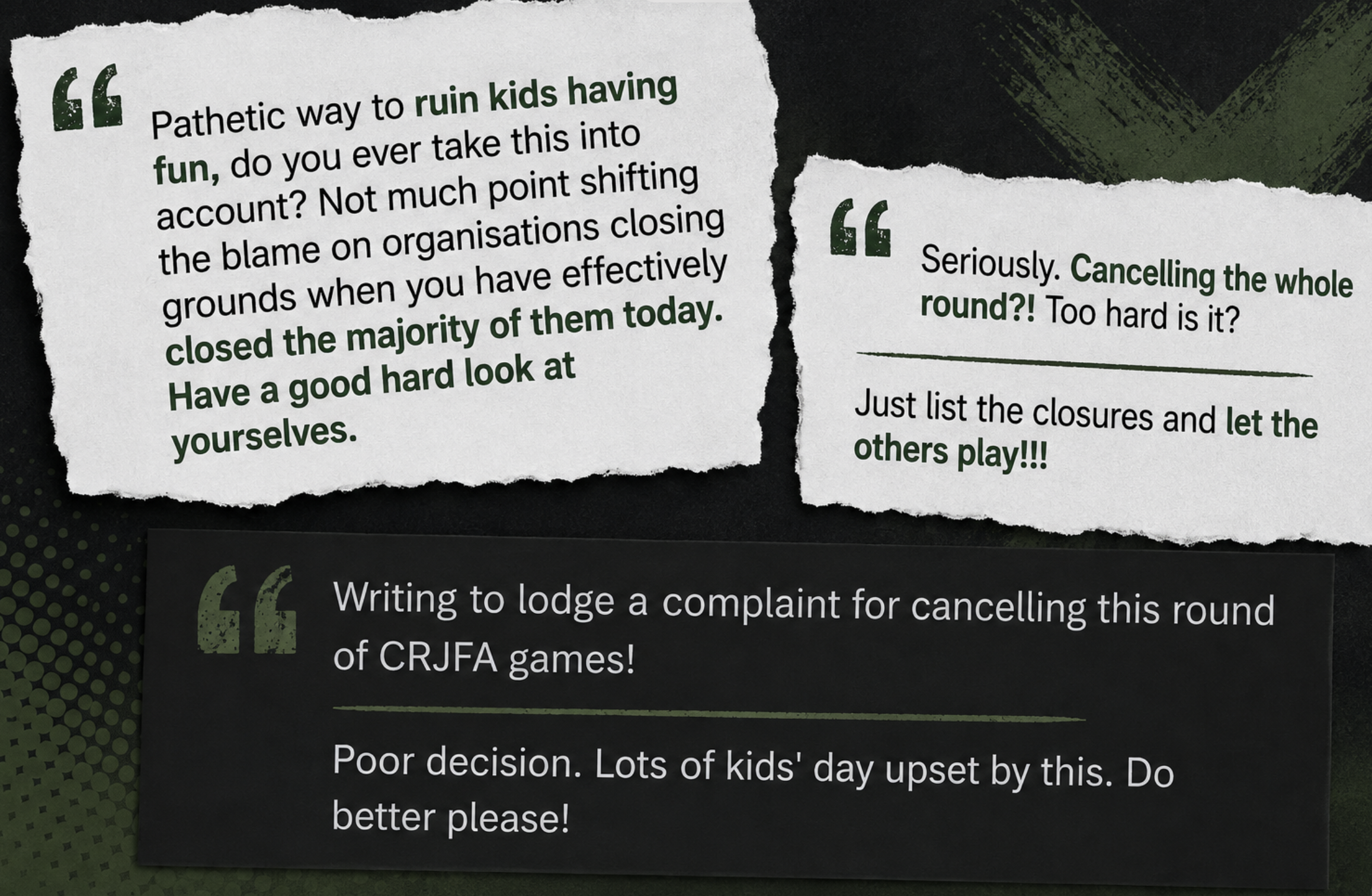
Some angry.
Some abusive.
Many anonymous.
Directed at the people who, hours earlier, had been doing everything possible to get football played.
Social media.
Wow.
To be fair, it was a small number.
But it is always the way.
The squeaky wheels get the most attention.
They are the ones you dwell on.
The ones that make you toss and turn at midnight long after the decision has been made and there is nothing left to do about it.
I also received one beautiful email thanking us.
Most people do not write when they are happy.
A word on timing
Emma and I also watched CRJFA being tagged by would-be local government candidates questioning the decision.
We welcome their interest in junior football.
We would welcome even more strongly their support for the infrastructure that would make mornings like this less damaging.
Better drainage.
More all-weather facilities.
More artificial football surfaces.
Grounds that can cope with a Tasmanian winter.
If local government candidates genuinely want fewer junior football games washed out, there is something tangible to advocate for.
One of those candidates was standing for Kingborough Council.
One of the first ground closures we received that morning came from Kingborough.
Lightwood Park.
Make of that what you will.
We also saw comments on other associations' pages congratulating them for playing on when we had not.
We were pleased for every child who got a game.
But comparisons are not always like-for-like.
CRJFA is managing nearly 4,000 players, around 250 games and more than 40 grounds stretching from North Chigwell to Dover.
When multiple venues begin closing across a competition of that size, the effect compounds very quickly.
What we would ask
Please remember something before directing anger at the people who make these calls.
We are football people through and through.
Emma has young children who were disappointed.
I have a son whose own morning became considerably harder because of the decision we made.
Our ground contractor was standing out in the rain trying to save pitches.
Two of us were sitting with phones and laptops trying to keep the competition moving while closures and forfeits arrived faster than we could communicate them.
Nobody wakes up hoping to cancel a weekend of junior football.
Nobody enjoys being the person thousands of families are frustrated with by lunchtime.
We understand the frustration.
We understand the disappointment.
You are entitled to disagree with the decision.
You are entitled to question it.
You are entitled to tell us you think we got it wrong.
But abuse directed at the people trying to deliver junior football is not acceptable.
And if yesterday has started a wider conversation about wet-weather cancellations, good.
Let us have that conversation.
Let us talk about drainage.
Let us talk about artificial surfaces.
Let us talk about the fact that nearly 4,000 children are trying to play every weekend on more than 40 grounds and how vulnerable that competition becomes when prolonged rain hits.
If councils and local government candidates want to help, there is something very real to work on.
Because behind every decision like this are people up before the sun, people standing in the rain checking grounds and two of us on phones and laptops trying desperately to keep football going.
Yesterday, the right call was safety first.
And sometimes doing the right thing still means being the person everyone is angry with.