When the Pathway Breaks
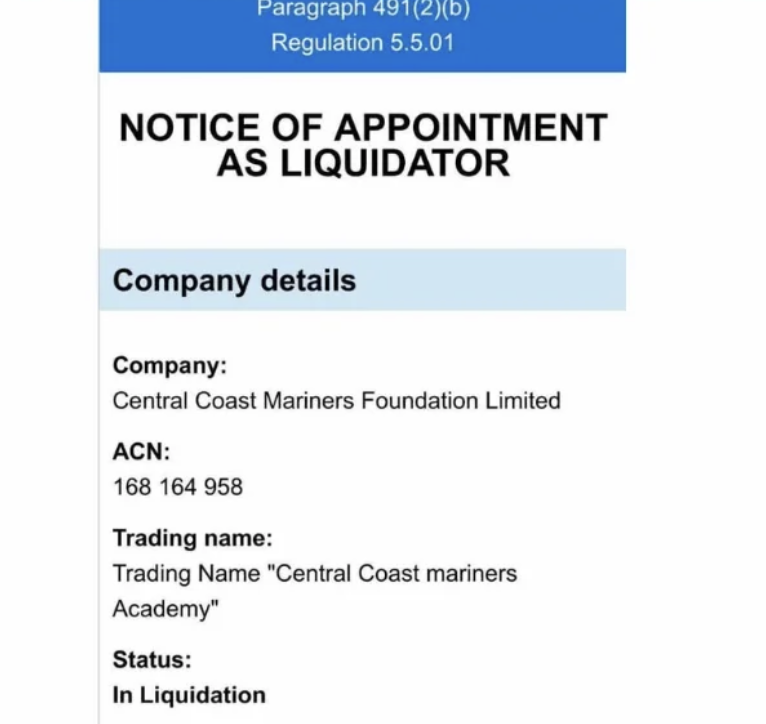
I woke up this morning to the kind of football news that lands like a thud.
Not a result.
Not a rumour.
Not a coaching change.
Administration.
The Central Coast Mariners academy has been placed into liquidation.
Western United has been fighting for its survival.
Two clubs in the A-League system, both shaking at once.
And the story most people will tell is the business story.
Debt.
Governance.
Ownership.
Stability.
Sustainability.
But that isn’t where my mind goes first.
My mind goes to the children.
My mind goes to the parents.
Because they are the ones who live inside the dream.
And when the dream collapses, it doesn’t collapse gently.
The pointy end of the pyramid
Australian football is a pyramid.
Grassroots at the base.
Clubs and associations holding up the middle.
NPL and state leagues building the structure.
And at the top, the A-League.
That pointy end is the dream.
It is the finish line kids can picture.
It is the summit parents cling to when they are driving in the dark to training, packing lunches, paying fees and watching their child give everything.
Academies exist because the dream exists.
They are the bridge between hope and reality.
They are the part of the pyramid that tells children: this could be you.
And for the families who are inside A-League academies, it stops being a concept.
It becomes their life.
Tasmania sits outside the summit
And to be clear, Tasmania doesn’t even have an A-League team.
We are not part of that top layer and realistically won’t be.
So for Tasmanian kids, the pyramid is not just narrow at the top — it is also distant.
The “pointy end” sits across Bass Strait.
It exists in a different weekly ecosystem of eyeballs, metrics and opportunity, where scouts watch, data accumulates and pathways are visible in real time.
Here, we build our football in the margins.
We produce talent and we lose talent.
We ask families to commit and then, if a child is good enough, we often ask them to leave.
That’s the Tasmanian truth.
And it makes the instability at the top of the pyramid even harder to stomach, because the dream already asks more of our kids than it asks of most.
What A-League academy life actually looks like
A-League academy football is not “extra training”.
It is a lifestyle.
It is early mornings, long commutes, gym programs, recovery sessions, injury management, physio, school juggling, fatigue.
It is families rearranging work rosters.
It is holidays planned around football calendars.
It is birthday parties missed.
It is the quiet intensity of teenagers trying to behave like professionals.
And most of all, it is belief.
Belief that it is worth it.
Belief that the system is real.
Belief that the pathway is stable.
Because families don’t commit like this if they think the pyramid can simply fall down.
A note on where I sit in this
I write this fully aware of my own position in the system.
Morton’s Soccer School provides the coaching program for South Hobart and we charge fees, because coaching, grounds, equipment and administration all have real costs.
But philosophy matters.
Our role is not to sell professional dreams to children.
Our role is to help kids love football, train in a quality environment and stay in the game for decades, whatever level they eventually reach.
When the adults fail, the kids pay
Here is the part that is hardest to sit with.
The people running the top of the pyramid are adults.
They make adult decisions.
They take adult risks.
They build business models, chase licences, sign deals, borrow money, spend money.
But the ones exposed when it collapses are not the adults.
It’s the kids.
The academy kid who has built their identity around being “on the pathway”.
The teenager whose confidence rises and falls with selection.
The quiet hard worker who is not the star but is hanging on.
The goalkeeper who knows there are only two positions on the team, and one mistake can erase them.
The parents who have poured years into this.
Time.
Money.
Energy.
Hope.
And then it’s gone.
Not because of performance.
Not because of injury.
Not because they weren’t good enough.
Because the adults above them couldn’t keep the structure standing.
That is a different kind of heartbreak.
I’ve heard what this sounds like from the inside
I know a little about this because my son, Max, has coached in both the Melbourne City and Western United academy systems.
I have heard his stories.
I have listened to the pain and indecision from players who genuinely don’t know what to do.
Because the choices they face aren’t normal football choices.
They are career gambles.
Stay at Western United and risk missing another opportunity somewhere else, but hang on to the professional dream.
Or step back into NPL, find stability, even get paid to play football… but maybe miss the one opportunity that matters.
The one trial.
The one contract.
The one moment when a coach sees you and thinks: yes.
That is the cruelty of it.
Young players are forced to gamble with their own futures.
Not because of their attitude.
Not because they aren’t good enough.
But because the adults above them have built a system where the dream can collapse without warning.
And these are teenagers trying to make adult decisions with no safe answer.
The scramble for 2026
This is the reality nobody says out loud.
Season 2026 is now a scramble.
Families will be chasing alternatives.
Players will be looking for placements.
Parents will be sending messages, making calls, searching for opportunities.
And it won’t be neat.
Because there are only so many spots.
Only so many squads.
Only so many coaches.
Only so many programs.
And when A-League academy players flood into the market, the impact doesn’t stop with them.
It ripples outward.
Kids already in NPL teams may be pushed down.
Some may be pushed out.
Some will lose minutes.
Some will lose confidence.
Some will quietly quit.
Not because they hate football.
But because football has stopped loving them back.
This is what people miss when they talk about “pathway reform”.
It isn’t just the academy kids who get hurt.
It’s every kid underneath them too.
It makes me relieved we don’t have an A-League team and this can’t happen in Tasmania.
The pathway becomes pressure
A-League academies are supposed to develop players.
But at times they also create something else.
Pressure.
Adult pressure, applied to children.
Selection.
De-selection.
Rankings.
Benchmarking.
Constant comparison.
A belief that the next session matters more than joy.
A belief that a child’s value is measurable, sortable, replaceable.
And now, with clubs collapsing and academies destabilised, the pressure becomes heavier.
Because the pathway no longer feels hard.
It feels unsafe.
It feels like the ground can move beneath you even when you are doing everything right.
That is not sport.
That is stress.
These are children
This is where I keep coming back to the simplest truth.
These are children.
Football should be fun.
Not easy.
Not soft.
Not without disappointment.
But fun.
Because fun is what keeps people in the game for decades.
Fun is what creates lifelong players.
Fun is what builds adults who still love football at 30, 40, 50, 60.
And if football is not fun, if football becomes something children dread, something that makes them anxious, something that makes them feel disposable, then we are doing it wrong.
Because children do not have the emotional armour of adults.
They carry their failures differently.
They internalise rejection.
They confuse de-selection with worth.
They mistake a club collapse for personal collapse.
This is why instability at the top is not just a “professional football issue”.
It is a wellbeing issue.
It creates sad children.
And sad children don’t become better players.
They just become children who stop loving the game.
If the pyramid shakes, everyone shakes
When professional clubs wobble, the effect doesn’t stop at the top.
It moves down.
And down.
And down.
It touches every layer.
That is why this matters, even if you have never set foot inside an A-League academy.
Because every junior club, every community ground, every parent who hopes, every kid who dreams, is part of the same pyramid.
And the pyramid is only as strong as its top.
Right now, the top is shaking.
And the ones standing underneath it are the kids.