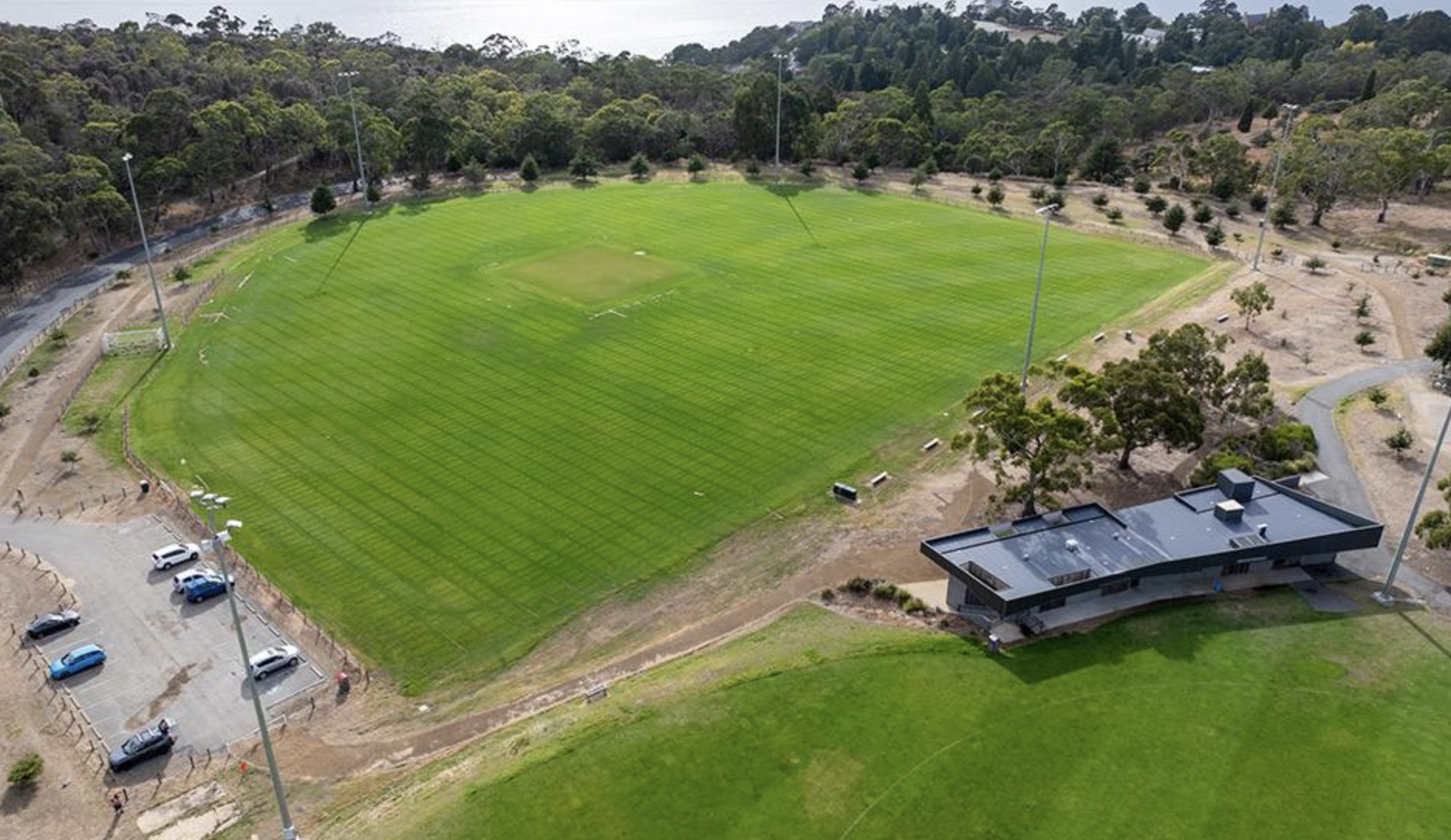
Soldiers Memorial Oval - photo credit City of Hobart
If football is Tasmania's most popular children's team sport, why are we still packing children indoors when the sun comes out?
I had an interesting conversation with a parent at training yesterday.
Nothing unusual. Just one of those conversations you have while watching children running around kicking footballs.
He told me about a friend from Malaysia who couldn't understand why we don't play football all year round in Australia.
Why does football stop for summer?
Good question.
Mind you, Malaysia doesn't have a Tasmanian July.
The more I thought about it, the more I wondered whether we have simply accepted a system that no longer reflects the sports our children actually want to play.
Yesterday we had more than 150 children at training.
It's October. The traditional football season is over. The weather is improving and the children are still turning up in numbers.
So why aren't we playing more football?
Winter football, summer cricket
For as long as I can remember, we've worked to a fairly simple sporting calendar.
Winter belongs to football, Australian rules and rugby.
Summer belongs to cricket and athletics.
Our councils generally allocate their grounds around those traditional seasons.
The City of Hobart, for example, divides its ground bookings into summer, from 1 October to 31 March, and winter, from 1 April to 30 September.
I understand why.
Grounds need maintenance. After a long Tasmanian winter many playing surfaces need repairing, aerating, top-dressing and resting.
I've worked with Hobart and Clarence councils for many years. I know how much effort goes into keeping our grounds playable.
That work matters and it has to happen.
I just wonder whether there's a way for football to share some of that summer space as well.
The children changed. Did the calendar?
Sixty years ago I suspect cricket really was what most Tasmanian children played in summer.
I'd love to show you the figures.
Unfortunately the sort of records I'd like to see simply don't exist before 2000. That's when the ABS first surveyed children's sport properly.
Even then, outdoor soccer was already the most popular organised sport for Australian boys.
By 2003 the Tasmanian figures for boys aged 5 to 14 showed the same thing.
Outdoor soccer: 22.3%
Australian rules football: 21.9%
Outdoor cricket: 12.5%
That was in 2003!
The surveys have changed since then, so the numbers don't line up exactly. But the trend is hard to miss.
Councils have done a great deal in that time. We have more rectangular pitches, better lighting and some synthetic surfaces.
The seasonal calendar is the one thing that has stayed much the same.
That isn't anyone's fault. It's simply how sport in Australia has always been organised.
Perhaps it's time we all had a fresh look at it.
Let's look at the numbers
It's very easy for those of us in football to say our sport needs more grounds, more facilities and more investment.
Every sport does it.
Yes, I'm a football person. I've been involved for more than 20 years. So check my numbers.
Rather than simply arguing our own case, let's look at what children are actually playing.
Figures quoted in the Tasmanian Parliament in April 2025 came from AusPlay, the Australian Sports Commission's national participation survey.
For children aged 0 to 14, AusPlay counts organised sport outside school hours, as reported by their parents.
Among Tasmanian children:
Soccer: 12.5%
Gymnastics: 10.9%
Basketball: 10.6%
Australian rules football: 9%
Netball: 5.9%
Cricket: 2.7%
Football's participation rate is more than four times that of cricket.
Before the cricket community comes after me, I'm not suggesting cricket shouldn't have grounds.
Of course it should.
These are community facilities. It's worth thinking about whether the way we all use them reflects what children are playing now.
Football Australia's 2025 participation report recorded 15,193 outdoor football participants in Tasmania.
The much larger figure of 41,395 includes futsal, schools, community programs and other football activities.
That's an important difference.
It applies to cricket too.
When is a participant a participant?
Cricket Tasmania's 2024–25 annual report recorded 4,888 children in Woolworths Cricket Blast, up 32% on the previous year.
That's terrific. Getting children into sport is something we should all celebrate.
The report also tells us more than 15,000 school students took part in Hurricanes Blast promotional sessions.
A child trying cricket during a school visit isn't the same as a child registered with a club, training each week and playing matches.
Both are worthwhile. They're just different things.
Football has to be just as careful. A child at a school football clinic isn't a registered club player either.
In fairness to cricket, AusPlay counts Cricket Blast but not school sessions. So that 2.7% isn't short-changing cricket.
If we're comparing demand for grounds, we need to compare like with like.
Registered players.
Teams.
Matches.
Hours of use.
Those numbers would tell us much more.
Twenty-two cricketers or hundreds of footballers?
Think about this.
A traditional cricket match involves 22 players and can occupy an entire oval for much of the day.
A turf wicket also needs a lot of specialist care. Preparation, watering, mowing, rolling and ongoing maintenance.
All perfectly understandable.
But imagine dividing a similar sized ground into four small-sided football pitches.
Four 7v7 matches running at once would have 56 children playing.
Run six rounds across the day and you have 336 player appearances.
One ground. One day.
Even if you count hours rather than heads, the gap is still there.
A full day of cricket gives 22 players around six hours each. That's about 130 player-hours.
Six rounds of 50-minute small-sided games gives around 280.
More than double, on the same piece of land.
Before anyone starts measuring their local cricket oval, this is a theoretical example!
Grounds come in different shapes and sizes, pitches need safe run-off areas and some surfaces won't cope with that sort of use.
Cricket grounds aren't sitting idle during the week either. There's training, junior programs and other activities.
But it does make you think about how many children could enjoy the same piece of public land.
Perhaps participant numbers and hours of use could be part of the conversation.
Waiting for the bookings
Anyone who runs a club or association knows the time of year.
You've put in your ground requests.
Then you wait.
Will the council be able to give us what we asked for?
It's a stressful few weeks. Grounds mean everything to sporting clubs and associations. Without them there is no competition, no training and no season.
It's one reason I've always made sure our ground hire is paid promptly and in full.
Councils have a hard job fitting everyone in. Every sport wants the best grounds at the best times.
In winter football is played on grounds right across the south.
In summer it's a very different story.
Only a few grounds are still available to us.
Could more grounds be shared between sports?
Could a few grounds reopen after a suitable rest following winter renovations?
I suspect there are opportunities if we look closely enough.
Why not multi sport usage?
Councils have already worked hard on better surfaces. Hybrid turf, synthetic pitches and improved drainage have all helped.
The challenge in summer is the wicket in the middle of the ground.
So why not play around it?
On a large oval the centre square could be fenced off and protected. Small-sided pitches could be marked out on the outfield around it.
Cricket would still have its wicket. Football would have somewhere to play.
It could help councils too. Dual use means more bookings and more ground hire from facilities they are already maintaining.
Brighton Council has already been looking at how Thompson Oval could be used year-round, while also recognising junior cricket's need for its pitch.
So councils are already thinking about this.
And then there's futsal!
This one puzzles me.
We spend our winter playing outdoor football in freezing temperatures, driving rain and sometimes appalling conditions.
In June the sun sets in Hobart before quarter to five. Plenty of our children train in the dark.
Then summer arrives.
Hobart has the longest summer days of any Australian capital. More than 15 hours of daylight in December, with the sun still up at nearly nine o'clock in early January.
So what do we do?
We move the children indoors to play futsal!
Don't misunderstand me. I like futsal. It's a terrific game for developing technical skills, quick thinking and decision-making.
Plenty of children really enjoy it.
I'm also old enough to remember rebound indoor soccer.
The ball came off the walls, the seats and sometimes even the roof. It hardly ever stopped.
Non-stop football.
I loved it.
But wouldn't it be wonderful to offer more outdoor football on those long spring and summer evenings as well?
Small-sided games. 5v5, 7v7 or 9v9.
Short competitions, perhaps eight or ten weeks, with plenty of touches on the ball and less commitment than a full winter season.
This isn't about replacing futsal.
Children could still play futsal, cricket, basketball or whatever else they enjoy.
Nobody is suggesting every child should play football twelve months of the year.
But surely we could give those who want to play the chance?
We could organise it. We just need somewhere to play.
As President of the Central Region Junior Football Association, I know what it takes to run junior football.
During winter we coordinate around 250 matches across more than 40 grounds every weekend, involving about 4,000 children.
I would love to see us offer more football outside the traditional winter season.
We have the experience.
We have the structure.
Judging by the number of children still at training in October, there's plenty of enthusiasm.
What we don't have is the ground space.
Imagine if we could find just a handful of suitable grounds across Hobart, Clarence, Glenorchy, Kingborough and Brighton for a summer small-sided competition.
We wouldn't need dozens of grounds.
Even a small pilot competition would be a start.
I don't know all the answers.
But I think they're questions worth asking.
Planning for tomorrow
It would be wonderful to see sports and councils sit down together with real numbers.
Registered players, teams, matches and hours of ground use.
Not to take anything away from cricket or any other sport.
It isn't just football either. Basketball has its own problems finding court time. Other sports will have similar stories.
Sport has changed a lot over the past few decades.
Children's interests have changed.
Participation has changed.
I keep coming back to that conversation at training.
His Malaysian friend couldn't understand why we don't play football all year round.
It sounded like an innocent question.
I think it was a very good one.
If we were starting from scratch today, knowing what we know about sporting participation, would we organise our grounds and sporting seasons exactly the same way?
I'm not so sure we would.