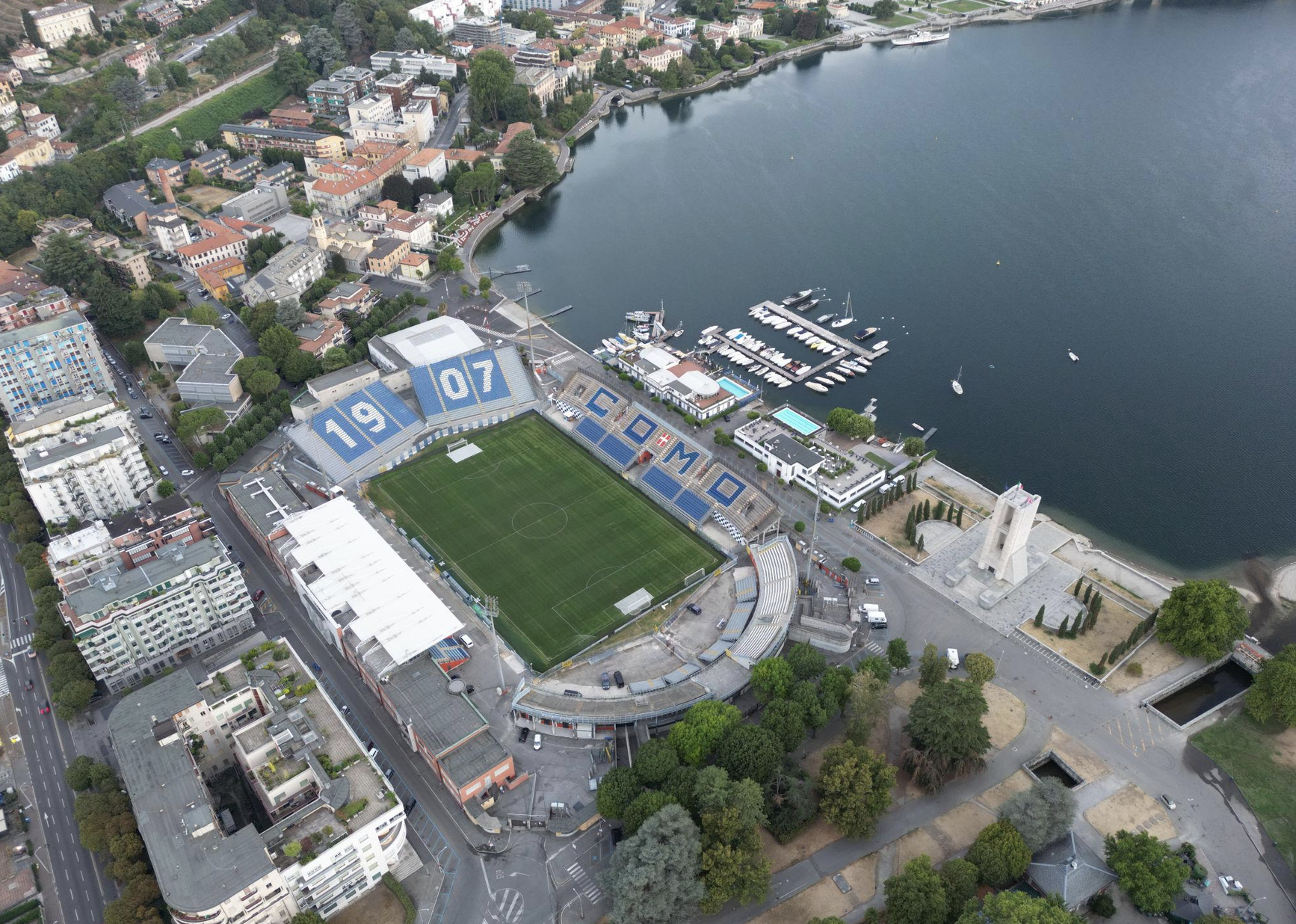
The Stadio Giuseppe Sinigaglia, nestled between the mountains and Lake Como. Almost a century old, undergoing a transformation and now hosting Champions League football. Not a bad view for a city of just 84,000 people.
From Fergie time to Lake Como. One club has George Clooney, a beautiful lake and a football plan. The other has 20 English league titles and a very expensive identity crisis.
Well, well, well.
It's just before five in the morning in Hobart and I'm watching Manchester United being given a football lesson by Como.
Yes, Como.
The little Italian club from the shores of one of the most beautiful lakes in the world. The place where George Clooney has a villa, the rich and famous arrive by boat and apparently someone has remembered how to run a football club.
Final score?
Como 4, Manchester United 1.
United grabbed a goal back in stoppage time.
No great celebration. Just a sigh and a shrug.
A consolation goal that consoled absolutely nobody.
Somewhere, Sir Alex Ferguson must be shaking his head.
And I have to admit, I'm feeling a little nostalgic.
When we used to set the alarm for United
When I first met Ken in 2007, we would set the alarm to get up in the middle of the night to watch Manchester United.
Ken signed for United on his 15th birthday. Sir Matt Busby was the manager and Jimmy Murphy the first team coach. He was part of the second wave of Busby Babes.
So this was never just another team in our house.
Living in Hobart, following English football requires a certain level of commitment. Particularly when you have to climb out of a warm bed at some ridiculous hour.
But back then, it was worth it.
What a team.
Cristiano Ronaldo, Wayne Rooney, Carlos Tevez, Paul Scholes, Ryan Giggs, Michael Carrick, Rio Ferdinand, Nemanja Vidić, Patrice Evra and Edwin van der Sar.
And of course, Sir Alex Ferguson.
How could I forget David Beckham? He had left for Real Madrid in 2003, but he was such an important part of the United era I loved. Those wonderful crosses. Those free kicks.
In 2008, United won the Premier League and Champions League double.
They were magnificent.
Then there was Dimitar Berbatov, who arrived later that year.
Oh, how I loved watching that man play football.
Silky smooth with an exquisite first touch. He seemed to operate at an entirely different speed from everyone around him.
While others ran around at a hundred miles an hour, Berbatov appeared to have all the time in the world.
He didn't so much control a football as persuade it to do exactly what he wanted.
Football can be beautiful. Berbatov was proof.
You didn't just watch United hoping they would win. You expected them to win.
Even when they were behind with five minutes remaining, you still expected something extraordinary to happen.
Fergie time.
Those were the days.
When the money men arrived
The Glazer family took control of Manchester United in 2005. The takeover was financed through substantial borrowing that left the club carrying enormous debt.
But Ferguson kept winning.
Perhaps that was part of the problem.
As long as the trophies kept arriving, it was easier to overlook the questions about ownership, debt and the direction of the club.
Then in 2013, Ferguson retired.
David Gill, the chief executive who had worked alongside him, also departed.
United had just won their 20th English league title.
Suddenly two of the most influential people in the organisation were gone.
What followed has been 13 years of managers, expensive experiments, questionable recruitment and endless promises of a new beginning.
What a procession of managers it has been.
David Moyes. Ryan Giggs. Louis van Gaal. José Mourinho. Ole Gunnar Solskjær. Michael Carrick. Ralf Rangnick. Erik ten Hag. Ruud van Nistelrooy. Ruben Amorim. Darren Fletcher. And now Michael Carrick again.
Twelve managerial appointments or spells, counting the caretakers and Carrick's two periods in charge.
Some excellent football people among them.
Yet the same fundamental problems keep reappearing.
The Glazers remained. Sir Jim Ratcliffe and INEOS eventually arrived to take responsibility for football operations.
Still the rebuilding continues.
Perhaps Ferguson was so good that he disguised the weaknesses of the organisation around him.
Once he left, there was nowhere to hide.
Dining out on past glories
To be fair, last season looked brighter.
Carrick took over in January, won 11 of his 16 matches and guided United to third place. Back into the Champions League. He was given the job permanently.
For a moment, it looked like the corner had been turned.
This morning suggested otherwise.
Because for too long Manchester United have been dining out on their past reputation.
There. I've said it.
They still have the global following, the famous red shirts, the commercial deals and Old Trafford.
Ah yes, Old Trafford.
The Theatre of Dreams.
Or perhaps these days, the Theatre of Leaks.
The stadium is tired. The roof has leaked spectacularly, with water cascading onto the seating during heavy rain.
For years the club has spent enormous amounts of money on players while one of the most famous football grounds in the world has visibly deteriorated.
There's something symbolic about that.
The roof leaks, the recruitment leaks money and the football leaks goals.
But the commercial machine keeps turning.
United have spent fortunes on players. Some were superstars. Some were ageing stars. Some presumably looked like stars on somebody's computer.
The result has been remarkably consistent.
Another rebuild.
You can only blame so many managers before someone needs to look at the people making the decisions.
To supporters, it must sometimes feel as though their beloved football club has become little more than a cash cow.
A very famous cash cow, admittedly.
One with a museum full of trophies.
But a cash cow nonetheless.
We didn't get out of bed in Hobart to admire Manchester United's balance sheet.
We got out of bed to watch football.
Wonderful football.
Somewhere along the way, United seem to have forgotten that.
Meanwhile, beside a beautiful Italian lake
Como 1907, as the name suggests, were founded in 1907.
The city of Como has a population of around 84,000 people. It's in northern Italy, close to the Swiss border and about 50 kilometres from Milan.
A beautiful little city, famous for its lake, its mountains, its magnificent villas and of course George Clooney.
Not exactly the first place you'd expect to find a club giving Manchester United a football lesson.
Como 1907 are the city's major professional football club.
Just down the road are two giants of European football, AC Milan and Inter Milan.
Imagine trying to establish yourself in that neighbourhood.
Como's history has been anything but glamorous.
Financial collapse in 2004. Another bankruptcy in 2016. By 2017 a successor club was starting again in Serie D, Italy's fourth tier.
A football institution with more than a century of history, rebuilding from the bottom.
Then in 2019, Indonesian billionaire investors associated with the Hartono family arrived.
Unlike the endless rebuilding at Old Trafford, Como began putting together a football operation with a recognisable plan.
In 2022 Cesc Fàbregas arrived as a player and investor. Thierry Henry also became a minority shareholder.
Fàbregas moved into coaching and has become central to the club's development.
In 2024 Como returned to Serie A after 21 years away.
Last season they finished fourth and qualified for the Champions League for the first time in their history.
From Serie D to Europe's biggest club competition in seven years.
Extraordinary.
Let's not pretend this is a romantic tale of a penniless little club taking on the establishment.
Como's owners are billionaires.
Serious billionaires.
But they appear to have understood that having money and knowing how to run a football club are two entirely different things.
Someone might like to explain that to Manchester United.
A football ground to fall in love with
Then there's the stadium.
The Stadio Giuseppe Sinigaglia opened in 1927 and sits right beside Lake Como.
Mountains in the background. Water almost on the doorstep. One of the most picturesque settings for a football ground anywhere in the world.
Forget the enormous concrete structures of modern European football.
This holds about 12,000 people. It's intimate, historic and wonderfully located.
Yes, it is being upgraded.
Improvements to the stands and facilities have been needed for top-flight football and UEFA requirements.
A larger redevelopment is planned, with the club working alongside the municipality and architects Populous.
I hope they don't lose what makes the place so special.
Football grounds should have character.
They should belong to their communities.
This one certainly does.
Consider the scale.
The entire city of Como has a population not much greater than the capacity of Old Trafford.
Yet here they are, competing on the same European stage.
One club is investing in the future of its historic lakeside home.
The other has spent years explaining why the roof leaks.
The best seats in the house
This is my favourite part of the Como story.
For the club's first ever Champions League match against RB Leipzig in September, president Mirwan Suwarso and several directors gave up their own seats.
They went to supporters born in 1950 or earlier.
How wonderful is that?
Not the corporate sponsors.
Not the wealthy directors.
The people who had followed Como through bankruptcies, relegations and years in the lower divisions.
Imagine being one of those supporters.
Watching your club almost disappear. Starting again in the fourth division. Turning up year after year because that's what football supporters do.
Then finding yourself in the directors' seats watching Champions League football.
Como won that night 4-1.
The same score as this morning.
I absolutely love it.
It says something about what a football club should be.
Not simply a commercial enterprise or an investment opportunity.
A community.
A history.
A place where generations of people have given their time, their money and their emotions.
Sometimes, just sometimes, those people should get the best seats in the house.
George Clooney and the beautiful game
Como have another useful asset.
Lake Como itself.
It's not exactly a difficult destination to promote.
The club has embraced the glamour with fashion partnerships, luxury hospitality and a brand that reaches well beyond football.
Even the merchandise looks like something you might wear to lunch at an expensive lakeside restaurant.
But beneath the glamour is a football team that looks like it knows what it's doing.
A revolutionary concept, apparently.
Perhaps United's executives should stay a few extra days.
Enjoy the scenery. Have a nice meal. Take a boat trip.
They might even bump into George Clooney.
He could offer a few tips on putting together a successful cast.
After all, Manchester United have spent fortunes trying to do exactly that.
The difference is that Clooney's productions generally have a script.
How the mighty have fallen
Here I am in Hobart, almost 20 years after Ken and I first started setting our alarms to watch Manchester United.
Still getting up in the middle of the night.
Only now I'm watching a club that was playing fourth division football in 2019 give them a football lesson.
There's another irony.
Michael Carrick played in that magnificent United team we watched in 2008. Now he's the manager trying to put the pieces back together.
I wonder whether he ever looks back and thinks about what made that team so special.
Whatever it was, Manchester United seem to have misplaced it.
Along with an extraordinary amount of money.
This morning, deep into stoppage time, United finally scored.
Four-one.
No wild celebration. No sense of a comeback. Just a sigh and a shrug.
I remember a time when a Manchester United goal that late could make you jump out of your chair.
This morning, it barely raised an eyebrow.
On the final whistle I turned to Ken.
"How does it make you feel?"
"Sad," he said. "I think I'll concentrate on golf. There's more joy in seeing the ball drop in the hole at the moment."
A former Busby Babe reduced to depression.
Of course, he doesn't mean it.
He will keep watching.
And he will keep being depressed by what he's witnessing.
How the mighty have fallen.
And how wonderful to see someone else rise.