Conditional Multiculturalism
Multicultural Round, Conditional Belonging
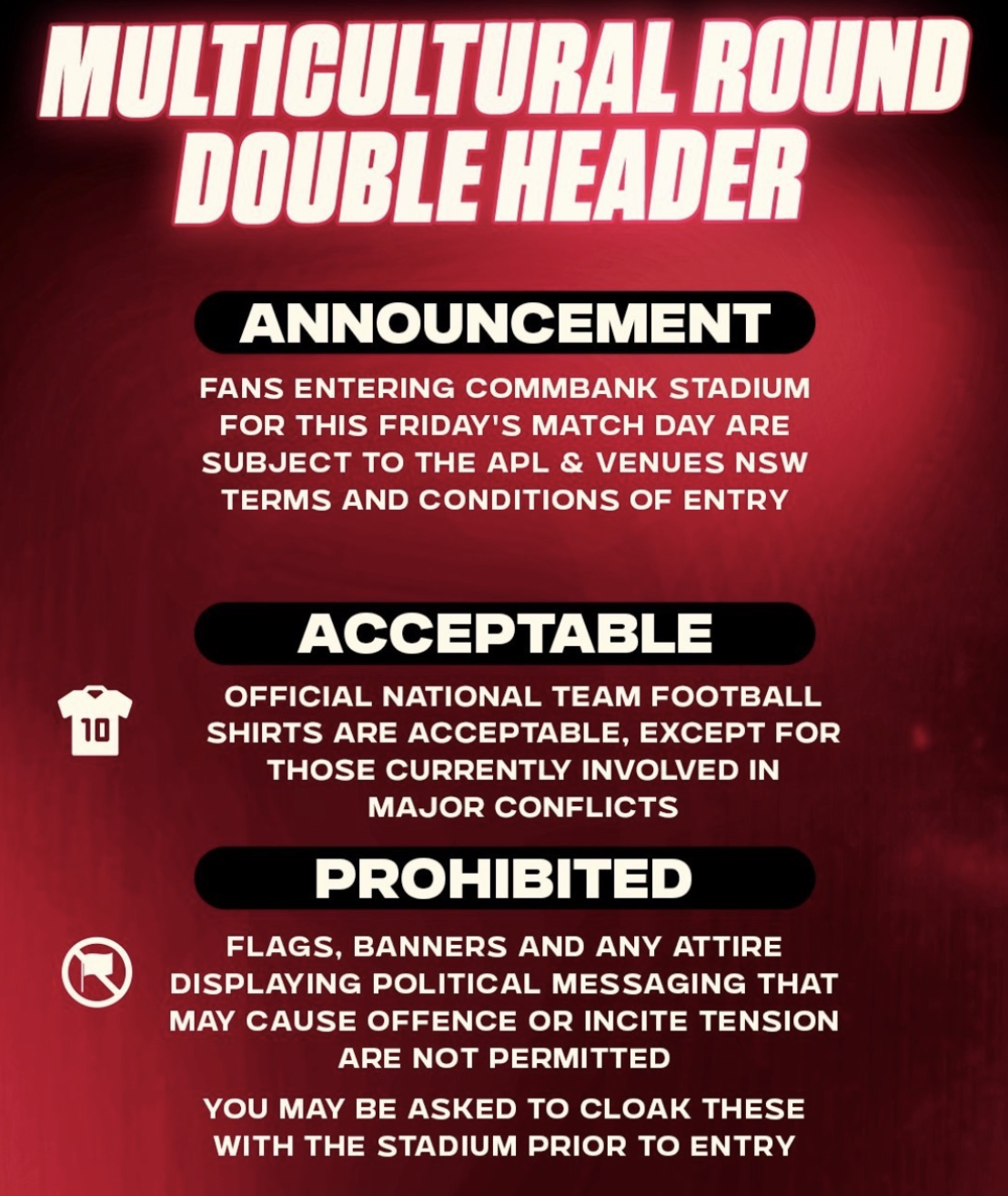
There was an announcement this week ahead of the A-League Multicultural Round.
For clarity, the A-League is operated by the Australian Professional Leagues, commonly referred to as the APL, the body responsible for managing the men’s and women’s professional competitions in Australia.
The announcement stated that national team shirts are acceptable.
Except for those “currently involved in major conflicts.”
Flags, banners and political messaging are prohibited.
On the surface, that sounds administrative.
In practice, it raises a simple question.
Who decides at the gate?
Who determines what qualifies as a “major conflict”?
On what date?
Using what list?
And who briefs the 19-year-old casual security guard tasked with enforcing it?
There are dozens of ongoing armed conflicts globally at any moment. Some involve internationally recognised wars. Others are regional, civil or long-running disputes. Who decides which ones are “major”? And on what basis?
Football policy only works if it can be lived.
If it cannot be clearly explained, consistently applied and calmly enforced at a turnstile, it is not good policy. It is theory.
This matters even more during Multicultural Round.
Because multicultural football in Australia is not a marketing concept.
It is the foundation of the game.
We Have Been Here Before
When the A-League was formed in 2004–05 under the old Football Federation Australia, one of its guiding principles was a clean break from explicitly ethnic club identities.
The intent was commercial neutrality.
Broader appeal.
Modern branding.
A new national start.
Names were softened.
Symbols were neutralised.
Heritage was repositioned.
Historic migrant clubs continued in the state systems, carrying their identity with them.
That reset may have been strategic.
But identity does not disappear because a governance document prefers it to.
Greek, Croatian, Italian, Macedonian, Serbian, Hungarian and Turkish communities built Australian football. That is not controversial. That is history.
So when a league now announces that certain national team shirts may not be acceptable because of “major conflicts,” it touches a long and sensitive seam.
Not because people want division.
But because football identity in this country has always been intertwined with migration and belonging.
Identity Is Not Automatically Political
If the concern is political messaging, say that clearly.
Political slogans.
Explicit protest material.
Incitement.
Those are enforceable categories.
But a national team shirt is not automatically a political statement.
For many families it represents:
Heritage.
Memory.
Parents and grandparents.
A connection to somewhere else.
Multicultural Round should be the safest place in the calendar for that expression.
Instead, the announcement introduces uncertainty.
It blurs identity with geopolitics.
And it outsources judgement to frontline staff who should never be asked to adjudicate global conflict at a stadium gate.
Governance Is in the Detail
Good policy is:
Clear.
Enforceable.
Fair.
Consistent.
If you cannot explain it in one sentence without qualifiers, it will fracture in practice.
If you cannot train gate staff to apply it calmly and uniformly, it will create embarrassment.
If you cannot define the terms publicly, it will create suspicion.
Multiculturalism is not conditional belonging.
It cannot be “celebrate your identity, unless we have quietly decided it is complicated.”
Football in Australia has always wrestled with the tension between commercial neutrality and migrant heritage.
Each time we try to administratively tidy identity, it reappears in another form.
Because it is lived, not theoretical.
If the aim is safety, explain the criteria transparently.
If the aim is political neutrality, enforce that consistently.
But do not write a rule that sounds reasonable in a boardroom and becomes unworkable at the turnstile.
Multicultural Round deserves better than ambiguity.
So do the people who built this game.