Danny Linger - The Accidental Football President
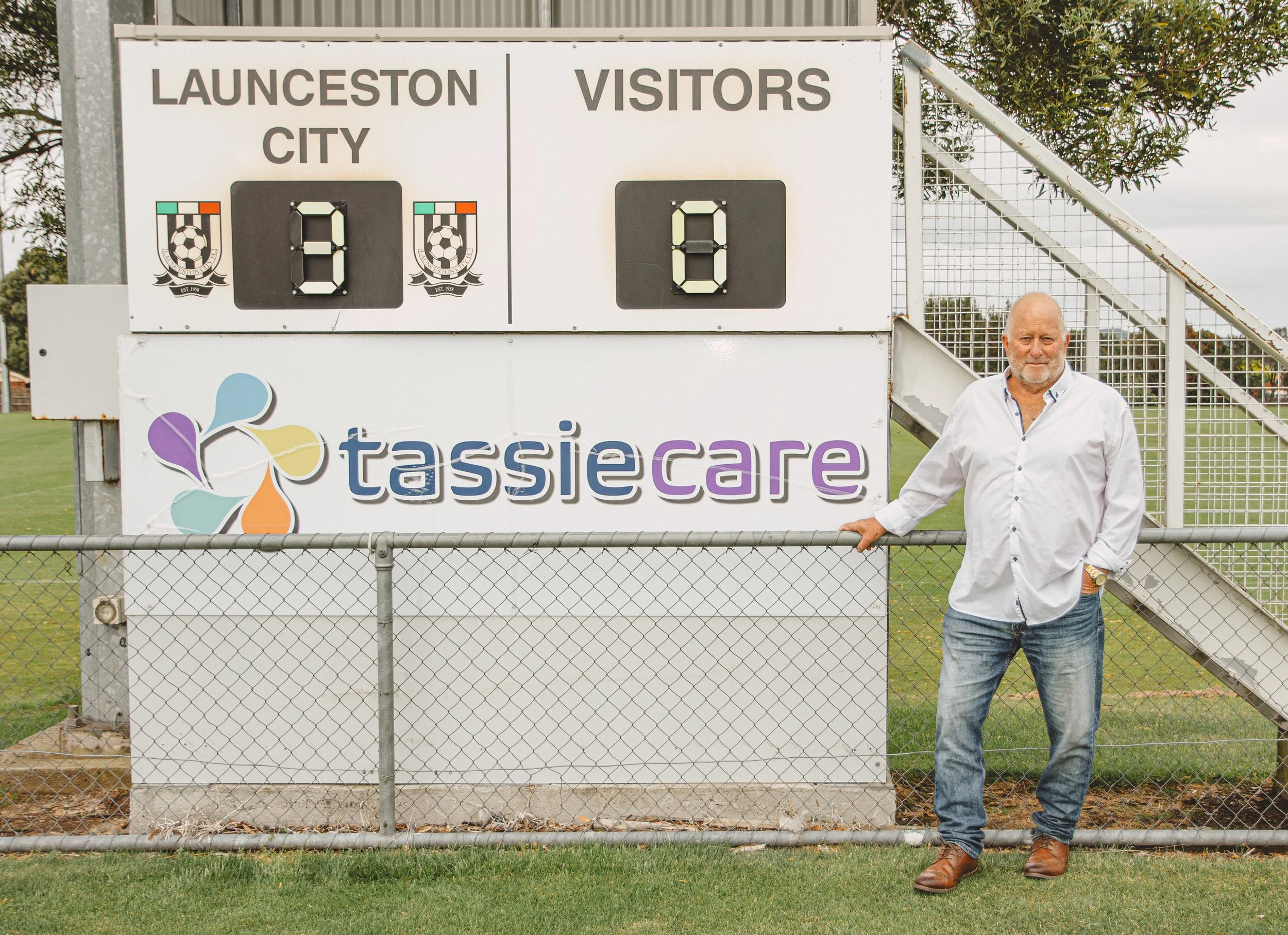
Danny Linger photographed by Nikki Long
Community football in Tasmania runs on volunteers who often arrive as parents, then slowly find themselves carrying whole clubs. Danny Linger, President of Launceston City FC, is one of those people. His story is practical, personal and at times blunt, especially when it comes to the demands placed on Tasmanian clubs and the gap between national expectations and local realities.
How Danny found football
Danny’s first involvement in football was not as a player or a coach.
It was as a parent.
When his son Jarrod started playing with his mates from school, Danny found himself at the sideline. He thinks it was around 2006, although he says he should check. Football, still referred to as soccer across most of the country, was not his first choice. He is more aligned to motorsport. But he could see the benefits of a “non-contact” sport and he jokes that it was probably more the mums who liked that part.
What struck him early was how enjoyable it was for all participants, even the parents. He remembers the smiles on those little faces and says that alone was reward enough.
In those early days he even thought it was great to get an early game on a Saturday at Churchill Park, because it left the rest of the weekend free to do all manner of other activities.
Little did he know that would soon change once they moved into senior football.
From there, joining Westside Devils felt natural. It was the power of numbers, all the boys from school joining the same club. For those not in the know, Westside Devils Junior Football Club was the junior feeder club to Launceston City FC, the senior counterpart based out of Prospect Vale Park.
Danny says he feels very fortunate and extremely proud that circumstances ensured he became part of such a fantastic club.
Why he still shows up
Jarrod has long since moved on with his life in Queensland but Danny is still deeply involved.
He says the question of why he keeps doing it could involve a very long winded and in-depth answer, but he tries to keep it as concise as he can. After working so many hours at all manner of tasks and club positions, he says the real answer is a sense of social responsibility to do as much as he can in this space.
Even now, he gets a huge amount of satisfaction seeing all the juniors running around in their treasured City tops each week. Whether that is normal team training or as part of the Juventus Academy, he says it really is a great sight.
He takes great pride in seeing junior and youth players develop into genuine respectful adults. Regardless of whether they continue in the sport or not, he says if that is all they achieve then they have succeeded.
The second part of the answer, he says, is a determination to continue developing the facilities.
He is careful here. He says his next comment is not intended to upset any other clubs because everyone has a passion for their own home base, but he firmly believes that, in general terms at least, Prospect Vale Park is right up there with any other football facility in the state, at least on field.
The pitches and the overall available space are right up there.
Off field, he says, they are lacking. Things are moving, but as everyone knows it is a slow burn and they need to keep pushing for what they deserve. With almost 900 members, he says four change rooms just do not cut it.
He says it has been a long road, but they are slowly making ground. They have also worked very hard to build relationships with major partners, mainly The Australian Italian Club and Meander Valley Council.
What a club President actually does
Danny says his day-to-day tasks have changed over time.
In the early days he was setting up on game day, acting as NPL team manager, something he says he really enjoyed, driving the bus and generally communicating with members, Football Tasmania and council.
During COVID, he describes it as a big year, with many early mornings trying to produce all manner of documents so everyone could get back on the park. He says he was exhausted after that.
In later years he says he has mainly dealt with infrastructure, senior committee matters and of course the various NPL regulatory requirements.
He does not think he would be too different from many other volunteers, but he believes most people outside club management would be shocked at how many hours volunteers dedicate to their club, to the point of it almost being a second job. He points to volunteers who are at the club multiple times per week to ensure everything is clean, tidy and runs smoothly on game day.
His message is straightforward.
Do not sit back and think it all just happens.
Roll up your sleeves and help, even if it is only for an hour.
You might actually enjoy it.
The hardest part nobody sees
Danny says straight up that volunteers do not do this for any accolades or thanks.
That is not it at all.
In saying that, he says it is nice to hear compliments instead of complaints, but at the end of the day they do the best they can with the time they have available, they really do try.
He often admits they do not always get it right, but he says the column with the ticks is much longer than the one with the crosses. They do make a difference.
He says the hardest part is not having enough time and energy to devote to getting things done. He always feels there is more to do and so little time to make it happen. He says it can be frustrating getting bogged down in official red tape.
Standards he will not compromise on
Danny says that in the last few years the club has really developed its management structure, especially since the amalgamation with the junior club back in 2019.
They are always aiming for best practice in all areas and he says they are proud of their work in achieving national Club Changer accreditation and all the work that went into it. He says the recognition from Football Australia reflects that work.
If he has to pick a standard that is non-negotiable, he says it is their child protection framework, ensuring they value and protect their junior members.
That is something, he says, they cannot and will not compromise.
How do you balance being welcoming and inclusive with lifting standards and performance?”
Danny says this is a very difficult question and he is not sure he can answer it without writing a novel.
He points to the scale. More than 70 teams, from U6 to WSL to NPL.
He says they have highly valued and smart professionals working at the club, much smarter than him, and each person makes a commitment to ensure the club aligns to its values without compromise.
What junior football should be about
Danny says his view is probably already evident.
He believes junior football should be about developing respectful well-balanced adults.
To some degree the rest is secondary.
By the time players get to senior football, he says winning becomes part of life and something they strive for each day.
The biggest structural weakness in Tasmanian development
Danny is blunt.
An 18-game senior NPL roster.
He says it is embarrassing.
He asks how this happened. He asks how Tasmania can possibly expect to develop and compete on the national stage when the competition is so short. He acknowledges finals exist, but he points out not all clubs will reap any benefit from those extra games.
He then compares it to other states. He says NPL Victoria plays a roster of 26 games while NPL New South Wales ends up with a 30-game roster, and he asks you to check that.
The true cost of facilities
Danny explains that Launceston City is in a unique position.
The club facilities are located on private land they lease, while the pitches are owned by Meander Valley Council. The location brings certain advantages, but it also carries a huge burden as they develop their infrastructure.
He says they are extremely grateful to council for the work they have done and continue to undertake to develop the on-field facilities, but as the club increases its investment off field it comes at a cost, and he suggests asking the finance department.
He says they are starting to see an increase in external entities wishing to utilise Prospect Vale Park, which is exciting, but to make the most of those opportunities they need to invest even more money.
His wish is to finish stage 2 of their development, but he fears that is a long way off and the cost is growing each year.
Where clubs are carrying too much
Danny laughs and says, oh boy, this is a good one.
He says the short answer is he finds it incredible that in a state of a little over 550,000 people, about the same as the population of the Gold Coast for instance, clubs are expected to meet the same criteria as every other NPL club in the country.
He says some of this has meant clubs have stepped up and improved, but when clubs are expected to meet the same infrastructure requirements as mainland NPL clubs, he feels it goes too far. There is just not the money available to invest.
He says certain entities forget they are all volunteers working their butts off just to put teams on the park. At the end of the day, he says it is the volunteer clubs that have the most to lose financially, and they are not given enough credit for all that hard work.
If Football Tasmania handed him the pen
Danny’s answer is short and sharp.
Listen and engage with your stakeholders.
Do not just nod and smile.
Actually act on the feedback provided by the major stakeholders, and he says he does not mean cherry pick what suits a pre-set agenda.
He says between the clubs across the state, the level of expertise available is immense, something any national organisation would cherish, yet he does not feel it is tapped into too wisely.
The best decision he made, and what he would do differently
Without doubt, Danny says the best decision would be pushing ahead with the junior and senior amalgamation in 2019.
He says it had been spoken about for some time, and the opportunity arose due to the senior club needing to update its 40-year-old constitution and the fact the junior club did not have one at all.
He says they discussed it with the junior committee, and then Alex Aylott, Junior President at the time, and Danny exchanged letters of intent. They worked at it during that year and took it to a Special General Meeting.
He says it was almost an anticlimax with a unanimous vote, but it was a great feeling to finally get it done.
Since then, he says, the club has gone from strength to strength. They have a board in place overseeing various committees and he says it seems to be working well.
He is careful to add they would not be where they are today without the commitment of previous committees. He does not want to take away from what people did over the years to establish the club in the first place.
On regret, he says he is not sure there is anything in particular. He says maybe over the years he could have spent less time on the day-to-day stuff and concentrated on moving the club forward, but it is not really a regret as such.
The brutally honest message to councils and government
Danny says football is here.
Football is growing.
And it is not about the shape of the ball.
He says football deserves better and government and councils should come along for the ride, not sit back and watch.
He adds, and remember, we vote too.
If he stepped away tomorrow
Danny says the club is currently undertaking refurbishment of nearly 50-year-old original change rooms thanks to a Federal Grant on the back of Play Our Way funding.
Construction is due for completion around April, but it still only gives them four individual change rooms. For a club of their size, with both male and female teams, he says they really need at least six, along with the additional storage that comes with that.
He says he is proud of the Peter Mies Pavilion, but they still need another $2 to $3 million to complete the development. He jokes that other than selling kidneys on the black market, he is not sure when or how they can gain that funding, and says they will just keep pushing.
He says council is working on an upgrade to their access off Westbury Road and they are collaborating on a lighting upgrade that is long overdue.
Watch this space, he says.
Finish this sentence honestly
Tasmanian football won’t truly improve until we actually come together as one.
Danny says that means grass roots, clubs and all participants have a voice that is heard, actually listened to and given a real chance to collaborate on the future of the sport. That voice needs to be clearly heard and understood from all key bodies.
Football Tasmania, Football Australia, and most of all politicians.
He says they should be seen all year round at games and events and collaborate to enrich the game, participation and the lives of young people. He says he does not mean show up when it is convenient, he means actually listen and act to make change.
He says they do not want to just see politicians at election time, although to be fair there are some that show up more than just every three years and that is appreciated. They know who they are.
He then returns to governing bodies. They say they are consulting and listening. He says he is yet to be convinced on that point and he will just leave that right there.
The final word
Danny adds something he wants included.
How much the club values volunteers and sponsors.
He says Launceston City and in fact all clubs, cannot function without them. Together they provide a community service that is quite often undervalued.
Launceston City really does have the best support, he says.
And he cannot thank them enough.