Eight Bloody One: The Monty Python Story Behind Barnstoneworth United
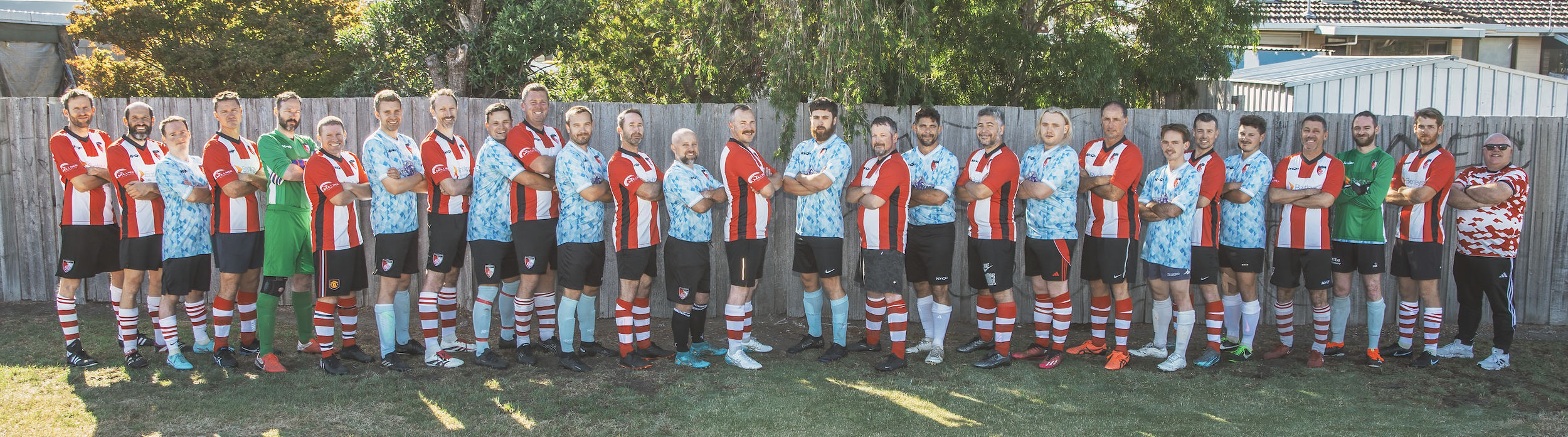
Photo credit: Nikki Long
A Hobart football club built on mateship, social football and the magic of the Lakoseljac Cup.
Some football clubs begin with big ambitions.
Others begin with a joke that refuses to disappear.
Barnstoneworth United belongs firmly in the second category.
In Hobart football circles the name alone often stops people in their tracks. Opponents regularly ask the same question.
Where on earth did that name come from?
The answer, like many good football stories, involves a group of mates, a British comedy sketch and a club that never took itself too seriously.
Thirty years later it is still going strong.
And on a Friday night in the Lakoseljac Cup the small social club from Wentworth Park produced one of the most memorable results in its history.
But to understand Barnstoneworth United, you have to start with Monty Python.
Golden Gordon and the birth of Barnstoneworth
The origins of Barnstoneworth United do not lie in Tasmania at all.
They begin with a British comedy series called Ripping Yarns, written by Michael Palin and Terry Jones of Monty Python fame, which ran from 1976 to 1979.
One episode, Golden Gordon, featured a fictional football club from Huddersfield in 1935.
Barnstoneworth United had once played in the top league but had fallen spectacularly, losing every game in the bottom division.
Their biggest supporter was Gordon Ottershaw, played by Michael Palin.
After every defeat he would return home furious and smash the furniture in frustration, much to the despair of his long suffering wife and son.
After one particularly brutal defeat Gordon delivers the unforgettable line.
“Eight bloody one! And even that were an own goal!”
Eventually the club is set to be sold off to a scrap dealer and the upcoming match against Denley Moor is meant to be the club’s final game.
In desperation Gordon tracks down the legendary players from the 1922 team.
As the match approaches kick off there are only four players available and just three pairs of shorts between them.
Then, in true football fairy tale fashion, the old legends arrive just in time and Barnstoneworth United turn back the clock and win.
The inspiration for the story came from Huddersfield Town’s decline in the 1970s when Ripping Yarns was being filmed.
For Chris Scholefield, one of Barnstoneworth Hobart’s long time custodians, the connection goes even further.
One of his prized possessions is an old Barnstoneworth playing shirt signed by Sir Michael Palin himself during a visit to Hobart.
Palin left a message that captures the spirit of the club perfectly.
“Remember the score, 8 bloody 1! It’s not the shorts that matter, it’s what’s in them that counts! All the best, Gordon Ottershaw.”
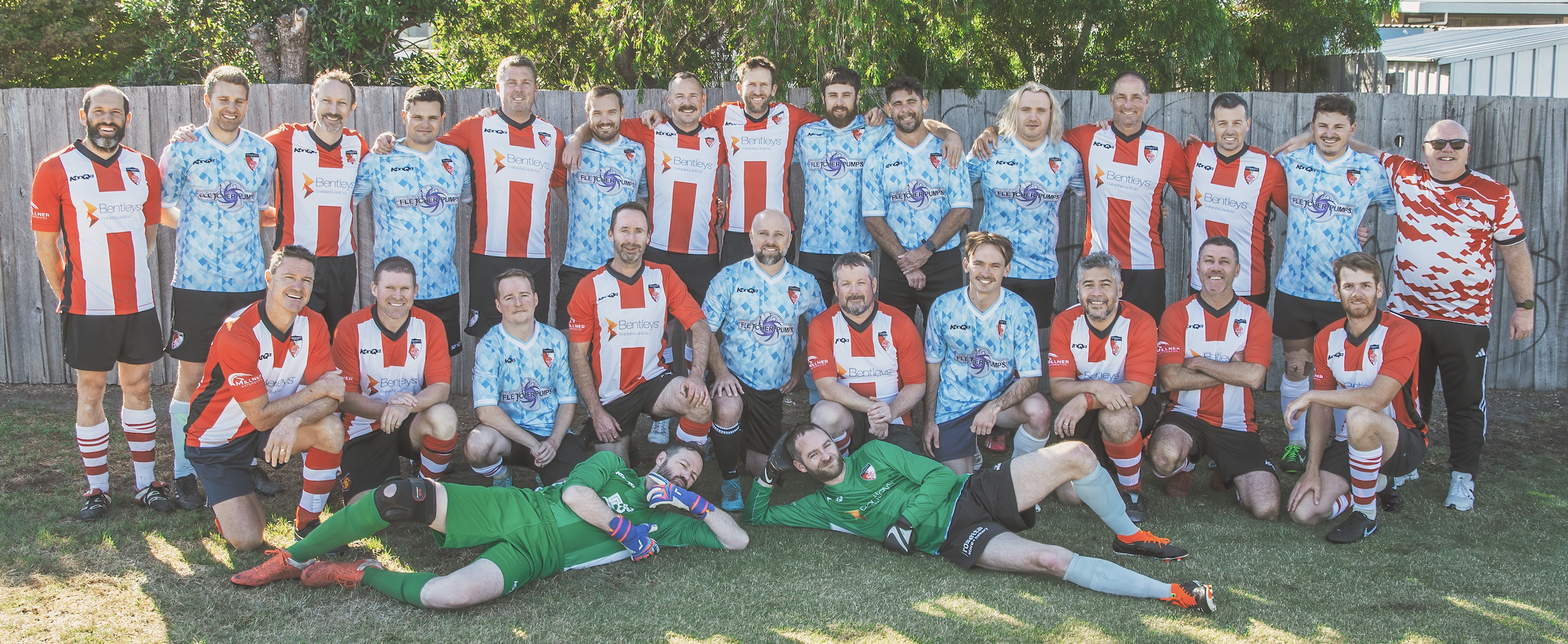
Photo credit: Nikki Long
From mates and beers to a football club
Barnstoneworth United began in Hobart around thirty years ago.
The driving force behind the club was the legendary Chris Hindmarch, known to most simply as Hiney.
Hindmarch had come to Tasmania from Wolverhampton and played for Caledonians for many years through the 1970s and 80s.
Eventually he and a group of football mates decided to start something of their own.
The founding group included Greg McGuire, George Kalis, Phil Boulter, Simon Hansen, Tim Morris and Brent Kenna.
Many of the original players had come through clubs such as Phoenix Rovers, Clarence United and Caledonians, bringing together a group of footballers who had been around Hobart football for years.
Wentworth Park quickly became the club’s spiritual home.
From the very beginning the idea was simple.
A group of good mates who wanted a kick and a few beers after the game.
That philosophy has never really changed.
Football without the win at all cost mentality
Barnstoneworth United does not pretend to be something it isn’t.
There is no win at all cost mentality.
The club’s ethos revolves around something much simpler.
Acceptance. Mateship. A love of football.
“We wish for all of our teams to be successful,” Chris explains.
“But football is just a game. It is never about the W and L count. Barney is about enjoying the game and developing treasured friendships and memories.”
Training, it should be said, is optional.
The club usually runs a pre season but once the season begins players largely keep themselves fit in their own way.
Part of the club’s philosophy is simple.
Stay in our lane.
Barnstoneworth has always preferred steady survival over grand ambition and over three decades it has quietly outlasted many bigger clubs that have come and gone.
A strange mix of quality and chaos
For a club built around mates and beers, Barnstoneworth has attracted some very serious footballers over the years.
Several players have NPL and Championship experience.
Chris casually mentions names that will be familiar to Tasmanian football followers.
Hugh Ludford.
Matty Lewis.
Chris Hunt.
Along with players from Clarence Zebras such as Sam Hills and Jeremy Price.
Others have arrived from interstate, overseas or simply through friendship connections.
Sometimes a player just turns up and asks if they can join.
They are always welcomed.
To maintain the balance between experienced players and those simply looking for a game, the club introduced a third team in recent years.
The introduction of a third team ensured players of all levels could still enjoy meaningful time on the pitch.
Success, songs and social football
Despite its relaxed approach, Barnstoneworth has enjoyed considerable success in the Social Leagues, particularly over the past six years.
But results have never been the real point.
Winning is nice of course.
Mostly because it means the players get to belt out the club song afterwards.
With enthusiasm.
The magic of the Cup
Entering the Lakoseljac Cup as a Social League club tends to provoke a particular reaction.
Somewhere between amusement and bewilderment.
But Barnstoneworth never entered the competition as a novelty.
Chris and the players have always taken it seriously.
They wanted to test themselves against the best teams in the state.
At first they knew the likely outcome.
One match. Perhaps a trip north. Maybe a clash with an NPL team.
But slowly something began to change.
With each appearance the team gained experience.
A game plan developed.
The squad found the right balance between youth and experience.
Belief began to grow.
Ironically it was a 3–0 loss to eventual cup winners South Hobart last year that convinced the players they were closer than many realised.
They had the right ingredients.
All they needed was the right night.
A night to remember
That night arrived on a Friday night in the Lakoseljac Cup.
From the opening whistle Barnstoneworth refused to be intimidated.
They pressed hard, chased every ball and gave their Championship opponent no time to settle.
Suddenly they were two goals ahead.
Even when Hobart fought back to level the game at 2–2 there was no panic.
The players simply kept attacking.
When Barnstoneworth scored again and then added a fourth, belief swept through the team.
This might actually happen.
The most remarkable detail?
The cup squad had not trained together once before the match.
Yet the players produced ninety minutes of disciplined, relentless football.
By the ninety fifth minute Chris admits he was screaming silently for the referee to blow the whistle.
When it finally came, the moment felt enormous.
One of the finest victories in the club’s history.
The characters of Barney
Like all good football clubs, Barnstoneworth runs on personalities.
On that Friday night skipper Matt Hope was the heartbeat of the team.
A passionate leader who wears his heart on his sleeve and inspires teammates to run through the proverbial brick wall.
He is also capable of delivering rousing team talks that combine tactics, humour and intensity.
Yianni Anagnostis brings a different kind of energy.
A confident player and a true larrikin whose positivity lifts the dressing room.
But Chris insists the strength of the club goes deeper than individuals.
Across all three squads the players genuinely enjoy each other’s company.
Everyone contributes.
Everyone belongs.
SchoBall
Chris describes his coaching role with typical understatement.
He does not try to teach experienced players how to “suck eggs”.
Instead he focuses on tactics.
Developing a game plan.
Selecting the players who might suit a particular opponent.
Sometimes trusting a gut feeling.
From the sideline he is vocal and relentlessly positive.
But like most grassroots football volunteers he also does everything else.
Kit man.
Ground set up.
The first person there putting up the nets so the players can simply arrive and play.
The team’s playing style has earned a nickname from some of the cheekier players.
“SchoBall.”
Possession based football, played to feet, with quick movement and an attacking mindset.
When you have players of quality, Chris says, you might as well let them play.
A Hobart football family
Barnstoneworth clubs now exist in Melbourne and Orange as well.
But the Hobart version remains proudly local.
Chris describes it as part of a small group of niche clubs within Tasmanian football.
Clubs that exist primarily for the community they represent.
Except in this case the community is a collection of mates and families that has grown over time.
Some of the younger players now pulling on the shirt are the sons of men who started the club.
Football, as it so often does, runs through generations.
The fly in the ointment
For Championship clubs the Lakoseljac Cup offers a chance to test themselves against NPL opposition.
For Barnstoneworth the motivation is slightly different.
They see themselves as the fly in the ointment.
A small social club running on the sniff of an oily rag and a collectively big heart.
But on the right day they believe they can light things up and compete with anyone.
That is the magic of the Cup.
The underdog always has a chance.
A future built on steady steps
Thirty years after it began, Barnstoneworth United is still growing.
The club now fields three teams.
Young players are emerging under the leadership of Matt Hope.
There are dreams of one day starting a women’s social team as well.
Growth, however, is always measured.
The club has never wanted to expand too quickly and lose the culture that makes it special.
Chris admits he sometimes imagines a Wrexham style story.
Although he doubts Ryan Reynolds will be investing in Barnstoneworth any time soon.
Still, he has his own dream.
If he ever wins Powerball, he has promised his wife he might indulge in a little twisted philanthropy.
Building Barnstoneworth its own ground and clubrooms.
Just part of the furniture
Chris Scholefield himself has become part of the club’s fabric.
He has played more than 400 games for Barnstoneworth.
Before that he began his football at South Hobart in 1986 before moving to University in 1990.
After several years overseas he returned to Tasmania and joined Barnstoneworth in 2000 alongside a group of former teammates.
Around 2006 the older generation of the club made a decision.
Chris, they concluded, would be the least likely person to say no to running the club.
He has been president ever since.
“Barney is part of my DNA,” he says.
“I couldn’t imagine life without this brilliant club and the people who make it what it is.”
Monty Python and the Life of Barnstoneworth
When asked what a Monty Python film about the club might be called, Chris does not hesitate.
“Monty Python and the Life of Barnstoneworth.”
Or perhaps.
“Barnstoneworth United and the Holy Goal.”
And if the story continues the way it has so far, a sequel might be inevitable.
“The Knights Who Say Knee Injury.”
Which, if you think about it, might be the most accurate football title of them all.