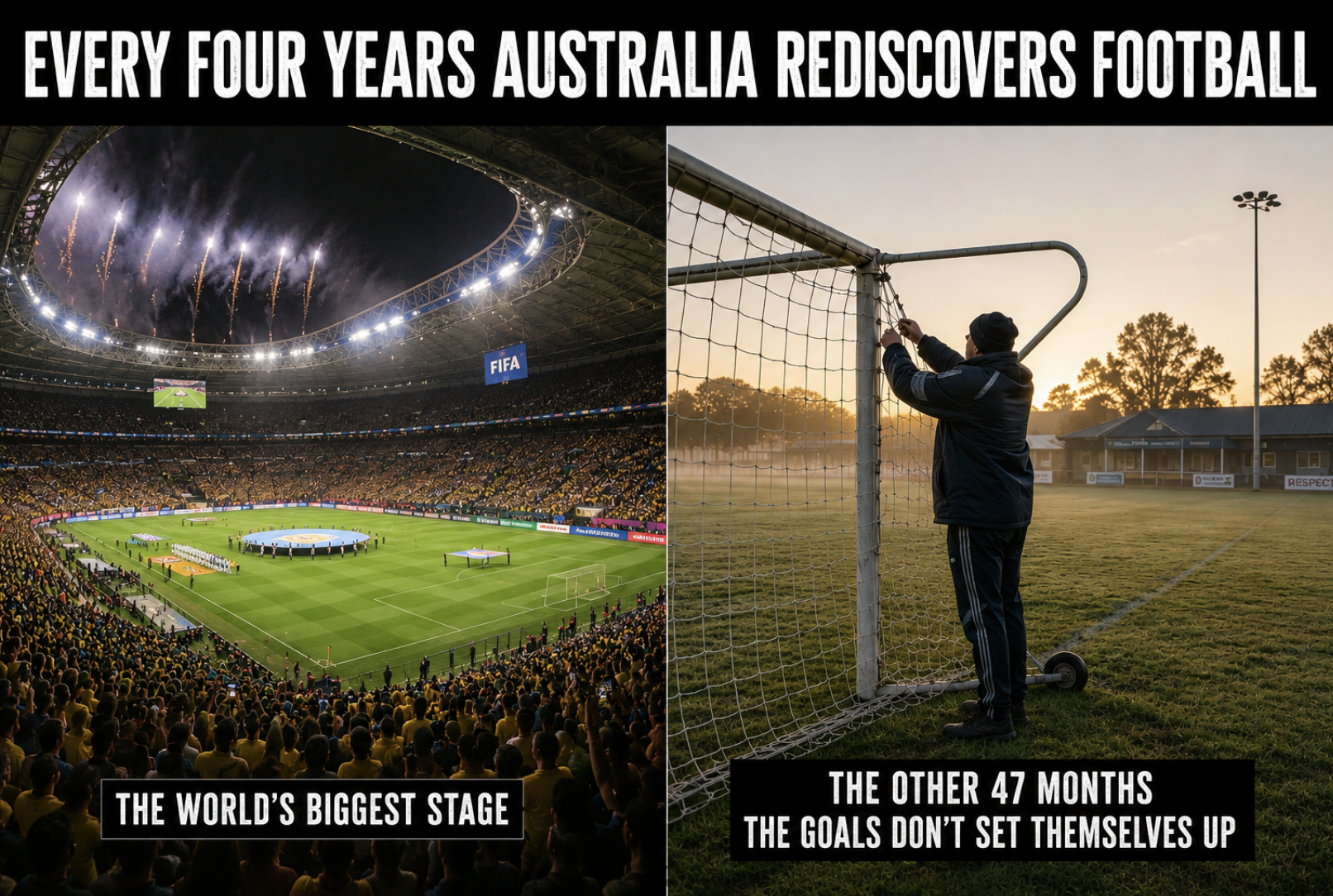
Every Four Years Australia Discovers Football
The FIFA Men's World Cup starts in 10 days.
Which means Australia is about to rediscover football.
Again.
This time I'm talking about the FIFA Men's World Cup.
The Women's World Cup deserves its own article, particularly after what the Matildas did to Australian sporting culture in 2023.
But for now, let's focus on the men.
People who haven't watched a match since the last Men's World Cup suddenly develop strong opinions about formations, selections and whether the Socceroos should play a back three.
As somebody who has spent the better part of twenty years standing beside football pitches, sitting through committee meetings, organising tournaments, arguing about facilities, marking fields and occasionally explaining offside to confused grandparents, I thought I should help.
What Is The FIFA Men's World Cup?
The FIFA Men's World Cup is the biggest sporting event on Earth.
Not one of the biggest.
The biggest.
For one month every four years, billions of people stop what they are doing to watch football.
The Men's World Cup Final attracts around 1.5 billion viewers.
That's enough people to fill the MCG about 15,000 times.
Which is why football people occasionally raise an eyebrow when somebody confidently announces that nobody watches football.
Football is the only sport where Australians regularly ask whether the world's most popular sport is actually popular.
Why Should I Care?
Because even if you don't like football, the World Cup is fascinating.
Countries stop.
Cities stop.
Workplaces stop.
Australian productivity definitely stops.
Particularly when the Socceroos are playing at three o'clock in the morning.
For one month football becomes impossible to ignore.
Which is ironic because football people spend the other forty-seven months trying to convince everyone it exists.
What Happens After The Draw?
Australia have been drawn with the United States, Paraguay and Türkiye.
For approximately seven minutes Australian football supporters discussed the draw sensibly.
Then somebody started calculating quarter-final scenarios.
By the end of the evening we had identified a route to the final.
This is another proud tradition of Australian football.
Hope is our strongest tactical weapon.
What Is A Group?
A group is the first stage of the tournament.
Australia will play:
• United States
• Paraguay
• Türkiye
Everybody plays everybody once.
The best teams progress.
The others spend four years explaining what went wrong.
Football people call this analysis.
The rest of us call it blaming the coach.
Sometimes they're the same thing.
Can Australia Get Out Of The Group?
Absolutely.
There are harder groups.
There are easier groups.
This one sits somewhere in the middle.
Nobody in Group D will be terrified of Australia.
Nobody in Group D will be delighted to play Australia either.
That is probably the most honest assessment.
The United States will fancy their chances.
Türkiye will fancy their chances.
Paraguay will fancy their chances.
Australia will definitely fancy their chances.
Possibly a little more than everybody else does.
What About New Zealand?
As somebody born in New Zealand, I should probably mention the All Whites.
New Zealand are my second team.
They are also the team Australians suddenly become very supportive of once the Socceroos have been eliminated.
Another proud trans-Tasman tradition.
The All Whites have drawn Germany, Colombia and Ghana.
Which football supporters politely describe as "challenging".
This is football language.
"Challenging" translates roughly to:
"Good luck with that."
Still, New Zealand supporters are currently doing exactly what Australian supporters are doing.
Studying the draw.
Calculating permutations.
Identifying pathways.
Convincing themselves there is a way through.
Because hope is not confined to Australia.
It is a shared trans-Tasman condition.
Besides, Australians and New Zealanders understand something many traditional football nations don't.
Nobody expects us to be there.
Which makes it a lot of fun when we are.
And if either Australia or New Zealand somehow makes a deep run into the tournament, millions of people on both sides of the Tasman will suddenly discover they have always been passionate football supporters.
Why Are Games On At Ridiculous Hours?
Because the World Cup is being hosted in North America.
Which means kick-off times are designed for North American audiences rather than people living in Hobart.
FIFA has stubbornly refused to consult Tasmanian football volunteers on this issue.
One of the strangest sights in football is watching somebody complain about an 8.30am junior kick-off and then voluntarily wake up at 2.47am to watch Australia play Paraguay.
Dogs will be confused.
Partners will be confused.
Children will be confused.
The football supporter will be sitting on the couch wrapped in a blanket shouting at the television as if this is perfectly normal behaviour.
Which, in football circles, it is.
Why Does Everybody Hate VAR?
VAR stands for Video Assistant Referee.
It was introduced to reduce controversial decisions.
Remarkably, it has created an entirely new category of controversial decisions.
This is quite an achievement.
Nobody likes VAR.
Everybody complains about VAR.
Nobody agrees on how to fix VAR.
Football has finally found something capable of uniting the entire world.
What Happens When The First Match Starts?
The first Australian goal will trigger scenes of national celebration.
The first Australian mistake will trigger demands for tactical changes.
The first Australian defeat will trigger demands for squad changes.
The second Australian defeat will trigger demands for coaching changes.
The third Australian defeat will trigger demands for structural reform of Australian football.
Football people move quickly.
Who Should I Pretend To Know?
Every World Cup requires a handful of names.
If you find yourself in a conversation and need to sound informed, try these:
"That Irankunda kid is exciting."
"Circati is going to be important."
"We look a different team with Souttar."
Then nod thoughtfully.
Nobody will question you.
In fact, if you can casually mention concerns about Australia's full-back depth, people may assume you've watched every qualifying match.
Use this power responsibly.
What About The Casual Football Experts?
Every World Cup produces thousands of them.
They emerge suddenly.
Usually from workplaces.
They have not watched football since the previous World Cup.
Within forty-eight hours they have strong opinions on formations, tactics and team selection.
By the quarter-finals they have disappeared again.
Like football-themed cicadas.
What About The Football Purists?
Every club has one.
Sometimes several.
They have watched every qualifier.
Every friendly.
Every youth international.
Every obscure livestream from somewhere in Asia filmed from what appears to be a nearby tree.
They are annoyed that casual fans suddenly care about football.
While simultaneously being delighted that casual fans suddenly care about football.
It is a complicated emotional state.
What Happens If Australia Wins?
The country will lose its collective mind.
Every politician will discover a lifelong passion for football.
Every media outlet will become a football expert.
Every sporting organisation will issue a congratulatory statement.
A taskforce will almost certainly be formed.
A review will probably be announced.
Someone will promise facilities.
Football people will smile politely.
We've seen this episode before.
The real challenge will be whether anybody remembers football still exists six months later.
What Happens When The World Cup Ends?
The casual experts disappear.
The politicians disappear.
The media attention disappears.
The football remains.
Because somewhere in Tasmania somebody still has to mark fields.
Somebody still has to coach Under 9s.
Somebody still has to organise registrations.
Somebody still has to unlock the clubrooms.
Somebody still has to put the nets up.
The Men's World Cup is football's biggest stage.
But the other forty-seven months between World Cups are kept alive by volunteers.
And somewhere on a cold Saturday morning, while the rest of the country has moved on to the next big thing, a volunteer will be standing in the rain wondering why they agreed to do this again.
Until kick-off.
Then they'll remember.
That's football.