Football Gambling 101
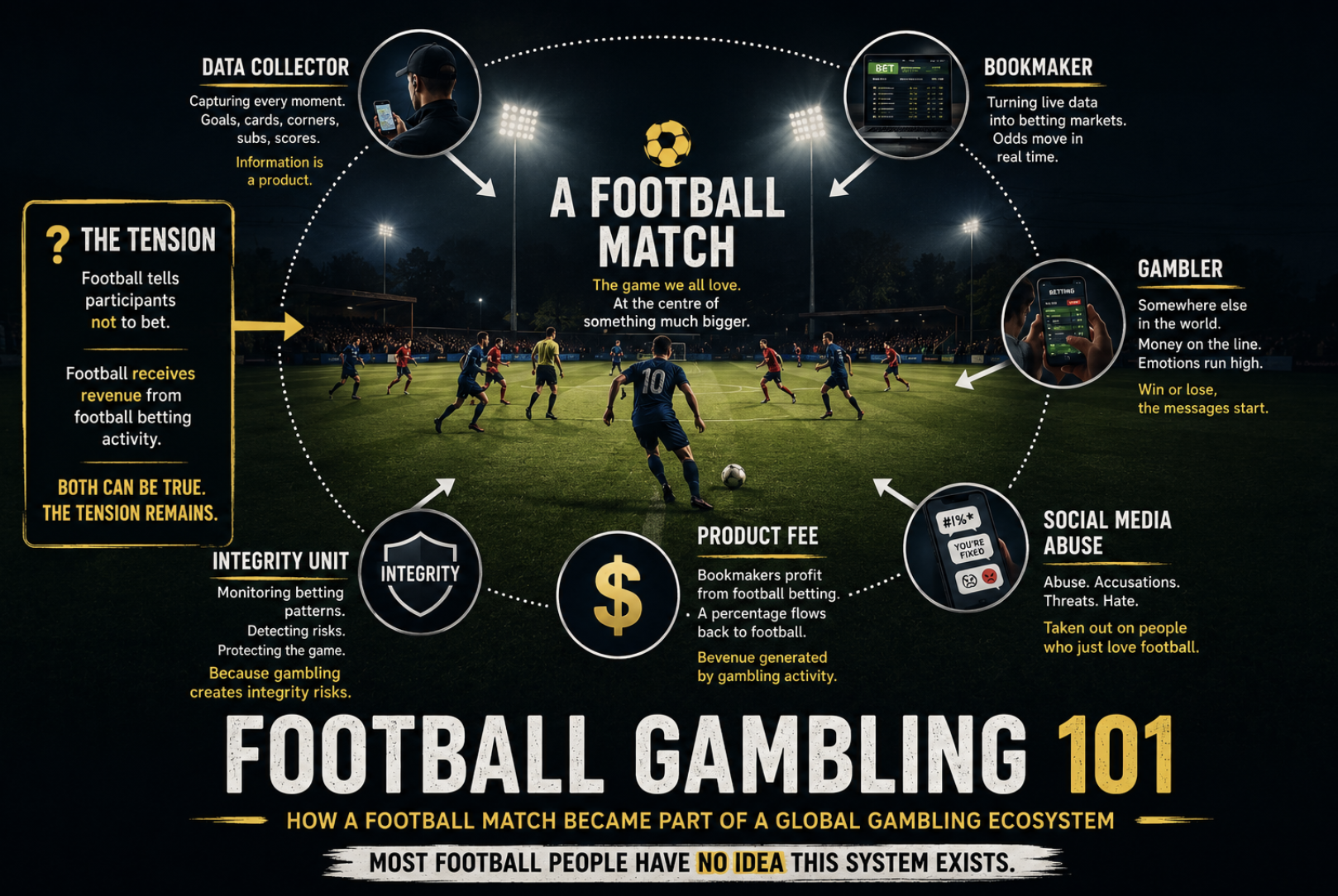
Or: How a football match in Tasmania became part of a global gambling ecosystem.
Yesterday I published a blog about the abuse football clubs receive from gamblers.
The messages.
The accusations.
The threats.
The endless claims of match fixing whenever somebody loses a bet.
I thought that was the story.
It turns out it was only the symptom.
Because once I started asking why those messages exist, I found myself following a trail that led through data collection, betting markets, integrity units, product-fee agreements and a financial relationship between football and gambling that most football people probably don't know exists.
If you had told me twenty years ago that a football match at Darcy Street would involve a data collector, a bookmaker, an integrity unit, a gambler in another country and a product-fee agreement flowing back to the governing body, I would have laughed.
Yet here we are.
The deeper I looked, the stranger it became.
Because once you start following the trail, you discover a football match isn't just a football match anymore.
There is an entire ecosystem sitting around it.
Most football people only ever see one small piece of it.
The players see the game.
The coach sees the tactics.
The supporters see the result.
The volunteer social media administrator sees the abuse.
But once you pull all the pieces together, the picture becomes extraordinary.
Let's break it down.
Step 1. The Football Match
This is the easy bit.
Twenty-two players.
Referees.
Coaches.
Parents.
Volunteers.
Supporters.
The thing most of us think football is.
A football match.
But that's only the beginning.
Step 2. The Data
Every football match creates data.
Goals.
Corners.
Yellow cards.
Red cards.
Substitutions.
Half-time scores.
Full-time scores.
Most of us think of this as football information.
To somebody else, it's a product.
Because information has value.
Especially when money is riding on it.
Step 3. The Person With The Earpiece (And Why Are They Here?)
If you've spent time around higher-level football, you've probably seen them.
A person sitting quietly.
Phone in hand.
Sometimes wearing an earpiece.
Sometimes entering information into a device.
Most football people assume they're a scout.
Sometimes they are.
Often they're collecting data.
The goal goes in.
The information is transmitted immediately.
A yellow card is shown.
The information is transmitted immediately.
The match becomes a stream of live information.
Not because somebody wants a match report.
Because somebody wants data.
Fast.
And the obvious question becomes:
Why?
Step 4. The Betting Market
Because data has value.
Bookmakers offer betting markets on football.
Results.
Goals.
Cards.
Corners.
Half-time scores.
Full-time scores.
The faster the information moves, the more valuable it becomes.
Which is why live data matters.
Because betting markets move in real time.
Step 5. The Gambler
Now we arrive at the person grassroots football knows very well.
The gambler.
The person sitting somewhere else in the world.
Watching scores.
Watching markets.
Watching outcomes.
Not because they care about the football club.
Because they have money riding on the result.
The favourite loses.
The messages start.
The goal doesn't come.
The messages start.
A teenager misses a penalty.
The messages start.
This is the part grassroots football sees.
The abuse.
The accusations.
The anger.
The social media messages.
The phone calls.
The claims of corruption and match fixing.
Not because people love football.
Because people lost money.
Step 6. The Integrity Unit
Football understands there are risks.
Match fixing.
Spot fixing.
Corruption.
Suspicious betting activity.
Competition manipulation.
That's why football has integrity departments.
Education programs.
Reporting systems.
Participant bans on betting.
Football Australia's Integrity Framework states that registered football participants must not bet on any football match or competition anywhere in Australia or anywhere else in the world.
Players cannot bet.
Coaches cannot bet.
Referees cannot bet.
Officials cannot bet.
Presidents cannot bet.
Board members cannot bet.
The message is clear.
Gambling creates integrity risks.
And football is right to take that seriously.
Step 7. Product Fees
This is where most people get lost.
I certainly did.
Let's slow down.
Imagine a bookmaker wants to offer betting on football.
The bookmaker is using football.
Football competitions.
Football results.
Football data.
Football players.
Football exists.
The bookmaker makes money because people bet on football.
So sporting bodies negotiate what are known as product-fee agreements.
Money flows back to the sport.
According to the ABC Four Corners investigation, Football Australia receives either:
1 per cent of annual football betting turnover in Australia, or
15 per cent of bookmaker profit,
whichever is higher.
Most people hear 1 per cent and think:
"That doesn't sound like much."
But here's the important part.
The fee is calculated on turnover.
Not profit.
Turnover is the total amount wagered.
Imagine 100,000 people place $100 worth of bets on football.
That's $10 million in betting turnover.
In that simple example, football's share at 1 per cent would be $100,000.
Now imagine that across:
The Socceroos
The Matildas
The A-League Men
The A-League Women
Australia Cup matches
NPL football
State leagues
International football bet on through Australian bookmakers
Across an entire year.
Suddenly we're not talking about pocket money.
We're talking about a genuine revenue stream.
Football Australia has described these product fees as a relatively small part of overall revenue.
Perhaps they are.
But unlike sponsorships, this revenue exists for one reason.
People are betting on football.
Step 8. The Tension
This is the part that made me stop.
Football tells players not to bet.
Football tells coaches not to bet.
Football tells referees not to bet.
Football tells officials not to bet.
Football tells presidents not to bet.
Football tells participants gambling threatens football integrity.
Then football receives revenue generated by football betting activity.
That doesn't automatically make anyone a hypocrite.
But it does create a tension.
Because football is simultaneously saying:
"Please don't bet on football."
And:
"Football receives money because people are betting on football."
Both things can be true.
But let's not pretend they sit comfortably beside each other.
That's not an accusation.
It's an observation.
What Has Football Become?
Twenty years ago a football match involved:
Players
Coaches
Referees
Parents
Volunteers
Supporters
Today it may also involve:
Data collectors
Live betting markets
Product-fee agreements
Integrity monitoring systems
Overseas gamblers
Social media abuse
Global wagering companies
And most people standing on the sideline have absolutely no idea.
That is not necessarily good.
It is not necessarily bad.
But it is certainly different.
The question is whether football people truly understand the system that now sits around the game.
Because once you start following the trail from a football match to a betting market, from a betting market to a product fee, from a product fee to an integrity unit, and from an integrity unit back to football itself, you realise something.
Modern football is no longer just football.
It has become part of something much bigger.
Most of us only ever see one small piece of it.
The player sees the game.
The coach sees the tactics.
The supporter sees the result.
The volunteer social media administrator sees the abuse.
The integrity unit sees the betting patterns.
The bookmaker sees the market.
The governing body sees the revenue.
Yet they are all looking at the same match.
The Question
Yesterday I thought I was writing about abusive messages sent to football clubs.
Instead, I found myself looking at data collection, betting markets, integrity systems, product-fee agreements and a financial relationship between football and gambling that most football people probably don't know exists.
A football match.
A data collector.
A bookmaker.
A gambler.
An integrity unit.
A product fee.
A social media administrator pressing delete.
They're all connected.
And once you see the whole picture, it's difficult to look at a football match in quite the same way again.