Forgive Me If I Call Bullshit
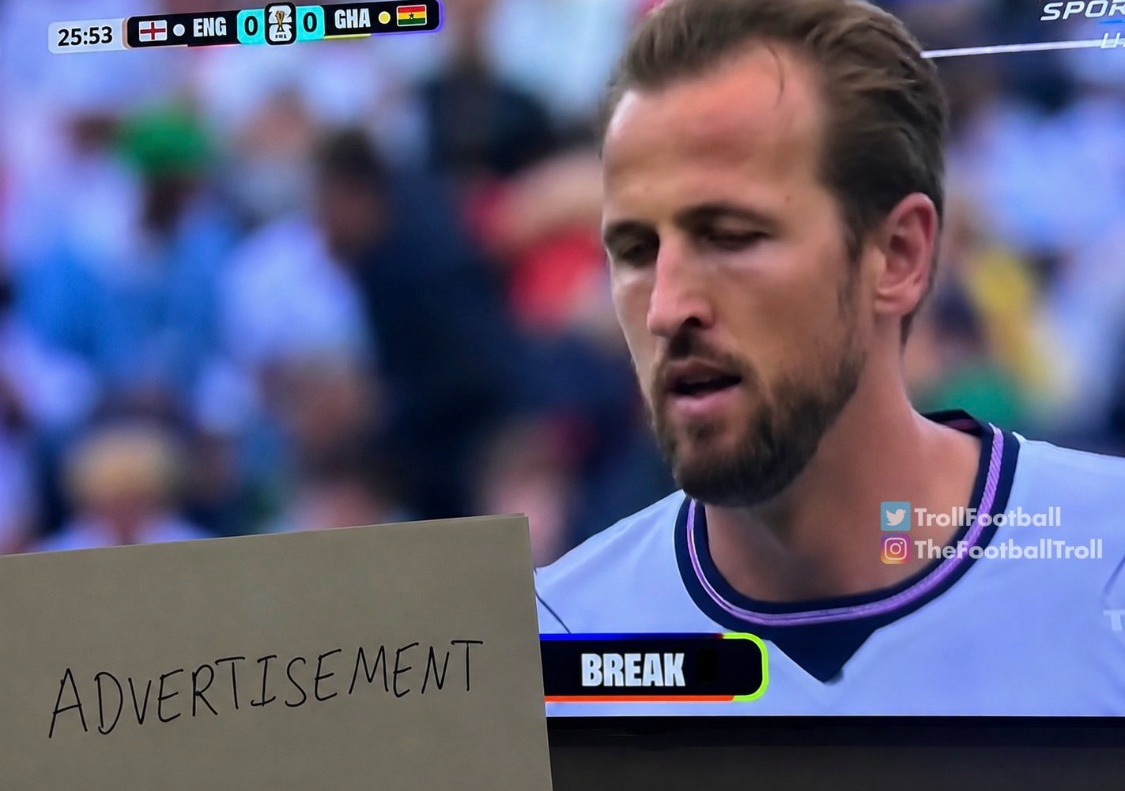
I laughed when I saw the image.
Not because it was particularly clever.
Because it perfectly captured what football supporters around the world are thinking.
There stood Harry Kane, captain of England, one of the fittest athletes on the planet.
The game stopped.
The hydration break arrived.
And a supporter held up a sign in front of the television screen that simply read:
ADVERTISEMENT
That, in one image, is the entire debate.
Football is played in halves.
Two of them.
Not quarters.
Which is why so many supporters are struggling with FIFA's latest obsession.
FIFA says the hydration breaks are purely about player welfare.
Football supporters aren't so sure.
Get On With It
Before somebody accuses me of wanting players collapsing from heat exhaustion, let's be clear.
If it is dangerously hot, stop the game.
If conditions genuinely put player welfare at risk, have a cooling break.
Nobody sensible disagrees with that.
Cooling breaks in extreme conditions already existed. Most football people had no problem with them.
I've spent decades standing on football grounds around Tasmania.
I've watched junior football at North Chigwell in weather where parents could barely feel their fingers.
I've stood at Wentworth Park in winter rain wondering whether I should have packed another jacket.
I've watched players train under lights on freezing Hobart evenings.
Football has always adapted to the conditions in front of it.
That's why cooling breaks in extreme heat never bothered me.
If it's 40 degrees, stop the game and let the players cool down. If it is freezing deal with it.
That's common sense.
What makes less sense is stopping every match regardless of whether the conditions justify it.
Australian football supporters have spent years arguing that the A-League shouldn't be played in summer because of the impact of extreme heat.
If FIFA wants to see a match that genuinely needs a hydration break, I can introduce them to a January afternoon in Western Sydney.
That's where footballers deserve sympathy.
That's where cooling breaks make sense.
That's where player welfare becomes the dominant consideration.
Not when it's 18 degrees in Boston and raining.
Yet during this World Cup, a hydration break was still taken in exactly those conditions.
Nobody looked at 18 degrees and rain in Boston and thought:
"You know what these players need? A hydration break."
And that's the problem.
At that point it stops looking like a heat policy.
It starts looking like a football policy.
Even The Coaches Are Complaining
This isn't just grumpy supporters yelling at clouds.
Marcelo Bielsa says the breaks add nothing and take away a lot.
Thomas Tuchel says they change the identity of the game.
That is exactly the point.
The issue isn't hydration.
The issue is identity.
Football feels different when you stop it every twenty minutes.
The rhythm changes.
The momentum changes.
The atmosphere changes.
And football people instinctively know it.
Thankfully Harry Kane Was Saved
There stood Harry Kane, captain of England and one of the fittest athletes on the planet.
Thankfully the game was stopped just in time.
Another few minutes and he may have forgotten to apply Rexona.
Harry got a drink.
The coaches got a team talk.
The broadcasters got a commercial break.
Everybody wins.
Or so we are told.
Forgive Me If I Call Bullshit
We are told the hydration breaks are essential for elite athlete welfare.
Fair enough.
Then the players return from the break and spend the next five minutes surrounded by advertisements for burgers, soft drinks, potato chips, beer and deodorant.
Apparently dehydration is the health issue we are worried about.
We are told modern footballers are elite athletes whose bodies must be treated like temples.
The match stops so they can hydrate correctly.
Then the television coverage immediately encourages the rest of us to eat a Big Mac, demolish a family-sized bag of Smiths chips and wash it all down with a soft drink.
Forgive me if I call bullshit.
If this is genuinely about player welfare, then say it.
If it is genuinely about heat management, then have a heat policy.
But don't be surprised when supporters connect the sporting decision with the commercial opportunities that suddenly appear around it.
Football supporters aren't stupid.
The Coincidence
The problem FIFA has isn't that supporters oppose player welfare.
The problem FIFA has is that football supporters possess eyes.
We can see the game stopping.
We can see the advertisements appearing.
We can see the extra commercial inventory being created.
Then we are told the two things are completely unrelated.
Football supporters are being asked to ignore a coincidence that arrives every 22 minutes.
And once supporters stop believing the explanation, the argument is already lost.
The irony is that FIFA may be right.
The breaks may genuinely help players recover.
The problem is that every time the game stops, supporters are given another reason to suspect there is more going on than player welfare.
The Slippery Slope
Football has spent decades telling us every change is small.
VAR was a small change.
Longer added time was a small change.
Hydration breaks are a small change.
Individually, perhaps they are.
Collectively they create a different game.
A game that feels increasingly designed for television.
A game that feels increasingly comfortable with interruptions.
A game that looks a little less like football and a little more like every other sport competing for advertising dollars.
Maybe that's inevitable.
Maybe I'm simply getting older.
But not every old idea is a bad one.
My Armpits Can Wait
If it is 40 degrees in Dallas, stop and get a drink.
If players are genuinely at risk, stop the game.
Player welfare should always come first.
But if it is 18 degrees in Boston and raining, get on with it.
Football doesn't need more interruptions.
Football doesn't need more commercials.
And football certainly doesn't need more opportunities for somebody to sell me deodorant in the middle of a football match.
Trust me.
At my age, I am already aware.
My deodorant can wait.
Football is played in halves.
Not quarters.