Football Deserves Better Than Silence
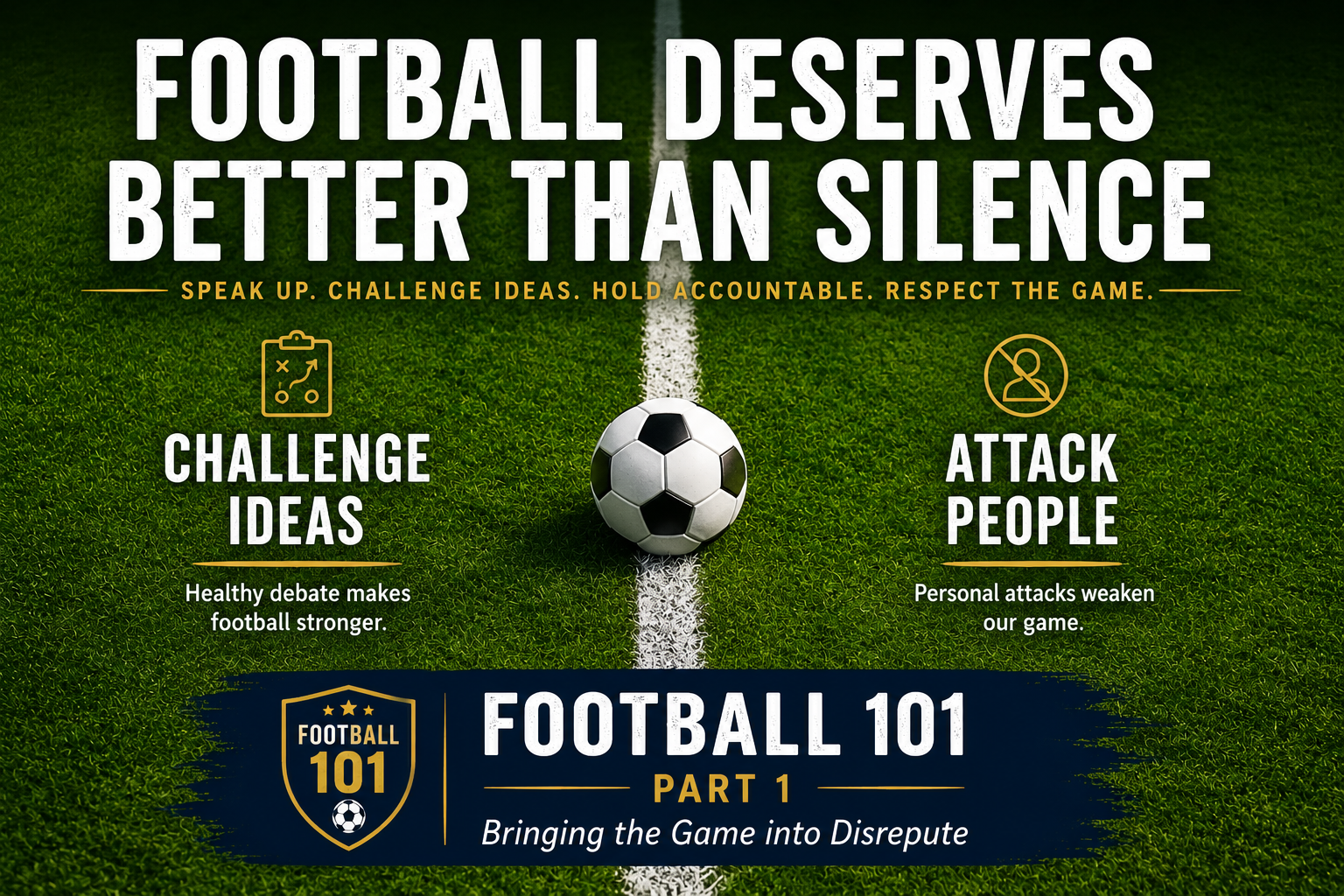
Football 101 | Part 1: Bringing the Game into Disrepute
Football deserves better than silence.
It deserves informed conversation.
It deserves people prepared to ask difficult questions.
It deserves people willing to challenge ideas.
It deserves accountability.
But it also deserves respect.
Somewhere between silence and abuse sits the conversation football should be encouraging.
That made me wonder.
How many of us actually understand where that line is?
Football people love quoting the Code of Conduct.
Sometimes as a warning.
Sometimes as a weapon.
Sometimes because they genuinely care about standards.
But I often wonder how many of us have actually read it.
Welcome to Football 101.
Over the coming months I'd like to explore some of the phrases, rules and governance concepts we hear every week but rarely stop to explain. Not as a lawyer, but as someone who has spent decades involved in football administration, governance and volunteering.
I have always believed football needs more people willing to speak up.
Not fewer.
The game doesn't improve because everyone agrees.
It improves because people ask questions.
They challenge decisions.
They debate ideas.
They hold clubs, administrators and governing bodies accountable.
Healthy football welcomes respectful discussion.
It shouldn't fear it.
But speaking up also comes with responsibilities.
There is a line.
The challenge is understanding where that line sits.
Can you publicly criticise a decision?
Can you question a policy?
Can you write a blog?
Can you challenge a governing body?
Can you say the board got it wrong?
The answer isn't simply yes.
And it isn't simply no.
It depends on how you do it.
So I went back to the Code of Conduct.
Not looking for reasons to stay quiet.
Looking for where football draws the line.
Because if we're going to encourage people to speak up, and I think we should, we also owe them an understanding of the boundaries.
It's Not Just About Players
One of the first things that struck me is that many football people assume the Code of Conduct is aimed at players.
A player sent off for abuse.
A coach dismissed for misconduct.
A referee writing a report.
In reality, it is much broader than that.
Depending on your role, the Code can apply to coaches, administrators, directors, volunteers, referees, committee members and club officials.
In other words, most of us.
It's Not Just About What You Say
Another surprise is that much of the Code isn't actually about words.
When people hear "Code of Conduct" they often think about social media posts or interviews after a match.
In reality, much of it deals with behaviour.
Integrity.
Honesty.
Respect.
Conflicts of interest.
Safeguarding.
Discrimination.
Abuse.
The Code is as much about how we conduct ourselves as it is about what we say.
The Grey Area
The easy examples are easy.
Most football people would agree there is no place for racism, bullying, harassment, threats or discrimination.
The interesting part comes later.
Football has always been built on opinions.
We debate competition structures.
We debate player pathways.
We debate scheduling.
We debate coaching appointments.
We debate governance.
We debate promotion and relegation.
And occasionally we debate whether an 18 degree day really requires a hydration break.
So where is the line?
Let's put it to the Pub Test.
The Pub Test
Imagine somebody standing outside your local club saying these things.
"I disagree with that decision."
"I think the competition structure needs changing."
"I would have handled that differently."
Most people would probably say that's healthy football debate.
Now consider these.
"That administrator is incompetent."
"The board lied."
"The competition was fixed."
Most of us instinctively feel the difference.
The first group criticises decisions.
The second group makes statements about people.
You don't need a law degree to understand that those are very different conversations.
Whenever I'm writing, I try to ask myself one simple question.
Am I challenging an idea, or am I attacking a person?
It is a surprisingly useful test.
The Facebook Effect
Twenty years ago, if you disagreed with a football decision, you probably told a few people around the clubrooms.
The conversation lasted ten minutes.
Then everyone went home.
Today that same opinion can be shared online and reach thousands of people within minutes.
Football hasn't changed.
The audience has.
That is one reason why Codes of Conduct have become increasingly important.
Words that once disappeared into the night now remain online.
So What Happens If Someone Complains?
This was the part that fascinated me most.
Most football people know there are disciplinary panels.
Very few know what happens before a matter ever reaches one.
Someone raises a concern.
That concern is assessed to determine whether there appears to be a case to answer.
Not every concern becomes a formal complaint.
Not every complaint proceeds.
Not every disagreement becomes a hearing.
Not every Facebook post results in charges.
Some matters go no further.
Some are investigated.
Some proceed through the disciplinary process.
Some don't.
I suspect most football people have no idea how many concerns never make it beyond that first assessment.
Who Decides?
This was probably the question I wanted answered more than any other.
If somebody believes you've breached the Code of Conduct, who actually decides?
Is it the person making the complaint?
The CEO?
A member of staff?
The answer is more complicated than that.
A concern may be raised.
It may then be assessed to determine whether there is a case to answer.
If it proceeds, the question of whether the Code has actually been breached is determined through football's disciplinary process.
That distinction matters.
A complaint is not a finding.
An allegation is not a determination.
An opinion is not the same thing as a decision.
Football has processes for a reason.
I suspect most football people would be surprised to learn how that process actually works.
Perhaps that's a topic for another Football 101 article.
What If The Complaint Is Wrong?
This question interested me just as much.
What happens if somebody complains, but the complaint has no merit?
What if criticism is mistaken for misconduct?
What if somebody simply doesn't like what has been written?
That's why football has processes.
Evidence matters.
Fairness matters.
People should have an opportunity to know the case against them and respond.
Most of us would call that common sense.
Lawyers call it natural justice.
The Blogger's Rule
After writing football articles, I've developed a rule of my own.
Criticise decisions.
Criticise policies.
Criticise structures.
Criticise outcomes.
Ask difficult questions.
Hold organisations accountable.
But be very careful when you start criticising people's motives.
There is a big difference between saying:
"I disagree with the decision."
and
"I know why they made the decision."
One is opinion.
The other is often assumption.
As a writer, that distinction matters.
I've also learnt that the strongest articles rarely need speculation.
The facts are usually powerful enough.
My Take
After reading the Code of Conduct, I came away with one overwhelming thought.
Football doesn't need fewer people prepared to speak up.
It needs more.
The game improves because people ask questions.
Because they challenge ideas.
Because they debate respectfully.
Because they hold all of us accountable.
The Code of Conduct shouldn't be viewed as something that silences discussion.
It should encourage better discussion.
Criticise decisions.
Challenge policies.
Question governance.
Hold leaders accountable.
Just don't confuse robust debate with personal attack.
Football deserves better than silence.
It deserves informed conversation.
Perhaps that's the real lesson.
The question isn't whether you should speak up.
It's how you choose to do it.
And if Football 101 helps even a few people better understand where that line sits, then writing this first article will have been worthwhile.