From Preston Streets to Tasmanian Touchlines
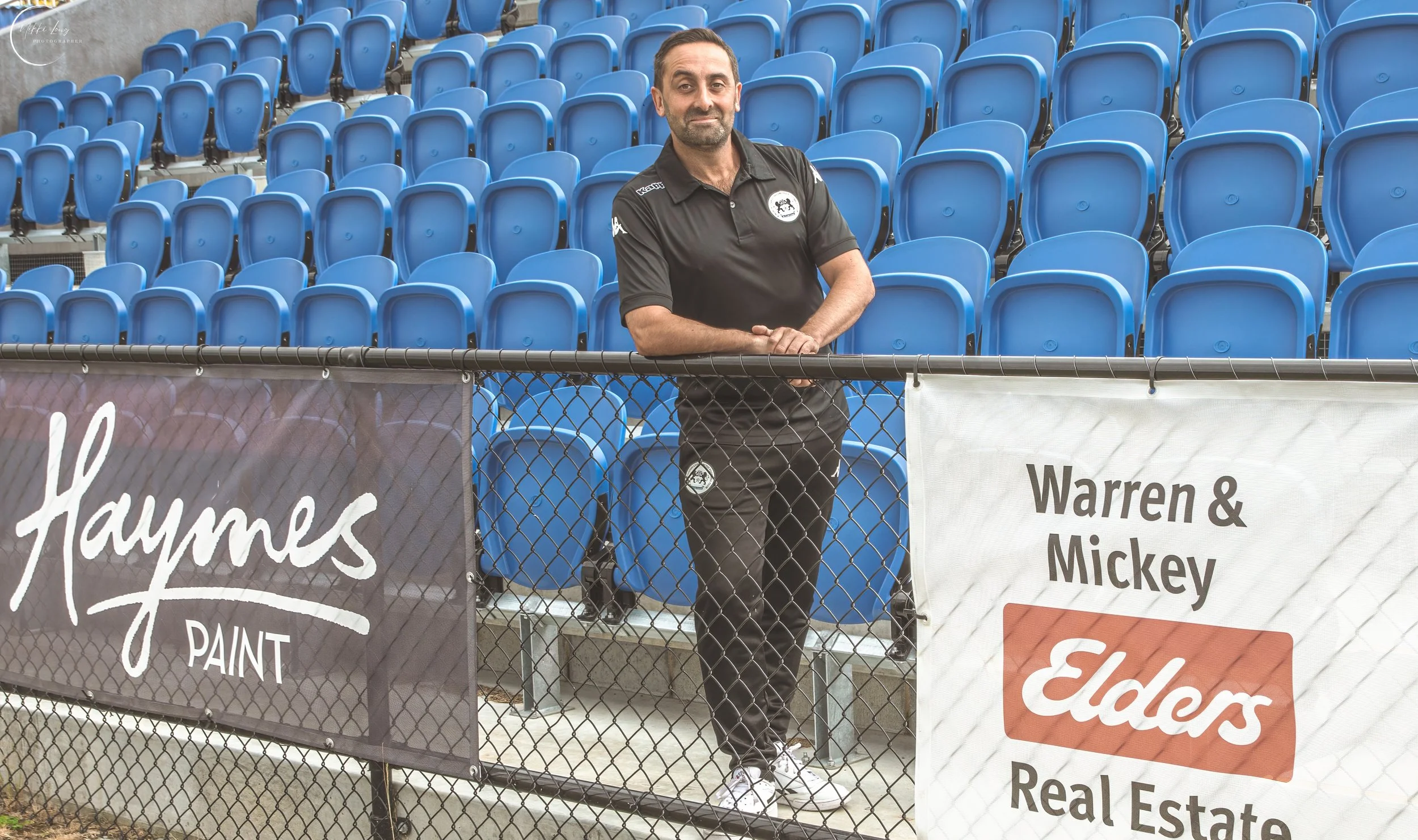
Jon Fenech photographed by Nikki Long
An interview with Jon Fenech, Sporting Director and NPL Men’s Head Coach, Kingborough Lions United
Some football journeys are planned.
Some just never really stop.
When you speak with Jon Fenech, you get the sense his path into coaching in Tasmania is simply the latest chapter in a life where football has always been present, shaping decisions long before they looked like decisions.
Growing up in football
Jon grew up in Preston in the north-west of England, with a Maltese father and British mother. Football was everyday life. Streets, parks, local pitches on weekends, usually with his dad and brother.
At 13 he was scouted by Blackpool Football Club and joined their academy, later becoming a young professional. At 17 he represented the Malta national football team at youth international level.
His journey then took him through Malta and southern Europe before returning to the UK to complete a Business and Economics degree at Durham University, playing semi-professionally alongside study.
One memory still sits high. Watching Roberto Baggio at the 1994 FIFA World Cup, sitting with family and watching his father ride every emotion as an Italy supporter. That moment cemented his love for the game, not just the football itself, but what it means inside families and across generations.
He later moved to Brisbane to help grow a property recruitment business with a university friend, while staying involved in football through playing and coaching in the lower leagues in Queensland. Football never really left. It simply shifted shape.
From player to coach
Jon began his coaching badges while still playing. As injuries and life commitments increased, he realised he could no longer give playing what it demanded.
Friends working at the highest levels of the professional game encouraged him back into football through coaching. That shift allowed him to combine leadership and management skills from business with his first love, football. He has always enjoyed analysing the game and helping players improve. Coaching felt like a natural evolution rather than a replacement.
Life beyond the pitch
There is, by his own admission, not much time outside football.
Alongside his role at Kingborough Lions United Football Club, Jon is completing a postgraduate degree in football management and sporting directorship through the Professional Footballers' Association, and has recently started his A Licence with the Asian Football Confederation.
Any spare time is spent with his daughter, and thanks to her, he has developed a surprising passion for jigsaw puzzles.
Coaching philosophy
Forward. Outwork. Together.
That is how Jon sums it up. Attack with intent, outwork the opposition and compete as one team. For him, progressing and creating matters more than playing safe. It is a mindset as much as a tactic.
His three non-negotiables sit clearly underneath that.
Courage to play forward, because growth requires risk and a willingness to take the game on.
Honest work rate, meaning effort, reactions and discipline in every moment, not just when things are going well.
Team-first behaviour, where decisions and standards must serve the group, not individuals.
At their best, his teams are high-energy and proactive. They press aggressively when appropriate, attack with speed and intent, and fight for each other in every moment of the game. What he describes is not only a style of play, but a behavioural standard that runs through the group.
Why Tasmania, why now
Jon describes his move as the right leap at the right time. He had built a corporate career he genuinely enjoyed and was proud of and left a great company in capable hands, but it felt like the moment to try something new.
When the opportunity arose at Kingborough Lions United Football Club, it immediately felt right. From his first conversations and time spent around the facilities, he saw a club committed to building something sustainable. Not just chasing short-term success, but creating a long-term future for players and the community. He also notes he is fortunate to have excellent facilities at Kingborough, even while recognising the broader challenges across the state.
Tasmania itself stood out. He talks about a strong football community, passionate people, and real potential. On any given weekend you see people from different clubs turning up to watch other games, catching up in clubrooms and supporting the game beyond their own team. That sense of connection is something he believes is not always present in bigger football markets.
What surprised him
One of the most pleasant surprises since arriving has been that connectedness. Junior nights at the club. Match days where familiar faces keep turning up across different grounds.
He was also struck by the scale and speed of change. Tasmanian football is moving quickly from community participation models towards demands for performance pathways, which are still very limited. Clubs are growing. Facilities are improving. Operational demands are increasing. Yet much of the work is still carried by volunteers and overstretched staff. The ambition is strong. The infrastructure and systems are still catching up.
And still, cold winter nights, lights on, a handful of people in jackets along the fence and great football moments. Environment is not just facilities, it is people.
Where Tasmania falls behind
Infrastructure depth is the biggest gap. Facilities, pitch availability and training environments are under pressure as demand at junior and youth level rises rapidly.
Operational systems are another challenge. Many clubs are still transitioning from volunteer-run models to more professional operations, which are far more established in Queensland and the UK.
There is also inconsistency in development environments. Not every player trains within a structured pathway. For Jon, this is not about talent. It is about systems, volume, and environment quality.
How Tas teams compare nationally
When asked how Tasmanian teams would translate into other competitions, Jon does not focus first on talent. He focuses on environment.
He believes a mid-table Tasmanian NPL side would likely compete in FQPL 1 in Queensland, while the top Tasmanian teams would compete in NPL Queensland. The difference, in his view, is not simply ability. It is squad depth, professionalism and the ability to maintain standards across a long, demanding season.
For Jon, it is not about the best eleven players. It is about the environment that supports them week after week.
The biggest myth
Jon believes the biggest myth Tasmanian football tells itself is that it is further behind than it actually is. That belief, he says, limits ambition before the work even begins.
In his view, Tasmania has the quality to aim higher, but it needs to start building with national relevance in mind rather than constantly comparing itself from a position of deficit. For Jon, mindset is part of the system, not separate from it.
Coaching in Tasmania
There are some very strong coaches operating at senior NPL and WSL level. The biggest opportunity lies in youth and women’s football, where coaching is often volunteer-led and knowledge does not always filter consistently down from senior environments.
Coaching is strongest where clubs have clear structures and alignment between youth and senior football. It is weakest where coaching is disconnected from club-wide planning and environments remain purely participation-driven without development frameworks.
Better support for grassroots coaches, male and female, is a key step. Jon adds that he would love to appoint more female coaches at Kingborough, but finding them is the hardest point.
Coach education, Jon says, should be about standards, not labels. He speaks positively about the work of David Smith and Football Tasmania, but believes real development happens beyond certificates, through workshops, mentoring, collaboration and shared learning environments. The best coaches never stop learning.
What governing bodies should focus on
Jon believes Football Tasmania should increasingly shift from administration toward enabling growth.
Advocating for statewide infrastructure, particularly more artificial surfaces, supporting clubs with increasing operational demands, strengthening long-term player pathways and leading statewide conversations about football’s future are all central.
What should be avoided are short-term decisions that undermine long-term development, leaving clubs to manage rapid growth without adequate support, duplicating efforts, or alienating clubs. Strong clubs, he believes, ultimately drive strong football outcomes statewide.
Three changes to lift standards
If he could lift standards in three years, Jon’s answers are straightforward but closely connected.
Facility upgrades across the state for year-round access, because consistent environments underpin consistent development.
Stronger alignment between youth and senior football, so players move through connected pathways rather than isolated teams and programs.
Improved operational and administrative support at clubs, because as expectations grow, clubs need systems that can carry the load rather than relying on overstretched volunteers.
For Jon, standards do not rise through words alone. They rise when the environment makes higher standards normal day to day.
His message to players and coaches
Jon’s message to players and coaches who want to improve is simple. Seek environments that demand more.
From his own journey, leaving England, transitioning out of playing and later stepping away from the corporate world, Jon says his biggest growth moments came when he chose environments that challenged him.
Improvement comes from training consistently in structured, competitive environments, being accountable for your own development, understanding that higher standards require sacrifice, particularly in semi-professional settings and adopting a growth mindset that recognises progress is often gradual.
The hinge point
Tasmanian football sits at a hinge point.
Ambition is rising. Expectations are rising. The standards players want to reach are rising. But systems, infrastructure, and support are still trying to catch up. It is not a talent problem. It is an environment problem. That is where he believes the real gap sits.
Those who lean into higher standards now will not just improve themselves. They will help shape what the game here becomes next.
And that is the real work.