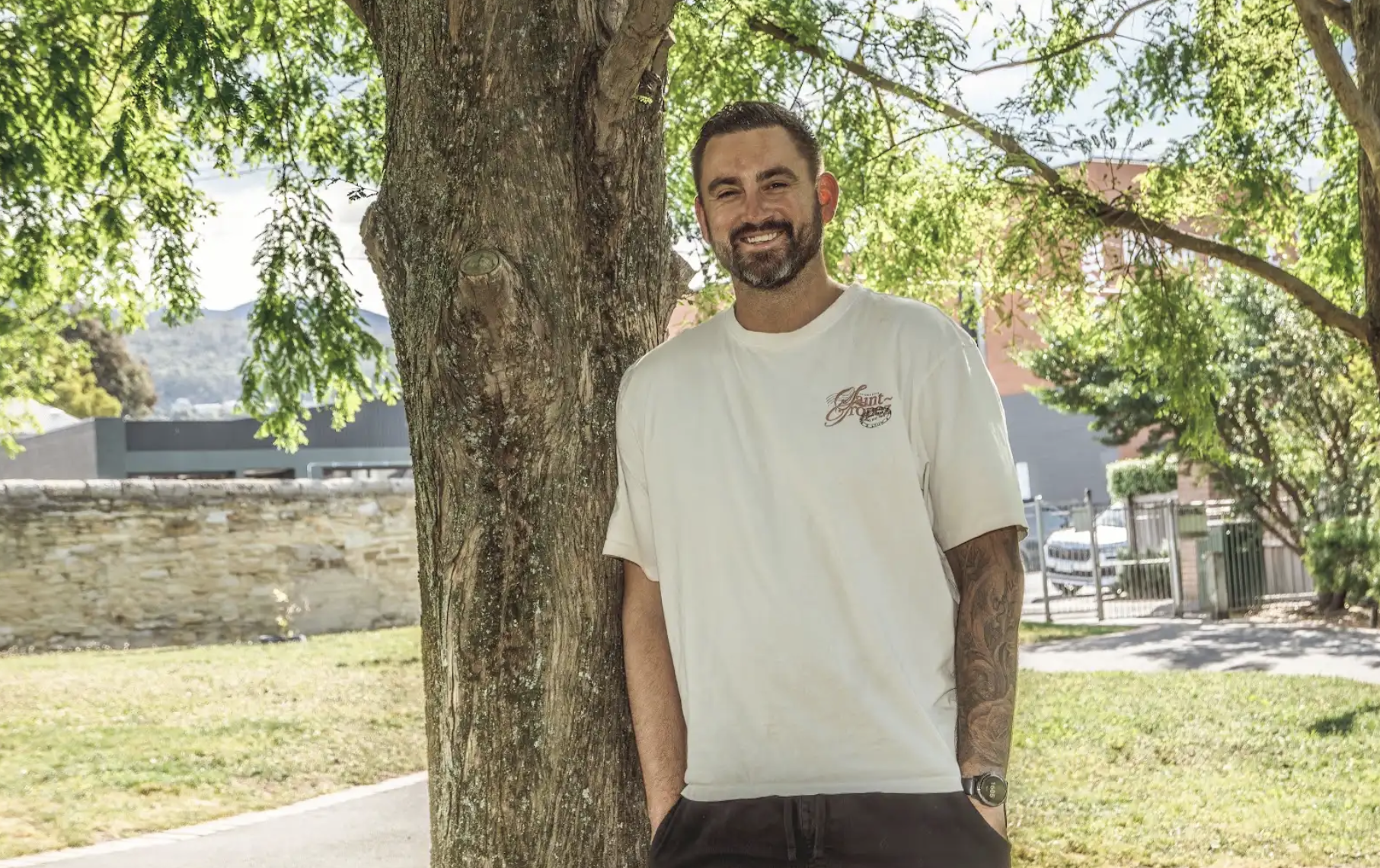
Alex Cisak - photographed by Nikki Long
I first heard the name Alex Cisak many years ago, through people at South Hobart Football Club.
"Oh yes, he played for us," I was told.
He was a young goalkeeper who had been given an opportunity overseas. The club was asked to release him and it did.
And the rest, as they say, is history.
For a long time that was about all I knew of Alex Cisak.
Then years later, when I had become a more regular watcher of the A-League, his name cropped up again. This time at Sydney FC.
He didn't get much game time at Sydney but I knew who he was.
And then, some years later, there he was in Hobart.
A tall man on the sideline of junior football, watching his own children play.
Our paths crossed through Morton's Soccer School. I came to know a passionate football man with some strong opinions about the game.
I wanted to know more.
So I asked him.
A boy and a football
Alex was born in Kraków in Poland and came to Hobart as a two-year-old.
His football story starts the way most do.
"One of my earliest memories is simply being obsessed with football. Before school, at lunchtime and after school, I was always playing, either in the playground or in the backyard. I'd spend hours trying to recreate goals I'd watched in the Premier League the weekend before. Football was pretty much all I wanted to do."
Then came club football.
"I joined South Hobart when I started high school and spent around two and a half years there. It was an important period in my development, and making my senior debut at just 15 is something that will always be a special memory for me."
A senior debut at 15.
But where does a boy like that go next?
"There really wasn't a clear pathway for young Tasmanian players at the time. Whenever I asked for advice about getting to the mainland or trialling overseas, the response was generally that it was going to be extremely difficult."
The man who opened the door
Alex had the dream. He wasn't sure he had the belief.
"I always dreamed of becoming a professional footballer, although when I was young I don't think I genuinely believed it would happen."
One person changed that.
"I was extremely fortunate to have Michael Soszynski take me under his wing. We were training four or five times a week, and he eventually helped make contact with an agent on the mainland. He put together a video of me training and, before I knew it, I was on a plane to Adelaide to attend the Ian Rush Soccer School."
It was there that he was seen.
"The current Leicester City goalkeeper coach was there at the time. I spent a week in Adelaide and was offered the opportunity to trial with Leicester City. That was really the moment everything started to become real."
Fifteen and a long way from home
"I actually left just after turning 15. I travelled with the agent who had helped organise the trial and ended up staying in digs with around 12 other players who were part of Leicester City's academy.
"At that age, moving from Tasmania to England was a massive cultural change. It forced me to grow up quickly, both as a footballer and as a person."
I asked him what the biggest shocks were.
"Probably the biggest thing was accountability.
"If you misplaced a pass or made the wrong decision, your teammates, who were often the same age as you, would let you know immediately. You learned very quickly that standards were incredibly high.
"There were hundreds of talented young players trying to earn the same opportunities, so competition was constant. It taught me resilience, accountability and the importance of maintaining your standards every single day."
Did he feel ready?
"I don't think you can ever completely know what to expect when you're 15 and heading into that environment.
"You trust the work you've put in and hope that all those hours of training have prepared you. The reality at that level is that first impressions matter. You have to arrive ready to compete because clubs are constantly assessing whether you are capable of playing at that standard.
"It certainly teaches you very quickly what professional football demands."
Good here is not good there
I wanted to know what Australians get wrong about playing in England.
"Probably the idea that because you're dominating at a certain level in Australia, you'll automatically go to England and walk into a team.
"The depth of talent there is enormous. There is always another player competing for your position, and that creates a very demanding football environment from a young age.
"Australia has a very different sporting culture because football competes with sports such as AFL, cricket and rugby. England is completely immersed in football, and you really notice that difference when you enter their system."
Out on loan
Young players in England are often sent out on loan. It can be an unsettling life.
Leicester sent Alex on loan to Oxford United and then to Tamworth, where he had his first run of senior games.
He didn't mind at all.
"I actually enjoyed it.
"As a young goalkeeper, it can be difficult to break into a starting eleven without senior experience. An outfield player might be given the final 10 or 15 minutes of a game to gain experience, whereas it's much harder to do that with a goalkeeper.
"Loans gave me the opportunity to move from U18 Premier League football into senior men's football.
"Suddenly you're playing with opposition supporters behind your goal giving you plenty of stick, and every result genuinely matters. Players are competing for contracts and livelihoods, and a poor season can have significant consequences.
"It was eye-opening, but it was also an important part of my development."
It taught him something else too.
"You realise very quickly that football isn't just about the players.
"People's livelihoods depend on the success of a club. If a team is relegated, the financial consequences can affect staff throughout the entire organisation.
"The passion of supporters in England is also incredible. People spend their entire week looking forward to Saturday afternoon. That makes playing professionally an amazing experience, but it also gives you an understanding of the responsibility that comes with representing a club and its community."
A goalkeeper's road
At Leicester Alex was part of the side that won the FA Premier Academy League in 2006-07.
He signed his first professional contract in May 2007.
He played five times for the Young Socceroos and went to the Under 20 World Cup in Egypt in 2009.
Breaking into the first team at Leicester was another matter.
There is only one goalkeeper's shirt.
In 2010 he started again at Accrington Stanley in League Two.
By the second half of the season the shirt was his. The fans voted him League Two Player of the Month for March 2011 and Accrington reached the play-offs.
Oldham Athletic came next.
In January 2012 the boy from Hobart played at Anfield against Liverpool in the FA Cup.
A month later he saved a penalty in injury time to beat Walsall.
There was a single game on loan at Portsmouth. He made a string of saves in a 1-1 draw at Coventry, Portsmouth's first point in eight matches.
In 2013 he signed for Burnley in the Championship.
His debut came off the bench at Brighton when Tom Heaton was sent off. Three days later he kept a clean sheet against Preston in the League Cup.
Burnley won promotion to the Premier League that season.
His football came on loan at York City and Leyton Orient, and Orient signed him permanently in 2015.
He was their Player of the Season in 2015/16.
Ange Postecoglou named him in five Socceroos squads for World Cup qualifiers.
More than 200 senior games in England.
Not bad for a boy from Hobart.
The mistakes everyone sees
A goalkeeper's life is different.
"Goalkeepers have to become very good at dealing with mistakes.
"Everyone makes mistakes, but the important thing is how you respond, what you learn from them and making sure you don't continually repeat them.
"A striker might miss five chances and then score the winner in the final minute and become the hero. A goalkeeper's mistake can immediately result in a goal, so mentally you have to learn how to reset very quickly."
So how do you deal with a mistake that everyone has seen?
"It depends how big the mistake is!
"During the game, I always tried to put it behind me immediately. That's much harder when you're younger. If you keep thinking about the mistake, your concentration drops and that's when one mistake can turn into another.
"After games, I used the drive home to replay everything in my head, the good, the bad and everything in between. But once I arrived home and stepped out of the car, I tried to leave football there.
"That's actually advice I'd give people outside football as well: don't continually bring your work home with you. Give yourself time to reflect, learn from it, and then switch off."
The part nobody sees
How much of a career is played in the head?
"Far more than you realise when you're young.
"You have to manage the ups and downs, performances, results, team selection, injuries and contracts.
"One of the best pieces of advice I received was to try to stay somewhere in the middle. Don't get too low when things aren't going your way, and don't get too high when everything is going well.
"If you lose on Saturday and allow that result to affect you for the entire week, it impacts not only you but potentially the people around you. Learning how to reset and maintain perspective was a massive part of playing professionally."
Every career has its near-misses. I asked whether players talk about them.
"Everyone handles it differently. Some players openly talk about those experiences, while others keep them to themselves or only discuss them with close family and friends.
"There's no single way of dealing with the disappointments that come with professional football."
And had he ever played when he shouldn't have?
"Definitely. I played through injuries at different stages of my career.
"Sometimes you're involved in vital games and you make the decision to take a calculated risk, knowing there is a possibility of making an injury worse. Players also face pressures around contracts. Someone coming towards the end of a deal might feel they need to be playing to earn another contract or put themselves in the shop window.
"It's one of the realities of professional sport."
When the enjoyment went
By the time Sydney FC came calling in 2017, Alex had spent 12 years in English professional football.
He had been a full-time footballer for more than half his life.
"I'd basically been training and playing football full-time since I was around 13 or 14, and eventually I reached a point where some of the enjoyment had disappeared.
"Coming back to Australia, I hoped a change of environment might help me rediscover that love for playing."
He retired relatively young. I asked him how he made that decision.
"Family became the biggest consideration.
"I had a young family and my youngest had just started school. From memory, since she had been born we'd moved house around nine times because of football.
"Eventually I looked at that and realised it wasn't fair on her or the rest of my family to continually move because of my career.
"Combined with the fact that I wasn't enjoying playing as much as I once had, it felt like the right time to put my family first and move into the next stage of my life."
Nine moves in one little girl's lifetime.
And the hardest part of stepping away?
"The changing-room banter, without question!
"You spend so many years being around a group of players every day that you definitely miss that environment when it's gone."
Would he do it again?
"Absolutely. I would do it all again.
"There are probably decisions later in my career involving agents or clubs that, with hindsight, I might have approached differently. Perhaps my career would have taken a different direction, but that's football. You can spend forever thinking about the 'ifs' and 'maybes.'
"When I look back now, I'm proud of what I achieved and grateful for the experiences football gave me."
Home
Through all of it, one thing never changed.
"Tasmania was always home. My family was here and, regardless of where football took me, I always knew that when my career eventually finished I wanted to come back."
And the love of the game he thought he had lost?
"Interestingly, that passion has returned in a completely different way now through watching my children play. It's genuinely something I look forward to all week, getting out on a Saturday or Sunday morning and watching them enjoy football."
Which is where I found him. On the sideline.
Through a parent's eyes
Alex now watches Tasmanian football as a father.
"It's been rewarding, but it has also given me a different perspective on football development in Tasmania.
"Having experienced the English academy system, I've seen first-hand what can happen when young players have access to quality facilities, good coaching and a strong football environment.
"Tasmania has passionate players, parents, coaches and volunteers, but there are areas where I think we can continue to improve, particularly facilities, access to pitches, female-friendly changing facilities and opportunities for young players to train and play more often.
"I think there's enormous potential here if football continues to receive investment and we create the right environment for young players."
Has being a parent in the system changed how he sees our game?
"Absolutely. It's given me a much greater appreciation for how much work goes into running football clubs in Tasmania.
"The overwhelming majority of people behind these clubs are volunteers. They're giving up evenings, weekends and family time because they love football and want children to have somewhere to play.
"I think sometimes people understandably see a club as an organisation and expect things to happen immediately without realising that the person answering the email, organising the teams or preparing the ground may be doing all of it voluntarily after finishing their normal job.
"I've gained a huge amount of respect for those people."
I have been that person answering the email.
It means a great deal to hear it from someone who has seen the professional game from the inside.
What still hasn't changed
"Facilities would be the biggest area for me.
"Football has enormous participation and potential in Tasmania, and I'd love to see greater investment in football infrastructure.
"Better pitches, more training spaces and modern facilities, including facilities suitable for the continued growth of the women's and girls' game, would have a significant impact on the development of football in Tasmania."
Would he still have to leave?
Alex left Tasmania at 15 to chase his dream.
Would a boy like him still have to leave today?
"I think developing a genuine pathway for both boys and girls remains one of the biggest opportunities for Tasmanian football.
"At the moment, talented young players will often need to leave Tasmania to access the highest levels of development.
"Having an A-League pathway that Tasmanian children can actually see and aspire towards would be enormous. Young players need to be able to look at someone who came through their local club and see a realistic route from junior football into the professional game."
He has not forgotten being told how hard it would be.
"That experience is actually one of the reasons I've made it a goal since returning to Tasmania to help young players access opportunities that perhaps weren't available to me.
"In the relatively short time I've been back in Hobart, I've helped arrange A-League opportunities for two goalkeepers, Reef Murfet and Tyson Rusden, who both went on to sign A-League contracts. I also assisted Max Atkinson with opportunities to trial in England last year, before he ultimately signed with Melbourne Victory at the end of last season.
"For me, if I can use my experience and contacts to open a door for a young Tasmanian player, that's incredibly rewarding."
The next ten years
"If you're genuinely planning for the next 10 years, I think you have to start with junior football.
"Invest in coach education at junior level, improve facilities and give children greater access to football.
"Ultimately, young players need quality coaching, more touches on the ball and more opportunities to play.
"If you improve the environment children experience at eight, nine or ten years old, you'll see the benefits when those players are 16, 18 and 20.
"That's where I think long-term improvement starts."
If it were his own child
My last question was about his own children.
What would he say if one of them showed the potential he had at 15?
"Don't let anyone tell you something is too hard or impossible.
"Potential alone isn't enough. You have to be prepared to put genuine effort into improving both on and off the field.
"Watch as much football as you can. Study the best players in your position and understand what makes them successful. Take different things you admire from different players and incorporate them into your own game rather than simply trying to copy one person.
"Most importantly, keep working. Opportunities aren't guaranteed, but you want to know that when one does arrive, you've done everything possible to be ready for it."
Alex Cisak was once just a name I had heard.
Someone opened a door for him.
Now he is holding it open for others.