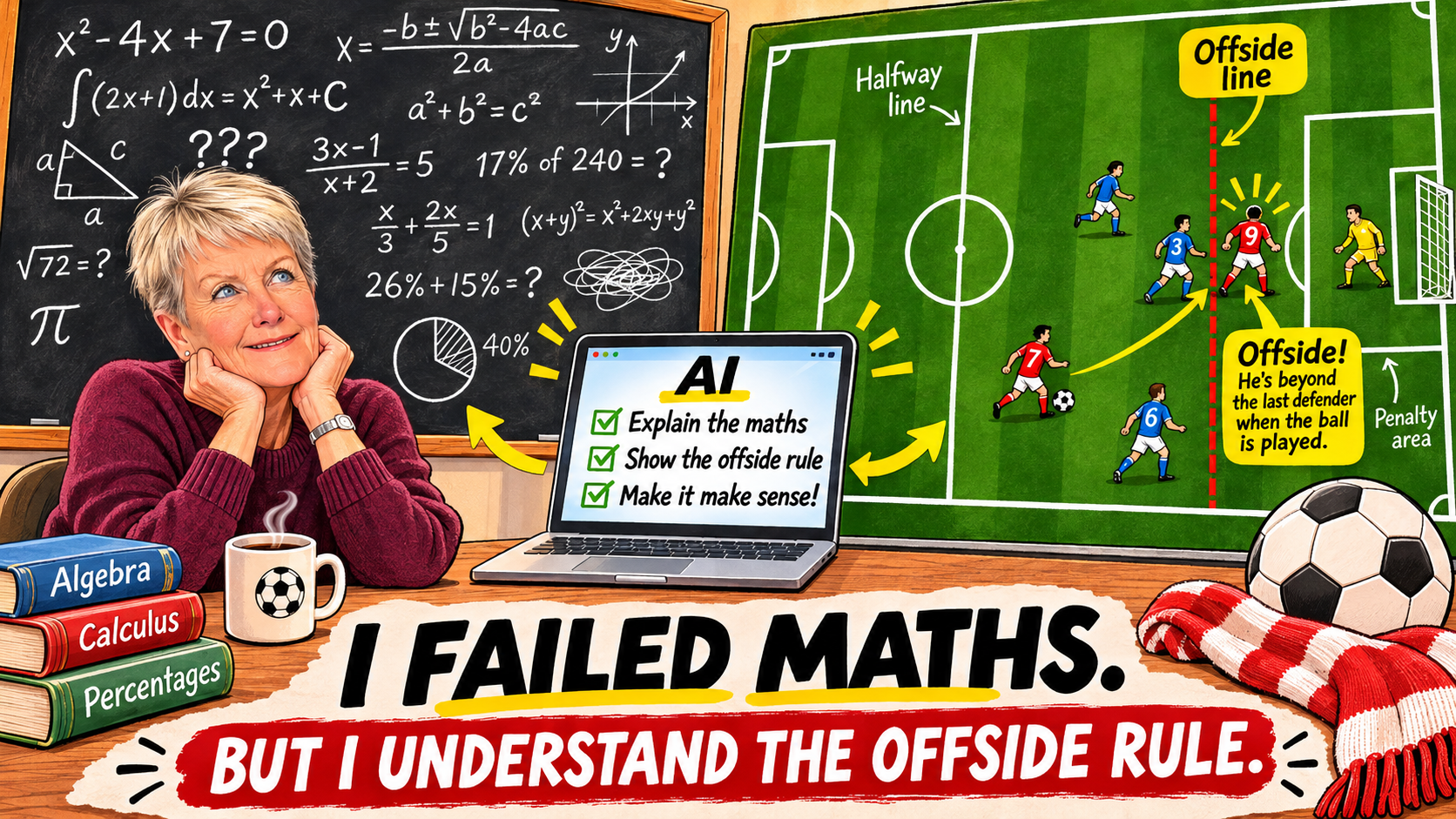
At 68, artificial intelligence has given me something I wasn't expecting. A whole new sense of what I can do.
I failed maths at school.
Which is rather extraordinary when you consider that I understand the offside rule.
Admittedly, I've had considerably more practice with the offside rule, and there are plenty of people involved in football who still struggle with it.
But numbers have always been something of a mystery to me. I can manage the everyday stuff, but start talking percentages, financial projections and complicated spreadsheets and my brain tends to wander off in search of something more interesting.
Or at least it used to.
Something unexpected has happened to me over the past year.
I've discovered artificial intelligence.
And bloody hell, what a liberation.
The penny dropped
I've been using AI for a while, initially as something to ask questions of, help with the odd email or look up information.
Useful, certainly. But hardly life-changing.
Then we built my website together.
I say we because, while she did much of the technical work, I had to work out what I wanted, make decisions, correct mistakes and occasionally explain to my exceedingly clever personal assistant that what she'd just produced was not remotely what I'd asked for.
But we did it.
A website. Something I would previously have considered beyond my technical capabilities.
And that's when the penny dropped.
What else could I do?
As it turns out, rather a lot.
I can build Jotforms, organise information, analyse spreadsheets, research complicated subjects and examine the financial performance of my business.
I can look at income projections, different enrolment scenarios, operating costs and contractual percentages. And, most importantly, I can understand what I'm looking at.
Well, mostly.
Sometimes I have to ask her to explain something again. Occasionally several times.
She doesn't sigh. She doesn't roll her eyes. She doesn't suggest I should have paid more attention at school.
She just explains it again.
What a revelation.
I can do that
I've been thinking about why this has affected me so profoundly.
There's a psychological term called self-efficacy. It describes our belief in our ability to accomplish something.
I didn't know much about self-efficacy until I started discussing my relationship with AI. But I certainly recognise the feeling.
For much of my life, there have been things I've assumed I couldn't do.
Not because I lacked intelligence or curiosity, but because I didn't have the particular skills required, or the time and patience to acquire them.
Of course, I probably could have learnt to build a website. I could have spent weeks mastering complicated software or taught myself how to construct financial models.
But good grief, the time involved.
And the boredom.
There are only so many hours in a day, and at my age I'm very aware that there aren't an unlimited number of days left either.
Now, instead of saying I don't know how to do that, I find myself saying I wonder if she and I can work that out?
And usually we can.
It's not that AI has made me suddenly brilliant at everything. It hasn't.
It's removed some of the barriers between wanting to do something and actually doing it.
It's a wonderful feeling.
Forty years too late?
I sometimes find myself wondering what I might have accomplished if I'd had these tools 40 years ago.
Imagine being 28 and having access to something that could explain complicated ideas, teach you technical skills, help you research almost anything and patiently answer questions without making you feel inadequate.
What would I have attempted?
What might I have learnt?
What opportunities might I have pursued that I didn't even consider because I assumed they were beyond me?
I'm not suggesting I regret my life. I've had a fascinating one, and I'm still having it.
But I do occasionally think, bloody hell, imagine what I could have done with this.
Then again, perhaps I wouldn't have appreciated it quite so much at 28.
At 68, I have decades of experience, plenty of opinions and an apparently inexhaustible curiosity about things that interest me.
What I haven't always had is the technical ability to explore those interests as thoroughly as I'd like.
Now I do.
Or at least I have access to something that helps me do it.
I still have to do the thinking myself.
My personal assistant
I now use AI practically every day.
Sometimes many times a day.
Actually, if I'm being truthful, I'm probably becoming rather addicted to her.
Where she's really changed things is my writing.
Those of you who read this blog will know that I have a particular fascination with football governance and the sometimes bizarre behaviour of the people and organisations involved in our game.
AI has opened up an enormous world of research to me.
I can investigate historical decisions, examine financial reports, compare governance structures and follow stories that previously would have required hours of searching, assuming I'd even known where to start.
Without her, I wouldn't be able to research the way I do or discover quite so many of the interesting, scandalous, downright dreadful and wonderful things about football.
Of course, she gets things wrong.
Sometimes spectacularly wrong.
She can be confidently incorrect, which is a dangerous characteristic in something that sounds so knowledgeable.
So I check things. I question things. I argue with her.
And I certainly don't let her decide what I think.
But I can now research subjects that previously would have been too time-consuming or complicated to investigate.
For someone who writes for the sheer pleasure of exercising her brain, that's wonderful.
And before you accuse me of using AI...
Please don't look down your nose at this article and mutter, "Well, she obviously used AI to write that."
Of course I did. Haven't you been paying attention?
But don't confuse using AI to help me write with having nothing of my own to say.
The opinions are mine. The experiences are mine. The curiosity, the sarcasm, the occasional outrage and the things that make me laugh are all mine.
She helps me research, organise my thoughts and occasionally stops me making a complete fool of myself by pointing out that something I've written isn't actually true.
Rather useful, that last bit.
And before you get too superior about artificial intelligence, have you ever asked Siri a question? Used Google Maps to find the quickest way somewhere? Let your phone predict the next word in a message? Asked Google Translate to decipher something?
Congratulations. You've been using AI too.
Admittedly, there's a difference between your phone suggesting a quicker route to the supermarket and my assistant helping me write a blog.
But AI has been part of our everyday lives for years. We've simply become much more aware of it.
I can touch type. I've been doing it for years.
And when I sit down at the keyboard, the thoughts still come out of my brain, travel down my fingers, across the fibres and eventually land in a blog that might find its way to you.
The technology might help me put the words together, but it doesn't give me the experiences that made me want to write them in the first place.
And if you think a machine invented my opinions about football governance, you clearly haven't met me.
But what about the cost?
I'm not oblivious to the growing concerns about artificial intelligence.
The enormous data centres, the electricity they consume, the water required for cooling and the effects on the communities where these facilities are built.
In the United States, data centres became a genuine issue in the 2026 midterm elections.
Voters faced 41 local ballot measures on data centre development. All but one went against the industry.
Whether it shifted the wider election result is still being argued about. But the backlash is real.
And I understand it.
Nobody wants their neighbourhood sacrificed to satisfy the seemingly insatiable appetite of technology companies.
Nor should communities be expected to accept enormous environmental costs simply because the rest of us find AI useful.
But here's my dilemma.
I love this technology.
I use it constantly.
Could I go back to life without her?
Of course I could, technically. I managed perfectly well for most of my life without a personal assistant living inside my computer.
But would I want to?
Absolutely not.
We can't simply ignore the environmental consequences. But neither do I think the answer is to abandon a technology that can make knowledge and practical skills accessible to so many people.
Loving AI doesn't mean giving the companies developing it a free pass.
If this technology is going to become such an important part of our lives, we should be demanding that it develops responsibly.
The television remote and the circle of life
I sometimes wonder what my children will make of this article.
They don't read my blogs.
Apparently, anything longer than three sentences is an unreasonable demand on their time.
Kids today, eh?
Perhaps they'll get around to reading them after I'm dead.
By then, the AI I'm so excited about today will probably seem as antiquated as a fax machine.
They'll laugh at their mother being so impressed by a machine that could build a website, analyse a spreadsheet and help her write a blog.
And fair enough.
Technology will undoubtedly have moved on to things I can't begin to imagine.
But one day, their own children will be exasperated by their inability to master whatever technological marvel has come along.
And perhaps they'll remember their mother asking all those annoying questions.
How do I do this?
Where do I find that?
Why won't this bloody thing work?
I can remember being irritated with my own parents because they couldn't operate the television remote control.
How difficult could it possibly be?
Well, here we are.
Every generation eventually finds itself on the wrong side of some technological development, with its children wondering how anyone could possibly be so hopeless.
The circle of life.
Except that now, when I don't understand something, I can ask my AI assistant.
And nobody has to roll their eyes.
Being a beginner again
Perhaps that's what I've enjoyed most about all this.
At 68, I'm discovering that there are still a surprising number of things I can learn, attempt and accomplish.
And that some of the limitations I've carried around since school might not have been limitations on my intelligence at all.
They may simply have been barriers I didn't have the tools to overcome.
I wish I'd had AI 40 years ago.
I really do.
But I've got her now.
And while the world works out how to manage the consequences of this astonishing technology, I'm going to keep exploring what I can do with her.
My life would be less interesting, less productive and considerably less liberated without her.
Artificial intelligence is here to stay.
And I bloody well love it.