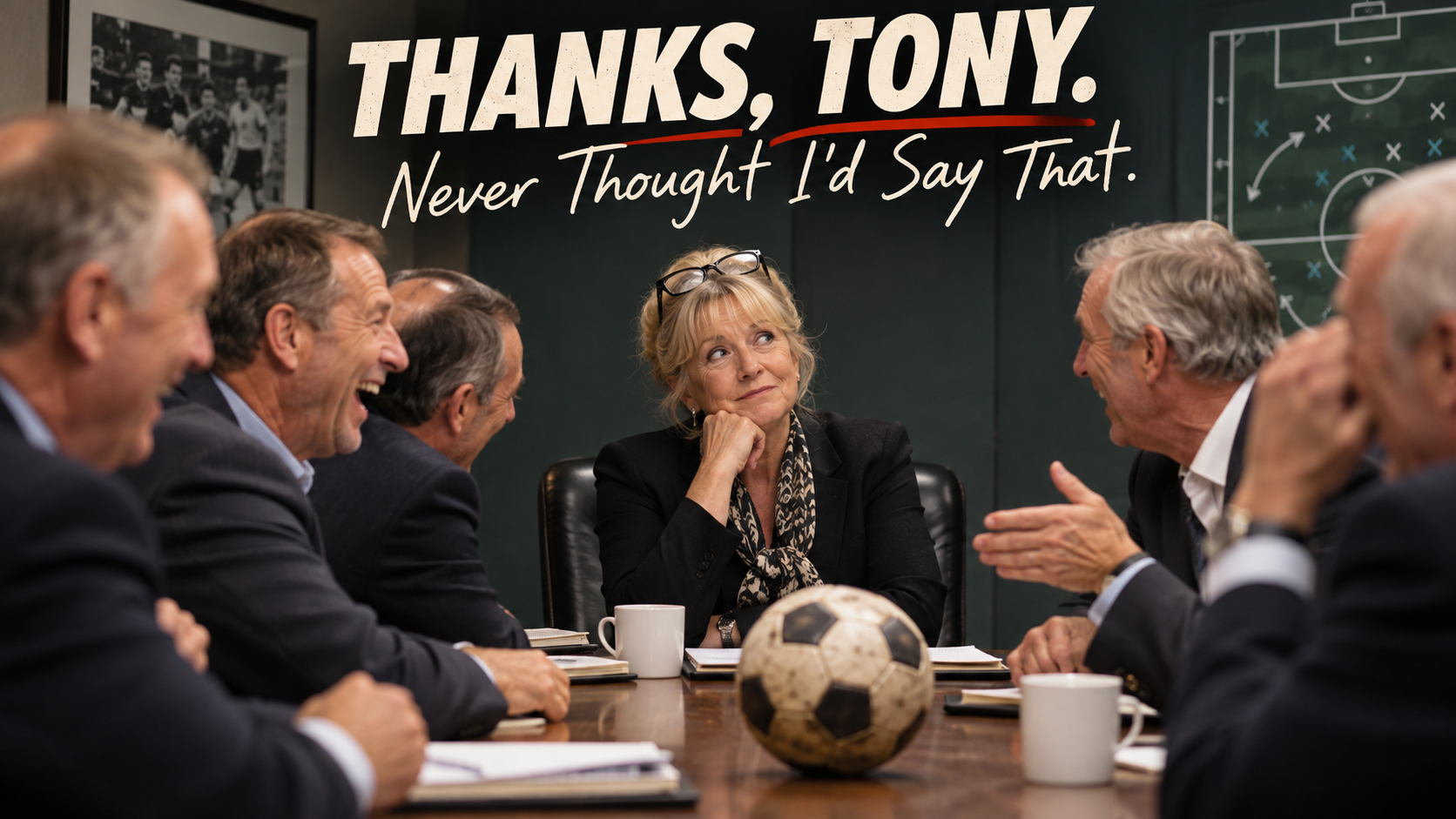
Well, there’s a sentence I never expected to write.
Thank you, Tony Abbott.
Fourteen years after Julia Gillard delivered her famous misogyny speech in Parliament, Tony is apparently still offended.
Speaking to the ABC’s I Was Actually There, he described her speech as “pretty over the top” and an “unjustified attack”.
Oh dear. Still smarting after all these years.
But thank you, Tony, because your continued indignation prompted me to sit down and watch the entire speech again.
And what a speech it was.
I remember watching it in October 2012. I was two years into my presidency of South Hobart Football Club, still learning the ropes and navigating the politics of a game very much dominated by men.
Watching it again in 2026, I found myself thinking less about Canberra and more about football.
Because some of what Julia Gillard was talking about still feels remarkably familiar.
A Woman in a Man’s World
When I became President of South Hobart FC in 2010, I entered a world where women in football leadership were something of a rarity.
Learning how football politics worked. Navigating the boys’ clubs. Trying to understand the relationships, alliances and unwritten rules that seemed to govern so much of the game.
I was often the only woman in the room, apart from the CEO’s assistant.
Football Tasmania had never had a female President or CEO.
And guess what?
Fourteen years after Julia Gillard’s speech, it still hasn’t.
Not one female president. Not one female CEO.
Not in 2012. Not in 2026.
For an organisation that likes to talk about inclusion, diversity and the growth of women’s football, that’s quite an achievement. Just not one I’d be putting in the annual report.
Years ago, I won Female Administrator of the Year at a breakfast at Wrest Point.
An honour, of course.
Although there were only about two female administrators in the state at the time.
I did feel a bit sorry for the other one.
I was supposed to step up, accept the award and sit down.
I’d written a speech instead - of course I had.
At the time, Football Tasmania had few if any women on its board, so I said so.
The FT President told me they were working on it.
To be fair, they did.
There are women on the board now.
Just not at the head of the table.
We celebrate the growth of women’s football. We promote female participation. We talk about pathways, opportunities and equality.
But apparently the pathway to the very top of Tasmanian football administration remains an exclusive gentlemen’s club.
And before someone tells me there simply haven’t been any suitable women, perhaps we should ask why. Where are the opportunities? Where is the encouragement? Where is the succession planning?
Or are we just waiting for a suitably qualified woman to materialise out of thin air?
Women have made enormous strides on the pitch.
At the top, we’re still waiting for someone to open the bloody door.
And even when you do get through it, you soon discover that having a seat at the table doesn’t necessarily mean you’re part of the conversation.
The Politics of the Urinal
I’ve written before about The Politics of the Urinal.
It’s not really about toilets. Although, as it turns out, they can be very handy places for conducting football business.
In my early years as President, I’d occasionally sit in meetings wondering whether I’d missed something.
A matter would come up for discussion and several of the men around the table seemed remarkably well informed. They knew what was being proposed, who supported it and, sometimes, what the outcome was likely to be.
Had there been another meeting?
A phone call?
Had I missed an email?
Eventually, the penny dropped.
The conversations had already happened. At the bar, over a beer, in the corridor or quite possibly while standing shoulder to shoulder at the urinal.
A remarkably efficient system of football governance, provided you had the appropriate plumbing.
By the time everyone sat around the official table, much of the groundwork had been done.
And there I was, thinking the meeting was where we were supposed to discuss things.
Silly me.
Of course, informal conversations happen in every organisation. There’s nothing inherently wrong with that.
But when those conversations consistently take place in spaces where women aren’t present, the playing field isn’t exactly level.
You can have the title, the responsibilities and the workload.
You can even be sitting at the table.
But if the real conversations are happening elsewhere, you’re already playing catch-up.
And that’s a rather interesting definition of inclusion.
A Question for the President
Over the years, I’ve encountered some extraordinary examples of what passes for humour in football.
One particular occasion still makes me shake my head.
Ken and I were attending another football club’s dinner to celebrate a significant milestone in its history. There were around 200 people in the room.
The club president was wandering around with a microphone, interviewing guests.
Eventually, he arrived at our table.
And asked me whether I would withhold sexual favours from Ken, who was coaching our team, if we didn’t win the league.
Yes. Really.
In front of 200 people.
I remember thinking, God, what do I say to that?
So I replied that it wouldn’t be an issue because we were going to win the league.
And we did.
His wife came over afterwards and apologised to me. I think she was embarrassed.
Which suggests I wasn’t the only person in the room who thought the question was inappropriate.
And isn’t this one of those moments in life when you desperately wish you could have your time over again?
Not because you didn’t handle it, but because somewhere between driving home, brushing your teeth and lying awake in bed, you come up with the perfect response.
Sharp. Witty. Cutting.
The sort of reply that would have brought the house down and left the person holding the microphone wishing he’d never picked it up.
Unfortunately, these magnificent responses tend to arrive several hours after they’re required.
Mine certainly did.
Still, telling him we’d win the league wasn’t a bad answer.
Women in football are often told we need a thick skin.
Believe me, I’ve got one.
Yet here I am, about ten years later, still thinking about what I should have said.
Perhaps the problem was never my skin.
Now, imagine a male club president being asked, in front of 200 people, whether he’d refuse to have sex with his wife if her team didn’t win the premiership.
Ridiculous, isn’t it?
But apparently, when the president is a woman and her husband is the coach, it’s perfectly acceptable dinner entertainment.
I was there as the president of a football club. Ken was there as a coach.
Yet somehow my contribution to the evening was reduced to a question about our sex life.
And here’s the really irritating part.
What was I supposed to do?
Tell him off? Demand an apology? Deliver a lecture on appropriate behaviour while 200 people waited for dessert?
Or do what women have been doing for years?
Smile, think quickly, come up with a clever answer and move on.
Because if you object, you’re humourless. If you get angry, you’re emotional. If you make a fuss, you’re difficult.
And if you laugh it off, everyone assumes the joke was perfectly fine.
A rather convenient arrangement, wouldn’t you say?
For the person holding the microphone, anyway.
Darling, and Other Little Pleasantries
Of course, not every example of sexism comes with a microphone and an audience of 200.
Some of it is so casual you almost miss it.
I remember hosting a visiting mainland club and introducing myself to members of its board.
“Thanks, darling.”
And that was pretty much the end of the conversation.
Darling.
Sixteen years as a club president and apparently I’d been promoted to darling.
I wonder whether they’d have greeted a male president with “Thanks, sweetheart.”
Somehow I doubt it.
Then there are the occasions when you’re simply overlooked.
I’ve attended matches at mainland clubs where the male officials were included in the hospitality and I wasn’t. As recently as last year.
No dramatic confrontation. No offensive remarks. Just the quiet assumption that the men belonged and I was presumably someone’s wife.
And sometimes it isn’t quiet at all.
I once sent someone an invitation to a significant Australia Cup match.
The response?
To tell me to go fuck myself because apparently I’d only sent the invitation to upset him.
An invitation to a football match.
Clearly a provocative act.
Now, I’m not suggesting every rude man is a misogynist. Some people are perfectly capable of being unpleasant to everyone, regardless of gender.
But when you’re a woman in football leadership, you do begin to notice a pattern.
The familiar terms. The assumptions. The little exclusions. The occasional spectacularly bad behaviour.
Individually, some of these incidents might seem trivial.
Collectively, over years, they’re bloody tiresome.
And the most frustrating part is that you’re expected to navigate all of it without making anyone else uncomfortable.
Because heaven forbid you should be the difficult woman in the room.
Perhaps we need another workshop on inclusion.
That should fix it.
And then there’s Ken.
Being married to a Tasmanian football legend has its disadvantages.
Everybody knows Ken Morton.
And rightly so. He’s earned his place in Tasmanian football history.
But sometimes I wonder whether people see me as a football administrator in my own right or simply as Ken’s wife.
Am I his handbag?
Something he brings along to matches, dinners and official functions?
Don’t get me wrong. I’m enormously proud of Ken and everything he’s achieved in football.
But I was president of a football club. I didn’t spend those years holding his coat.
I had a job to do, responsibilities to meet and opinions of my own. Plenty of them, as some people will no doubt confirm.
And perhaps that’s one of the reasons I don’t particularly enjoy attending football functions these days.
After years of navigating the assumptions, the little dismissals and the occasional spectacularly inappropriate remark, sometimes it’s simply easier not to go.
Back to Julia. And Tony.
Which brings me back to Julia Gillard.
I’m not comparing my experiences running a football club with those of Australia’s first female prime minister. She operated on a slightly larger stage, with considerably more people lining up to tell her what she was doing wrong.
But watching her speech again reminded me just how familiar some of those expectations were.
Be strong, but not aggressive.
Be confident, but not arrogant.
Stand up for yourself, but don’t make a fuss.
And whatever you do, don’t get angry. Nobody likes an angry woman.
Unless, of course, she’s angry about something the men have decided she should be angry about.
Gillard endured years of commentary about her appearance, her relationship, not having children and whether she was suitable to lead the country.
There were legitimate political criticisms of her government. Of course there were. That’s democracy.
But her gender and personal life were also fair game in a way that should have made a few more people uncomfortable.
And when she finally stood up in Parliament and delivered fifteen minutes of blistering criticism, some of the attention turned to whether she’d gone too far.
Apparently, even after years of putting up with that nonsense, there was still an acceptable level of indignation she was supposed to observe.
And Tony Abbott still thinks her speech was unjustified.
He says she was simply following the old doctrine that attack is the best form of defence.
Or perhaps, after years of it, she’d just had enough.
He also says he never consciously treated women as lesser because they were women.
Well, Tony, that’s rather the point, isn’t it?
You don’t necessarily have to be conscious of your behaviour for it to have an impact.
The man who calls a female president “darling” may think he’s being charming.
The man who makes a sexual joke in front of 200 people may think he’s being hilarious.
The men who conduct their football politics in the bar or at the urinal may not give a moment’s thought to who’s missing.
And perhaps that’s what makes casual misogyny so difficult to shift.
The people on the receiving end notice it.
The people dishing it out often don’t.
And when someone finally says something, they’re accused of overreacting.
Sound familiar, Tony?
Thanks Again, Tony
The dinner aside, I don’t spend my days dwelling on these experiences.
Football has given me an extraordinary amount. Wonderful friendships, great memories, plenty of laughs and more than a few arguments.
I wouldn’t trade those years for anything.
But I do sometimes wonder how many women have walked away from football leadership because they simply got tired of navigating the nonsense.
How many decided it wasn’t worth the effort?
How many never put their hands up in the first place?
And how many talented women are still sitting in meetings, wondering why everyone else seems to know what was decided before the meeting even started?
Meanwhile, Football Tasmania has still never had a female President or CEO.
Perhaps that’s just a coincidence.
A rather long-running one.
So thank you, Tony Abbott.
I never imagined I’d be thanking you for anything connected with Julia Gillard’s misogyny speech.
But you prompted me to watch it again.
And reminded me that some things haven’t changed nearly as much as we’d like to think.
Fourteen years on, Julia’s speech still resonates.
And you’re still offended.
So thanks, Tony.