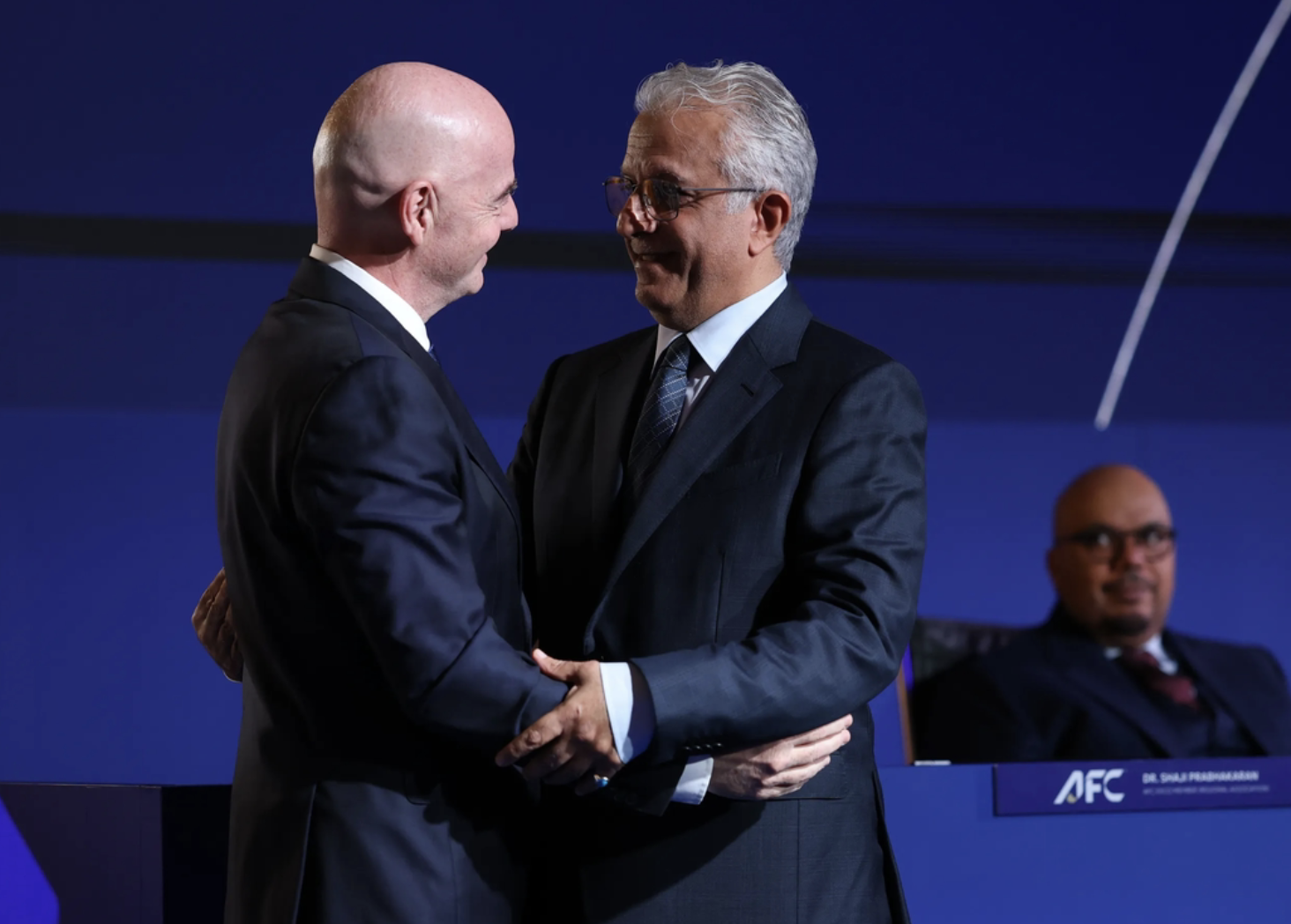
All smiles in Tokyo. Gianni Infantino and Sheikh Salman at the AFC Congress on 23 October 2026. Two months earlier, the AFC was questioning FIFA's leadership. What changed?
Photo: Gianni Infantino / Instagram
Football's money, political loyalty and a remarkable change of heart in the corridors of FIFA.
I know. Governance. FIFA. International football politics.
Boring.
And about as far removed from our everyday lives as you can possibly get.
But here's the thing. It's our money. Football's money. And surely we should have some interest in what happens to it.
I sometimes wonder why I bother writing about this stuff. I can research it, ask questions, get cross about it and write another blog. But in reality, who cares what I think?
I'm fairly certain Football Australia doesn't.
And I'm damn sure Sheikh Salman and Gianni Infantino have absolutely no idea that I exist, let alone the thousands of people playing football on a little island at the arse end of the world.
That can leave me feeling helpless.
But then I think about all those children turning up to training, the parents paying their registration fees, the volunteers marking pitches and the coaches giving up their evenings.
They are football.
Not the blokes in expensive suits sitting around enormous conference tables.
A hug in Tokyo
On Friday 23 October, something interesting happened in Tokyo.
Sheikh Salman bin Ibrahim Al Khalifa, the President of the Asian Football Confederation (AFC), publicly endorsed Gianni Infantino for another term as President of FIFA.
For anyone unfamiliar with football's alphabet soup, FIFA is the organisation that governs world football. The AFC looks after football across Asia, including Australia.
Infantino is the man at the top of FIFA.
Sheikh Salman is one of the most influential men in Asian football.
And on Friday, they embraced.
There was an awful lot of love in the room.
Whilst I would have loved to show you a photo of "the hug", it would have cost too much to buy from Getty.
You can see the two of them together on FIFA's own website.
The meeting was closed to the media, so we only know what they chose to tell us.
Infantino returned the favour. He praised Sheikh Salman's work and backed his bid for another term as AFC President.
"With this support, we move on together," he told the delegates.
Lovely.
Except that just two months ago, the AFC was part of a rebellion against Infantino's leadership.
What happened to all that outrage?
Well, there is a rather large amount of money involved.
Remember the rebellion?
Earlier this year, I wrote several blogs about Infantino and the growing unrest within FIFA.
The trouble started when FIFA explored a proposal to move its hugely valuable commercial operations into a new company and potentially sell a minority stake to private investors.
We're talking about the money generated by the World Cup, broadcasting rights, sponsorships and other commercial activities.
The proposal was called FIFA Forward Enterprise.
And it went down like a lead balloon.
The governing bodies of European football, Asian football and North and Central American football were furious.
They believed they had not been properly consulted and accused FIFA's leadership of a fundamental breach of trust.
These were not a handful of disgruntled supporters complaining on Facebook.
These were powerful organisations representing a substantial part of world football.
Infantino eventually abandoned the proposal and apologised for how it had been handled.
But the questions about transparency, accountability and governance remained.
At least I thought they did.
Then somebody mentioned the money
FIFA already distributes substantial amounts of money to its 211 national member associations through a programme called FIFA Forward.
The idea is simple enough.
FIFA earns billions from international football, particularly the World Cup, and some of that money is returned to national associations to help develop the game.
It can pay for facilities, coaching, women's football, youth programmes and other projects.
That is exactly what FIFA should be doing.
Under the current four-year programme, national associations can receive up to US$8 million.
The next funding cycle, covering 2027 to 2030, was originally expected to provide US$10 million per association.
Now FIFA is proposing to increase that to US$25 million.
That's approximately A$35.7 million for each national association over four years.
Not an additional $25 million on top of everything else, but a substantial increase in the total amount available.
And here's where the story becomes particularly interesting.
In September, two of Infantino's critics, the presidents of European football and North and Central American football, were themselves demanding that FIFA distribute more of its enormous financial reserves.
They wanted at least US$10 million extra per national association.
They also wanted independent scrutiny of FIFA's finances.
Their argument was that FIFA already had plenty of money and didn't need to sell part of its commercial operations to private investors to fund football development.
Infantino subsequently announced an even bigger increase.
The proposed total package is US$6.35 billion.
Six point three five billion US dollars.
It still needs final approval. That is due at the FIFA Congress in March.
The same month FIFA's members vote on whether Infantino gets another term.
And who is now travelling around the world announcing this generosity?
Gianni Infantino.
You have to admire the political theatre, if nothing else.
The people challenging him wanted more money distributed to football.
Now Infantino is the public face of a funding increase larger than they requested.
And some of his former critics are embracing him.
But hang on. Whose money is it?
This is the part that really gets me.
It isn't Gianni Infantino's money.
It belongs to football.
In August, the AFC agreed. Its letter with European and North and Central American football said football belongs to no individual.
One of the people who signed it was Sheikh Salman.
The money comes from the extraordinary commercial success of a game played and followed by billions of people.
FIFA is supposed to manage those resources on behalf of football.
Infantino is its elected president, not a wealthy philanthropist handing out his personal fortune.
Yet the more money FIFA promises, the more gratitude seems to flow towards the man announcing it.
Australian football identity Craig Foster was particularly forthright on social media this weekend.
He argued that FIFA's money, ultimately belonging to football's players, participants and supporters, was being used to purchase political loyalty.
That's a serious accusation and proving a direct exchange of money for votes would require evidence.
But the underlying question is entirely reasonable.
How do we stop football development funding from becoming a political tool?
And why should national associations feel personally indebted to a president for distributing money that belongs to football in the first place?
Why the little countries matter
Every FIFA member association has one vote in the presidential election.
Australia gets one.
Brazil gets one.
Germany gets one.
And so does a tiny Pacific island nation.
That is how FIFA is structured. The wealthy football nations don't automatically get more votes than the smaller ones.
In principle, I think that's fair.
The money is shared the same way. Papua New Guinea is entitled to the same amount as Brazil.
Now consider what US$25 million means to a country with very little money for football.
It could transform its facilities, coaching programmes and development pathways.
For Germany, it's pocket change.
Of course the smaller countries want the funding.
And of course their leaders are going to welcome someone announcing more of it.
But there is a difference between welcoming development funding and feeling politically obligated to the person announcing it.
There should never be any suggestion that an association's willingness to challenge FIFA's leadership might affect its access to football's money.
That's why governance matters.
Even if it sounds boring.
So what happened to the AFC's outrage?
Back to our friends in Tokyo.
In August, the AFC was demanding accountability and transparency from FIFA.
In October, its president was endorsing Infantino for another term.
The AFC itself is also in line for more money. FIFA proposes US$99 million for each of the six continental confederations.
So what did Sheikh Salman say about the about-face?
"Yes, we had some issues we spoke about in the past."
After meeting Infantino in Zurich, he said, there was "a true understanding between us."
That's it.
A true understanding. Of what, exactly?
Perhaps Sheikh Salman was satisfied with Infantino's apology.
Perhaps meaningful assurances have been given behind closed doors.
Perhaps the relationship has genuinely been repaired.
Or perhaps the prospect of billions more dollars being distributed around world football helped smooth things over.
Surely someone should explain what changed.
FIFA promised a review of what went wrong with its commercial proposal. Has anyone seen it?
After apologising to the FIFA Council this month, Infantino told Council members to put their governance questions in writing. He would answer them at the next meeting.
That meeting is on 16 December.
There's just one problem. Nominations for the FIFA presidency close on 18 November.
UEFA isn't prepared to wait. It has submitted 42 questions covering 12 areas of concern and demanded answers by 2 November.
Good on them.
FIFA's response? Council business is confidential. And its lawyers have accused UEFA of harassing Infantino.
Forty-two questions. Harassment.
Really?
Because surely anyone considering whether to challenge Infantino deserves to know what happened before nominations close.
And surely the people responsible for electing FIFA's president deserve those answers too.
I don't know what changed.
But I would certainly like to.
And what about Football Australia?
This is where it becomes particularly relevant to us.
Football Australia is hardly flush with cash.
Its 2025 financial statements reported an operating loss of $3.2 million and a statutory loss of $15.3 million, much of it one-off costs. The organisation has been cutting staff and restructuring its operations.
So the prospect of significantly increased FIFA funding must be welcome.
And I don't begrudge them that money for a moment.
Australian football desperately needs investment.
We need better facilities, more grounds, more opportunities for young players and greater support for the people delivering the game.
In August, Football Australia called for clear and credible action and accountability at FIFA. It also said it would work with and through the AFC.
It followed the AFC then.
Now the AFC has changed its mind.
More recently, Football Australia's chair, Anter Isaac, described FIFA's controversies as growing pains, suggesting its governance systems had struggled to keep pace with its commercial expansion.
He also said it was premature to discuss whether Australia would support Infantino's re-election.
Then came Friday's endorsement from the AFC President.
Australia is a member of the AFC, but Sheikh Salman doesn't cast Australia's vote.
Football Australia does.
A rock and a hard place
To be fair to Football Australia, it is in a tricky spot.
We are part of Asian football. We need the AFC for our competitions, our tournaments and our influence.
If Anter Isaac stood up tomorrow and said Australia doesn't support Infantino, we would be on our own.
The outlier.
The complainer from the bottom of the map.
Would that help Australian football? Probably not.
It's natural to get defensive when you're criticised. FIFA is no different.
The vote is a secret ballot anyway. Football Australia doesn't have to tell anyone how it votes.
That's if there is a vote at all. If nobody stands against Infantino by 18 November, he can be returned without one.
So I'm not asking Football Australia to pick a fight.
I'd just like to know what it thinks good governance at FIFA looks like.
And whether anything it asked for in August has actually happened.
That shouldn't be too much to ask.
We've seen this before
Anyone who remembers Sepp Blatter's long presidency of FIFA will recognise some familiar themes.
Blatter built strong relationships with smaller football nations and presented himself as their champion against the wealthy European football establishment.
Development funding was an important part of FIFA's work during those years.
Some of that work was valuable.
But FIFA also became engulfed in corruption scandals that eventually brought Blatter's presidency to an end.
Infantino arrived in 2016 promising a new era.
Transparency. Accountability. Reform.
Ten years later, we are still asking questions about the relationship between money and political power in world football.
That doesn't mean Infantino has committed the wrongdoing associated with the Blatter era.
But it does make me wonder how much has really changed.
A little island at the arse end of the world
And this is where I return to that feeling of helplessness.
I can write about Gianni Infantino until I'm blue in the face.
I can question FIFA, wonder about the sudden change of heart in Asia and ask what Football Australia intends to do.
Will any of them read it?
Almost certainly not.
Will it change the outcome of the FIFA presidential election?
I very much doubt it.
I don't object to FIFA distributing more money. I hope it does.
But it is our money.
Not Gianni's.
Not Sheikh Salman's.
Ours.
And if the people running world football want our trust, surely the least they can do is explain what happened to all those concerns about governance.
Because two months ago, they were demanding answers.
Now they're hugging.
And I would really like to know why.