Stop Telling Football to be Grateful, Part 3: OMG the Money!
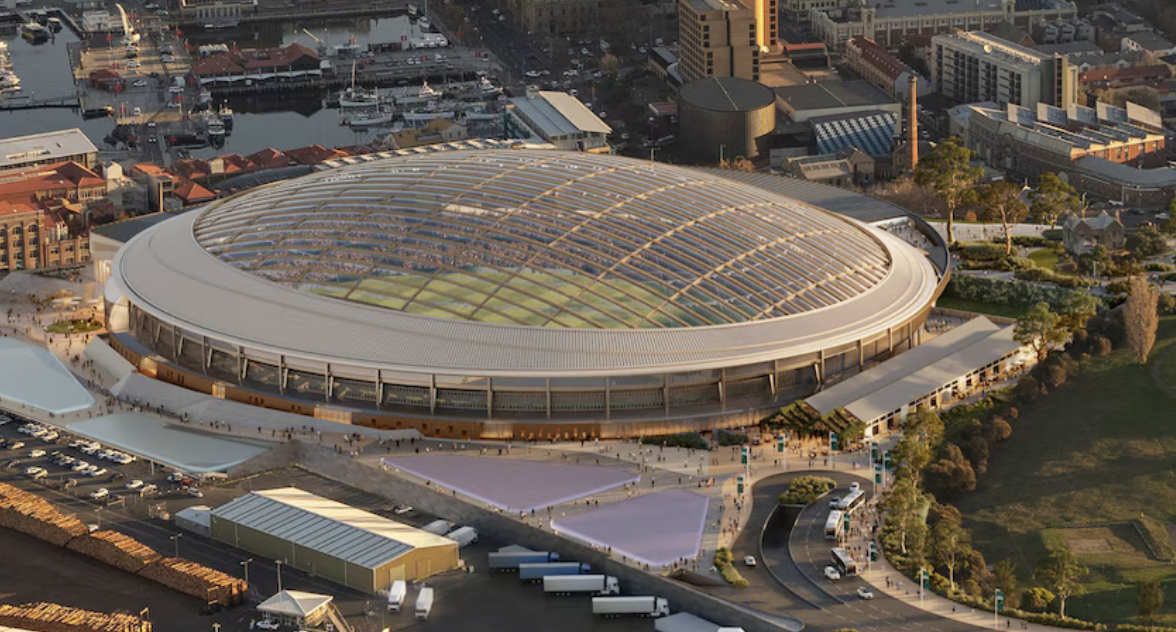
Artists impression of the Macquarie Point Stadium - show me the money
Follow the money (and what Tasmania funds and what it doesn’t)
Before I get into the figures, I want to clarify something.
When I say “the Government is funding AFL”, I’m not talking about some separate, mysterious pot of money that has nothing to do with ordinary Tasmanians.
Government money is not magic money.
It’s not someone else’s money.
It is our money.
It comes from taxpayers, ratepayers, workers, business owners, parents, volunteers, clubs, communities, everyone.
Sometimes people talk about “government” as if it is a completely separate entity, floating above society, handing out favours.
But it’s not separate.
It’s us.
So when millions of public dollars go into AFL facilities, AFL programs, AFL pathways and AFL priorities, that is not “AFL getting funding”.
That is Tasmania choosing, through its elected representatives, to direct our shared money into that code.
And if you are a football person, and you pay tax and you coach and you volunteer and you fundraise and you run a canteen and you pay club fees, then you are allowed to ask:
Why does one sport receive structural investment as a certainty, while another sport is told to share space and be grateful?
That isn’t bitterness.
That’s civic literacy.
Participation (so we’re talking facts, not opinions)
Football is often treated like the noisy code that should just calm down.
But football is not small.
Football Tasmania’s published participation summary (using Football Australia reporting) states Tasmania has 31,278 football participants, including 14,552 outdoor football participants.
AFL Tasmania reporting in 2024 put total registered participation at 21,002.
Participation data is never perfect, and categories are never identical across sports, but the point is obvious.
Football is a major participation sport.
AFL is a major sport too.
But in Tasmania, only one of them is treated like it deserves serious public investment.
What the Tasmanian Government gives football (soccer)
This is the number that should stop everyone mid-sentence.
A Tasmanian Parliament Question on Notice response states the Tasmanian Government provided Football Tasmania $1.85 million from 2022–23 to 2025–26. (afl.com.au)
That’s roughly $462,500 per year (averaged across four financial years).
If you break that down using Football Tasmania’s total participation figure:
31,278 participants.
That works out to about:
$14.80 per football participant per year
That is what the baseline public investment looks like for the biggest participation sport in Tasmania.
And the rest is made up by:
volunteer labour
fees
fundraising
canteens
raffles
parents topping up what the system refuses to provide
What the Tasmanian Government gives AFL (before we even talk about a stadium)
The Tasmanian Government’s funding commitment for the AFL licence has been reported as $12 million per year for 12 years (a total of $144 million). (ABC)
That is:
$12,000,000 per year
for 12 years
locked in
Now break it down against the AFL participation figure (21,002):
That’s approximately:
$571 per AFL participant per year (afl.com.au)
So, on a straight annual comparison:
Football baseline: ~$462,500 per year (afl.com.au)
AFL licence funding: $12,000,000 per year (ABC)
That is roughly 26 times higher, every year.
Not over the long run.
Every year.
AFL’s High Performance Centre (another major public spend)
AFL funding does not stop at the licence.
Reporting has stated a $105 million cap on State funding for the AFL High Performance Centre. (ABC)
In other words, AFL gets:
direct annual licence funding
plus a purpose-built high performance facility
And football gets told to share ovals and apply for a grant.
AFL infrastructure across Tasmania (the statewide pattern)
This isn’t just about Hobart.
The AFL infrastructure investment pattern exists across Tasmania.
York Park / UTAS Stadium (Launceston)
The redevelopment of York Park has been widely reported as a $130 million upgrade, consisting of $65 million from the Australian Government and $65 million from the Tasmanian Government. (ABC)
Dial Park (Penguin)
The Tasmanian Government committed $25 million (2024–2026) for infrastructure upgrades at the Dial Regional Sports Complex in Penguin (Dial Park). (Central Coast Council)
Again, not a competitive grant.
Not “if you’re lucky”.
A structural public funding decision.
And then there’s the stadium
Macquarie Point is now being discussed publicly as a $1.13 billion stadium project.
I’m not going to re-run the stadium debate here.
But the point is unavoidable:
Tasmania can mobilise a billion-dollar project for one sport.
But football people still can’t get basic rectangular field access, lighting and changerooms that respect women and girls.
The costs don’t stop at construction
There’s another point people keep missing.
These big projects aren’t a one-off cheque.
They come with ongoing costs.
ABC reporting has pointed to the stadium having substantial operating and lifecycle cost implications, with safeguards calling for information to be released on ongoing subsidy and lifecycle costs after contractor selection. (ABC)
So this isn’t just money spent.
It’s money committed.
The totals (this is what “be grateful” looks like)
Here’s the part people hate seeing written down.
If we set the stadium aside for a moment, AFL-linked government funding and upgrades include:
AFL licence funding: $144 million (ABC)
AFL High Performance Centre (State cap/commitment): $105 million (ABC)
York Park upgrade: $130 million (ABC)
Dial Park upgrade: $25 million (Central Coast Council)
That’s $404 million in AFL-linked public funding and infrastructure, before the stadium.
And if Macquarie Point proceeds at $1.13 billion, the scale becomes something else entirely.
So when football people are told to be grateful, this is what they are being asked to accept:
AFL gets hundreds of millions (and potentially over a billion) while football fights for crumbs.
Dollars per participant (the comparison that hurts)
This is where it becomes impossible to pretend this is “equal treatment”.
Annual comparison (rough but revealing)
Football baseline public investment:
$462,500 per year for Football Tasmania (avg) (afl.com.au)
31,278 participants
= ~$14.80 per participant per year
AFL licence funding public investment:
$12,000,000 per year (ABC)
21,002 participants
= ~$571 per participant per year
That’s not a small gap.
That is a policy decision.
Twelve-year comparison (so no one can argue “short term”)
Over 12 years:
AFL: $144m / 21,002 ≈ $6,857 per participant over 12 years (ABC)
Football baseline: $1.85m over 4 years = ~$5.55m over 12 years
$5.55m / 31,278 ≈ $177 per participant over 12 years (afl.com.au)
Read that again.
Over the same time period:
AFL: $6,857 per participant
Football: $177 per participant
And that’s still before HPC, York Park, Dial Park, or the stadium.
The grant myth (the rigged part nobody admits)
This is where football people start to feel like they’re going mad.
Because yes, football can apply for grants.
But so can AFL.
So AFL gets:
direct government funding at scale
elite facilities and upgrades as a default
and then still competes for the same grant pools community sport is forced to fight over
Football gets:
a tiny baseline allocation (afl.com.au)
the same competitive grant pools
minus the spare volunteers and spare time required to survive constant applications just to stand still
That is not an even playing field.
That is stacking advantage on advantage.
Why this matters (and why I’m done being polite about it)
This is not an anti-AFL post.
People can love AFL.
People can play AFL.
People can attend AFL matches.
The issue is not AFL existing.
The issue is Tasmania’s funding culture, where prestige sport receives investment as a certainty…
…and participation sport is treated like a problem to manage.
Football people aren’t ungrateful.
They are exhausted.
They are doing the maths.
And they are done being told to clap politely while their sport is squeezed into whatever space is left over.
Stop telling football to be grateful.
About the author
I’m Victoria Morton. I’ve spent 20 years in Tasmanian football as a volunteer, club leader and advocate.
I’m writing a personal record of what I’ve seen, what I’ve learned and what Tasmania’s football community lives every week.
👉 Read more about me here: About Victoria
Sources / Bibliography
Tasmanian Parliament, Question on Notice: Government funding provided to Football Tasmania (2022–23 to 2025–26), total $1.85m (afl.com.au)
Football Tasmania participation summary (Football Australia reporting): 31,278 participants (incl. outdoor, futsal, schools)
AFL Tasmania participation figure: 21,002 registered participants (2024 reporting)
ABC News (19 Sept 2022): Tasmanian Govt increased AFL licence funding offer to $144m over 12 years (ABC)
AFL.com.au (Nov 2022): In-principle agreement notes Tas Govt commitment includes $12m/year over 12 years (and HPC funding) (afl.com.au)
ABC News (3 Dec 2025): Stadium bill safeguards include $105m cap on state HPC funding; lifecycle/ongoing subsidy info (ABC)
AFL.com.au (13 Aug 2025): State contributing $105m to high performance centre (afl.com.au)
ABC News (28 Apr 2023): York Park upgrade includes $65m federal + $65m Tasmanian Govt (= $130m total) (ABC)
Central Coast Council (14 Mar 2025): Tas Govt committed $25m (2024–2026) for Dial Park upgrades (Central Coast Council)
Tasmanian Infrastructure: Dial Park major project info (Infrastructure Tasmania)
Macquarie Point stadium cost publicly reported as $1.13b