“That’s our Milan Lakoseljac, No.9”
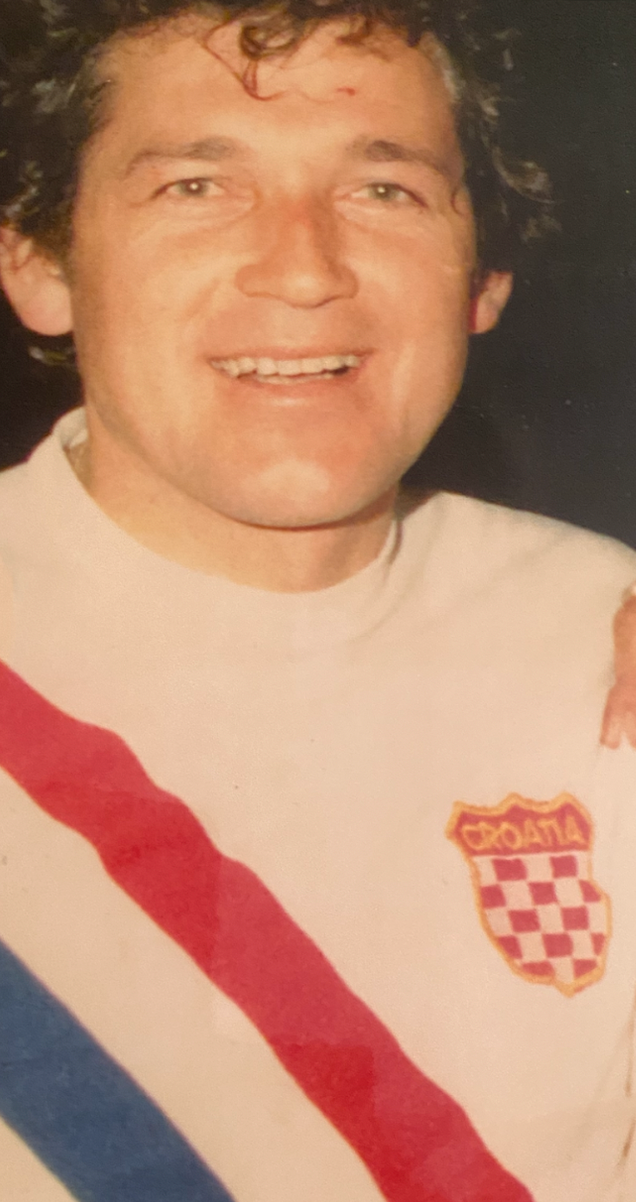
Milan Lakoseljac
If you have been involved in Tasmanian football, you know the feeling.
The draw.
The wait.
We tune in to see what our fate will hold.
Giant or minnow.
Travel or not.
Opportunity or exit.
A step closer to the Round of 32, or the end of the road.
There is a moment, when the ball is pulled, where everything shifts.
That is the Milan Lakoseljac Cup.
And the name Lakoseljac is synonymous with it.
A quick 101
The Cup didn’t always carry that name.
It began in 1963 as the Ampol Cup.
Later, it became the Statewide Cup.
In 2000, it was renamed in honour of Milan Lakoseljac after his passing.
The format has remained simple.
A knockout competition open to clubs across the state.
One game. One result. No second chances.
That simplicity is its strength.
Because it is the one competition where everyone meets.
North and south.
Top tier and lower divisions.
Experienced and unknown.
And for years, it has carried something even bigger.
The pathway to the Australia Cup.
A chance for Tasmanian clubs to step onto the national stage.
To test themselves. To be seen. To measure where they sit.
Even now, with the emergence of the National Second Division, offering a different kind of pathway, the Cup holds something that structure never can.
Chance.
Why this Cup, and why him?
The Cup is open.
Unpredictable.
Built on community.
In many ways, it reflects the era Milan came from.
An era where football in Tasmania wasn’t built by systems, but by people.
By communities.
By migrants who arrived, settled, and shaped the game in their own way.
That is the connection.
Not just a name on a trophy.
A reflection of where the game came from.
At the end of a big Easter round of Cup football, I wanted to understand more about that name.
Not the records. Not the goals.
The person.
So I reached out to Brendon Lakoseljac, Milan’s son.
What came back was generous, thoughtful, and quietly humble.
“Thankyou so much for this, it means a lot to all of us.”
That, in itself, tells you something.
The man, not the footballer
For all the talk of goals and honours, Brendan starts somewhere else.
“Dad was a great dad and husband who we love and miss dearly.”
And it’s worth pausing on that.
Because before anything else, before football, before records, that is who he was to them.
He was a hard worker in construction. He worked on the Bowen Bridge when it replaced the Bailey Bridge, and on many other major projects.
“He was a very likeable and sociable person… very smart and could do anything he put his mind to.”
Self-taught. Driven.
Because he arrived in Australia at 16, alone, without a word of English.
That part sits underneath everything else.
A life beyond the game
Football wasn’t the whole story.
He loved Eaglehawk Neck. Fishing. Catching his crays.
He followed the Geelong Cats, because Geelong was the first place he lived when he arrived in Australia.
And his other love, Manchester United. GGMU.
Work. Football. Family. Weekends away.
A life built, not given.
When the game finds you
Brendan doesn’t describe a single moment where he realised his dad was “someone”.
“It crept up on us.”
Conversations at grounds. People approaching. Stories shared.
“The last one being last night at the cup game at the Den with a supporter who played against dad that I didn’t know.”
That’s how legacy works in Tasmania.
Not in headlines.
In conversations.
Carrying the name
“Carrying the Lakoseljac name was an honour more than pressure.”
His memories are of being a kid at KGV, watching big crowds, stalls, atmosphere.
“I was in awe of the atmosphere and that is all I wanted to be a part of.”
And in a small, very Tasmanian detail:
“I also used to catch tadpoles in the creek at the back of KGV so that was pretty cool too.”
The player
“Fast and fit, very quick.”
So quick he earned the nickname “Monaro”, after the two-door HT Monaro he bought off the showroom floor.
“I wish we still had that.”
He was a team player. Demanded standards. Played in a strong, successful side.
But it’s the detail that stands out.
“He was very tactical and looked for defenders/goalkeepers weaknesses that he could exploit.”
Positioning. Instinct. Calmness.
“The finishing with the prowess and calmness of a number 9.”
And later, as a coach, he passed that thinking on.
The migrant game
The club wasn’t just football.
It was community.
“His friends at the club were his family.”
Card games. Bocce. Sundays.
“For our family, the Croatian community gave us the understanding of our heritage and culture.”
A home away from home.
“That era created and shaped football for sure.”
Is that understood now?
“To be honest I think it’s fading, but it’s still there.”
You still see the generational names.
You still see families in the game.
But the connection to that original generation is not as strong as it once was.
The Cup
When the Cup was named, the reaction was simple.
“We were humbled, grateful and so very proud.”
And still are.
“There are so many great names in Football Tasmania that would be warranted… so we are truly honoured.”
As Brendan explains, the family has never seen the name as something to own, but something to carry.
They support all teams in the competition equally.
Their priority is the competition itself, and the people in it.
That tells you everything about how they see it.
Is the name still connected?
Brendan believes it is.
Three generations of Lakoseljacs have played in Tasmania.
“There are so many people who can connect to the name in some way, good or bad over them 50+ years.”
He points to something small but telling.
“When people comment about the ‘Laka Cup’… that’s a personal note.”
It hasn’t drifted.
It still belongs.
And with Milan’s induction into both the Football Tasmania Hall of Fame and the Croatian Soccer Association of Australia Hall of Fame, that connection has only strengthened.
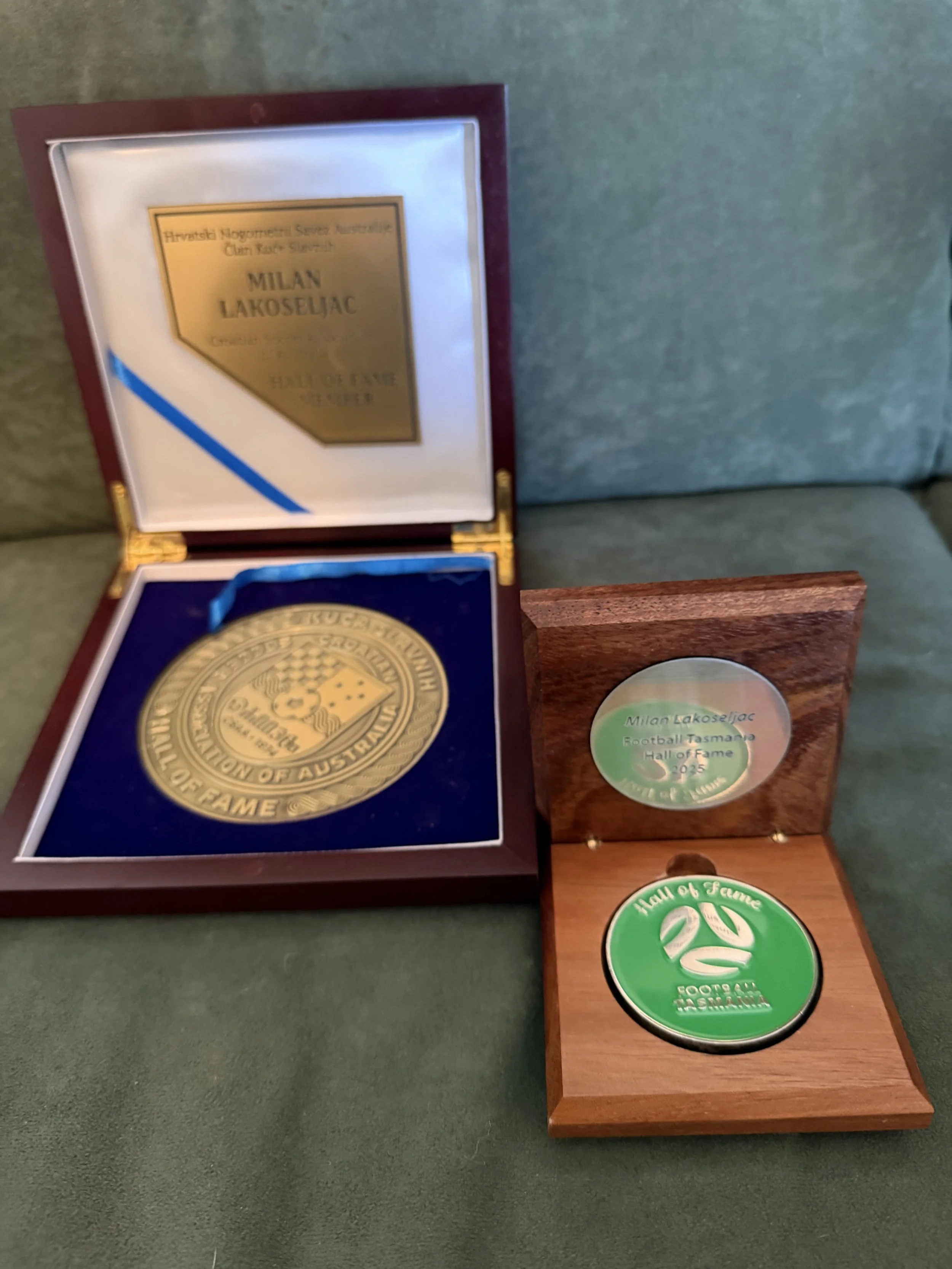
Milan’s medals
Cup football
When Brendan talks about the difference between league and Cup football, you can feel it.
League football is the grind.
Consistency. Depth. Rivalries. Week after week.
“A reward for maintained consistency.”
But Cup football is something else.
“A final every game, no second chances.”
“A chance for a medal. A chance for a memory.”
“The elation of a win, the hurt of a loss… cup games have it all.”
Why we remember it
Because it gives you something rare.
“Not everyone gets to play in a final in their career… it gives them that feeling every round.”
David versus Goliath.
The unthinkable.
“The memories and stories from cup games tend to live a long life.”
The bigger stage
“To play against the best in Australia is an experience you will not forget.”
“It may be the experience that changes your life.”
Three generations
“Being able to talk to current players with whom I have played against their dads and their grandfathers that have played against my dad is a very special part of what the game gives you.”
It’s not just family.
It’s continuity.
“A strong testament is seeing regular generational names returning to the game together with new growth.”
And Milan?
“We talk about this as a family every year.”
And the answer is simple.
“He would be humbled… and wonder what all the fuss is about.”
“He would feel undeserved… because he respected so many good names in Tasmanian football.”
A hard grafter.
A people person.
A man who loved the game.
And wanted others to experience it.
And every year, when the draw is made, when the games are played across the state, when clubs chase their moment…
that name is carried forward again.
“That’s our Milan Lakoseljac. No.9.”