The Chosen Ones
The Email
An email arrived in my inbox today.
Anonymous source.
One of the strange things about stepping away from formal governance roles is that people suddenly feel safer sending you things. Safer forwarding concerns privately that they would never raise publicly.
Because I am no longer President of South Hobart.
No longer on the Board.
No longer sitting inside official structures.
So now things just quietly arrive.
And yes, I know exactly what some people think every time I write one of these pieces.
“Oh here she goes again.”
“Always causing trouble.”
“Always speaking up.”
But if football people continue anonymously sending concerns to the same handful of loud voices, maybe the bigger issue is not the people speaking.
Maybe it is the culture that makes others reluctant to.
A Step In The Right Direction
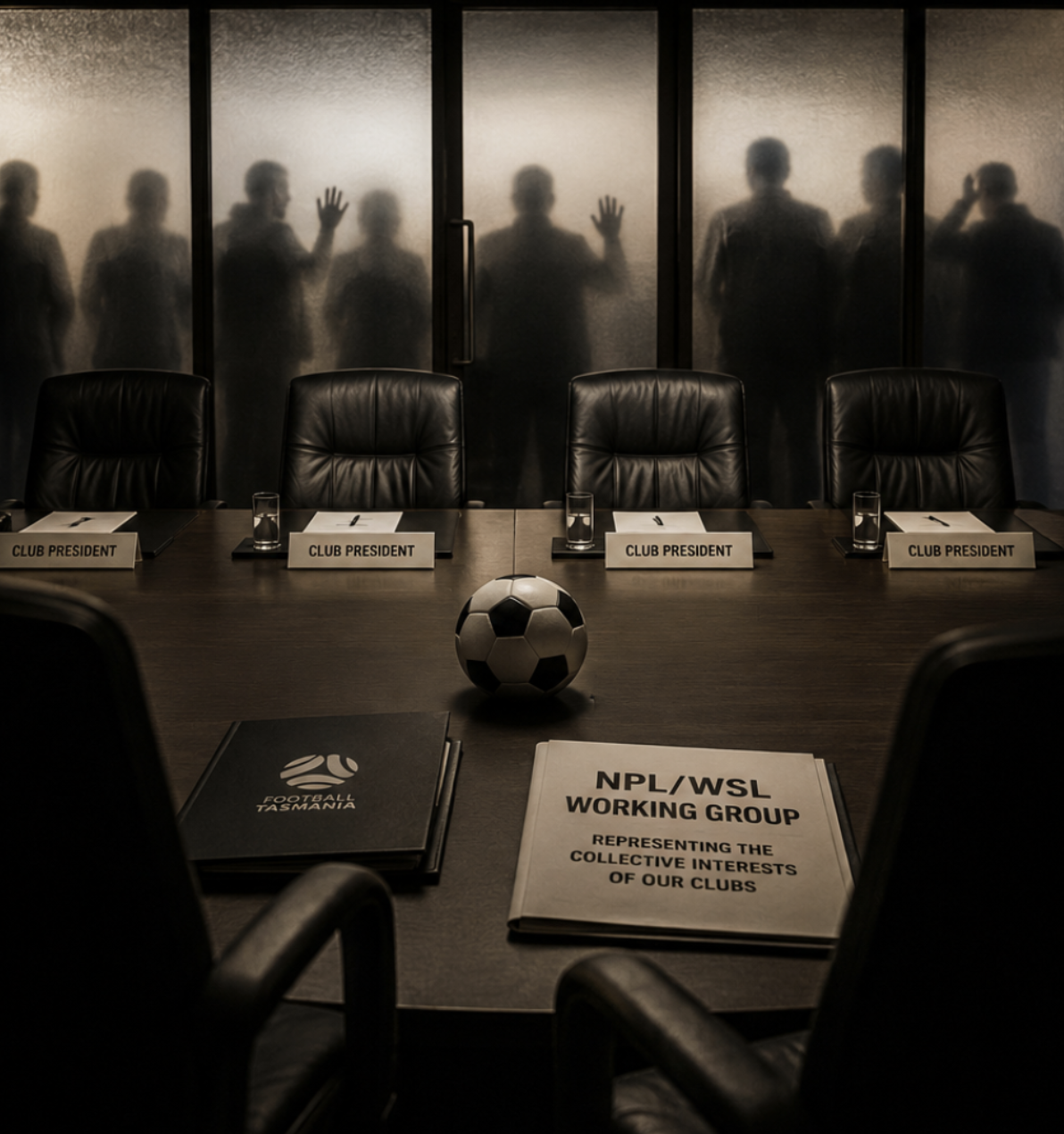
The email came from Football Tasmania CEO Tony Pignata to NPL and WSL club presidents announcing the formation of a new NPL/WSL Working Group.
The purpose sounds reasonable enough.
“The purpose of the group is to create a collaborative forum where key projects, current issues within the NPL/WSL, the future direction of the leagues, and opportunities to improve all aspects of the NPL and WSL competitions can be openly discussed.”
Honestly?
No issue with that at all.
In fact, I have been calling for exactly this kind of thing for years.
I constantly write about Football Tasmania needing to ask clubs what they think.
About reconnecting governance with grassroots football.
About clubs wanting a genuine voice.
About football people wanting to feel heard before decisions are made.
So this is, in theory, a step in the right direction.
But then the obvious question becomes:
If you genuinely want clubs to feel heard, why begin by making everybody wonder how the room was selected?
The Wording Matters
Because the email then moves from “discussion” into something far more significant.
“The working group will engage with all clubs throughout the process and will represent the collective interests of the clubs in discussions and decision-making relating to the NPL and WSL competitions.”
That wording matters.
Represent the collective interests of the clubs.
Decision-making.
Those are not casual phrases.
And naturally some pretty obvious questions follow.
Why these four presidents?
What was the process?
Were clubs asked for nominations?
Was there a vote?
Did clubs know this group was even being formed?
Why did Football Tasmania choose them?
Because that is essentially what has happened here.
Football Tasmania has hand-picked four club presidents to represent everybody else.
Maybe there are perfectly logical reasons behind the selections.
But if so, explain them.
That is what transparency looks like.
Seatgate
Honestly, the whole thing has a slight Seatgate energy to it.
The lucky recipients are announced.
Everyone else looks around wondering how the seats were allocated.
Who knew about it.
Who got the tap on the shoulder.
Who was already in the room before everyone else even knew there was a room.
And that matters because football governance is not just about intentions.
It is about legitimacy.
Transparency.
Trust in process.
Particularly in Tasmanian football where many clubs already feel major conversations happen in small circles before broader consultation begins.
The Tap On The Shoulder
And this is really the question sitting underneath the whole thing.
Who chose these four?
Seriously.
What was the criteria?
Geography?
Club size?
NPL success?
WSL involvement?
Good administrators?
Availability?
People unlikely to rock the boat?
People Football Tasmania already works well with?
People seen as “safe”?
Friendly fire?
What exactly?
Because if clubs are supposedly being represented collectively, surely the process for selecting the representatives matters enormously.
And maybe there was a logical process.
But if there was, it has not been explained.
That is the problem.
Because in the absence of transparency, football people do what football people always do:
They speculate.
And in Tasmanian football, speculation spreads faster than a wet winter rumour at a canteen.
So now everyone immediately starts analysing:
which clubs got representation
which clubs did not
which personalities are considered “constructive”
which clubs are viewed as difficult
who is seen as aligned with FT
who regularly challenges FT
whether northern and southern football are balanced
whether WSL concerns will genuinely be heard
whether stronger clubs dominate the conversation
whether smaller clubs feel invisible again
That is not because football people are paranoid.
It is because representation itself is political.
Particularly in a small football ecosystem where relationships and access matter so much.
And honestly, this is why process matters more than personalities.
Because the moment Football Tasmania hand-picks representatives instead of creating an open nomination or election process, the conversation shifts away from:
“How do we improve the leagues?”
And towards:
“Why them?”
That is avoidable.
That is the frustrating part.
Consultation Or Managed Feedback?
The irony is that the email repeatedly talks about collaboration and engagement.
Yet the structure itself appears to have been created before engaging with the clubs it now claims to represent.
That is the uncomfortable part.
Because consultation after the representatives are already chosen can start to feel less like collaboration and more like managed feedback.
And on a forensic read of the email, there is another issue.
There is actually no explanation of what this group formally is.
Not really.
No terms of reference.
No explanation of authority.
No clarity around whether this is advisory or decision-making.
No explanation of how members are selected or replaced.
No indication of term length.
No mention of whether minutes or recommendations will be shared with clubs.
No explanation of whether clubs get a say on proposals before anything progresses.
Just:
“The working group has now been established.”
Done.
Decided.
Announced.
That is why this risks being set up to fail before it even begins.
Not because involving clubs is wrong.
Quite the opposite.
It is because the process itself lacks transparency.
And when transparency is missing, football people immediately start filling the gaps themselves.
The Politics Of Representation
Structure without process quickly becomes politics.
And in Tasmanian football, politics is rarely about formal power.
It is about access.
Relationships.
Who gets information first.
Who gets heard.
Who gets invited into the room.
So when four clubs are selected, every other club immediately starts mentally mapping:
north/south balance
bigger clubs/smaller clubs
established clubs/emerging clubs
clubs aligned with FT
clubs often critical of FT
NPL priorities vs WSL priorities
That is inevitable.
Because representation in football is never neutral.
The Missing Perspective
And then there is another detail quietly sitting in the email.
This is supposedly an NPL and WSL Working Group.
Men’s and women’s football.
Yet among the selected club presidents representing the future direction of both competitions:
Not one woman.
Now to be fair, there may well be female representation from Football Tasmania itself within the broader discussions.
But that is not quite the same thing as lived clubland experience.
The experience of trying to build women’s football from inside clubs.
Finding coaches.
Retaining teenage girls.
Fighting for changeroom space.
Balancing budgets.
Managing volunteers.
Negotiating training access.
Building pathways.
Trying to make women’s football feel genuinely valued inside football culture.
That perspective matters.
Football loves promoting women’s football in strategy documents and social media graphics.
But when influence and access are being allocated, the room still somehow ends up looking very familiar.
This Was Avoidable
And the frustrating thing is this was probably easily avoidable.
Football Tasmania could have:
called for nominations
explained the selection criteria
allowed clubs to elect representatives
rotated positions annually
created clearer north/south or NPL/WSL representation structures
Transparency would probably have removed half the politics immediately.
Instead, the process itself has become the story.
Hang On A Minute
And football has a habit of accidentally revealing its real power structures in moments exactly like this.
Small moments.
Emails.
Committees.
Working groups.
Quiet selections.
The kinds of things most people skim past.
Until somebody awkwardly points at them and says:
“Hang on a minute.”