The Rebellion Has Begun: Can Gianni Infantino Survive It?
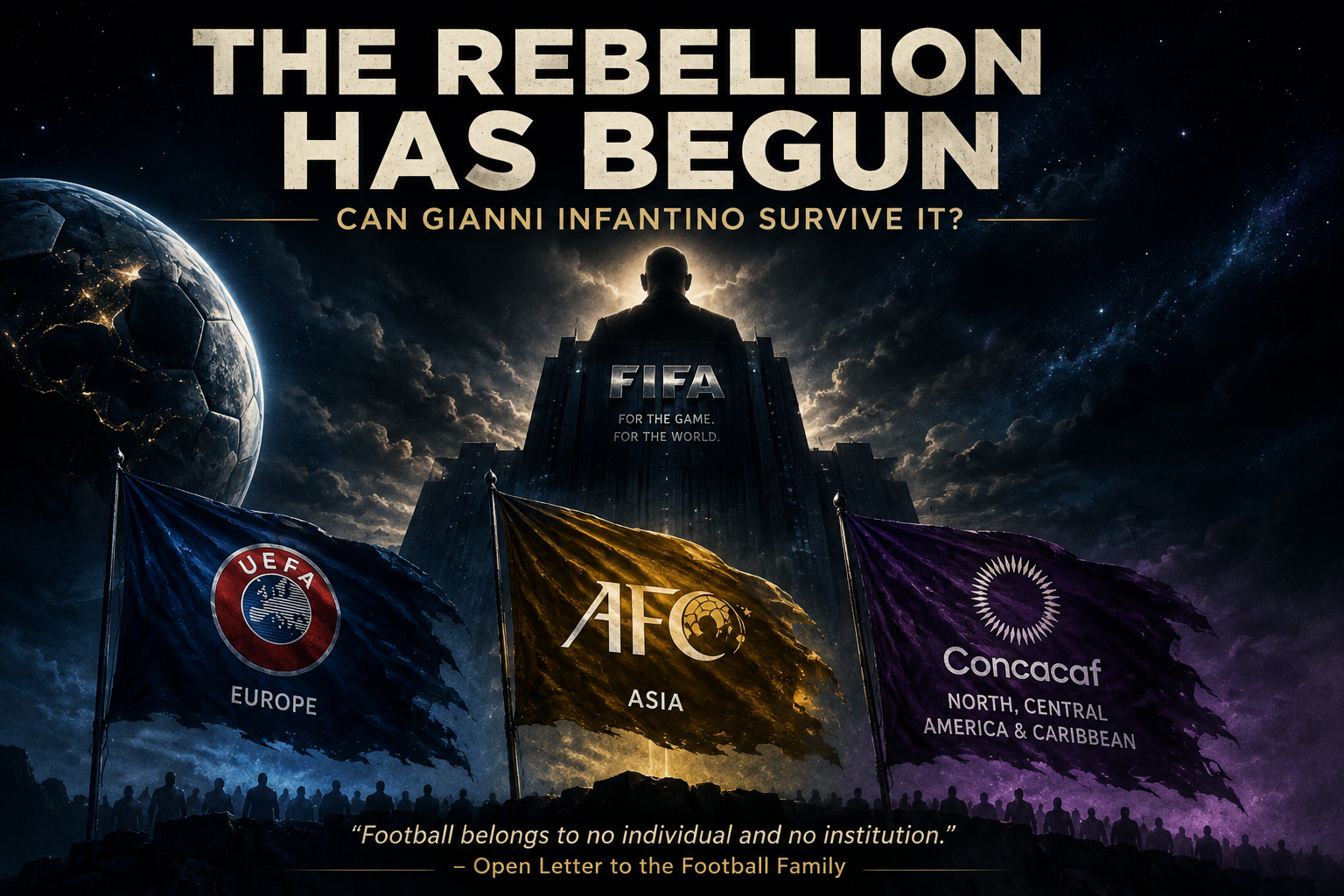
Only days after The Empire Strikes Back, three of world football's six continental confederations have issued an extraordinary joint letter challenging the leadership of FIFA President Gianni Infantino.
Well, that escalated quickly.
Now, I know lots of you probably don't give a damn about all this FIFA stuff going on.
But here's why you should.
FIFA governs our game. What happens at the very top eventually reaches football in the Pacific, Australia, Sydney and right down here in Tasmania.
So the more people who understand what is happening, ask questions and write about it, the better.
Because if you have ever wondered where some of the money you pay into football through registrations and subscriptions goes, how it moves through the layers of the game, who controls the enormous sums at the top, and how those people are held accountable, this stuff matters.
We spend plenty of time talking about what happens on the pitch.
Every now and then, we should probably look upstairs as well.
And right now, there is quite a fight going on up there.
Only days ago I wrote The Empire Strikes Back, looking at the growing revolt against Gianni Infantino and his extraordinary proposal to create FIFA Forward Enterprise, a new subsidiary bringing together FIFA's commercial rights and event operations, and sell a minority interest to outside investors.
At the time, the proposal was collapsing and some very powerful people in world football were clearly furious.
But there is a considerable difference between opposing one of Gianni Infantino's ideas and publicly challenging his leadership.
We have now crossed that line.
On Monday, 10 August, an open letter to the football family was issued jointly by three of FIFA's six continental confederations.
Not from journalists.
Not from former football administrators.
Not from one disgruntled national association.
It came from the leadership of:
UEFA, which governs football in Europe.
AFC, the Asian Football Confederation, which governs football across Asia and includes Australia.
And Concacaf, which governs football across North America, Central America and the Caribbean.
The letter was personally signed by the presidents of all three organisations:
Aleksander Čeferin, President of UEFA.
Salman bin Ibrahim Al Khalifa, President of the AFC.
Victor Montagliani, President of Concacaf.
And this wasn't simply three presidents putting their names to something.
Their three general secretaries also signed it: Theodore Theodoridis of UEFA, Datuk Seri Windsor John of the AFC and Philippe Moggio of Concacaf.
Six of the most senior administrators in international football, representing three continental governing bodies, speaking with one voice.
That is what makes this letter so significant.
What Does The Letter Actually Say?
It is ostensibly about the fallout from FIFA Forward Enterprise, Infantino's now abandoned proposal to bring FIFA's commercial rights and event operations together in a new FIFA-controlled subsidiary and open a minority interest to outside investment.
The potential numbers were enormous.
The proposed company was valued at around US$20 billion, with FIFA seeking billions in outside investment while retaining control.
FIFA argued that the arrangement could dramatically increase the amount of money available for football development around the world.
But read Monday's letter and it becomes very clear that this is no longer really about the proposal.
It is about how Gianni Infantino is running FIFA.
The six signatories accuse FIFA's leadership of deception.
They describe what happened as a "fundamental breach of trust."
They say the process surrounding the commercial proposal was designed to limit scrutiny.
They question why FIFA's elected representatives and Member Associations were excluded from important discussions.
They demand a fully independent investigation.
And, most strikingly, they challenge the entire philosophy of Infantino's leadership.
The letter begins with a statement that could hardly be more pointed.
Football, they write, is the world's greatest shared passion.
It belongs to no individual and no institution.
Then it gets considerably sharper.
The authors argue that leadership is not a possession and that when an individual places himself above the collective that gave him authority, the duty of leadership has been abandoned.
And eventually comes the sentence that removes virtually any doubt about who this is aimed at.
They describe conduct not as that of a custodian of the game, but of someone who believes the game is answerable to him.
They never actually write:
Gianni Infantino must resign.
But this is certainly not a letter asking him to improve his communication skills.
And subsequent reporting makes the political intention increasingly clear.
Reuters reports that people close to the confederations see the letter as an opportunity for Infantino to step aside before seeking re-election in March 2027, with his dignity intact.
A Quick Guide To The FIFA Family
Because football administrators do love an acronym, it is worth remembering how the world game is divided.
FIFA has six continental confederations:
UEFA: Europe
AFC: Asia, including Australia
CAF: Africa
Concacaf: North America, Central America and the Caribbean
CONMEBOL: South America
OFC: Oceania, including New Zealand
Australia, geographically part of Oceania, has competed as a member of the AFC since 2006.
So look again at who signed Monday's letter.
Europe plus Asia plus Concacaf.
Three of the six.
That is enormously different from UEFA simply having another fight with FIFA.
And perhaps the most politically interesting signature is not Čeferin's at all.
It is Salman's.
Asia Joining Europe Changes This
Aleksander Čeferin and Gianni Infantino being on opposite sides of a political fight is not particularly surprising.
UEFA and FIFA have been circling one another over money, competitions and power for years.
But AFC President Salman bin Ibrahim Al Khalifa standing beside Čeferin and accusing FIFA's leadership of deception is something else.
Infantino's political strength has long rested heavily on his support outside Europe.
Now the man leading the confederation containing Australia and dozens of other FIFA Member Associations has put his signature to a document accusing FIFA's leadership of deception and a fundamental breach of trust.
Then add Concacaf President Victor Montagliani.
Suddenly this is not Europe versus FIFA.
It is the leadership of three continental confederations effectively telling the FIFA President:
Football does not belong to you.
And that is why Monday's letter may turn out to be much more significant than the commercial proposal that started all of this.
"Designed To Limit Scrutiny"
This may be the most serious allegation in the entire letter.
The three confederations do not simply say consultation was inadequate.
They say the compressed timetable and lack of meaningful consultation were not accidental.
They describe them as the product of a design intended to limit scrutiny.
Think about what they are alleging.
Not incompetence.
Not poor communication.
Design.
In other words, they are suggesting the process was structured so the people who should have scrutinised an enormous decision affecting the commercial future of FIFA would have less opportunity to do so.
That is why this is not going away simply because FIFA Forward Enterprise has been abandoned.
The deal is dead.
The trust problem is not.
And Now It Appears They Want Him Gone
The letter itself stops short of explicitly demanding Infantino's resignation.
But subsequent reporting makes the political objective increasingly difficult to miss.
Reuters reports that people close to the confederations see the letter as giving Infantino a chance to step aside before his proposed re-election in March 2027.
Other reporting now describes UEFA, AFC and Concacaf as actively pushing for Infantino to quit.
That is a very different proposition from simply opposing FIFA Forward Enterprise.
The proposal has gone.
Now the argument is about whether Infantino should go with it.
And there is another extraordinary development.
The three confederations have reportedly held preliminary discussions about organising competitions themselves if the confrontation with FIFA escalates.
Just consider that for a moment.
Europe.
Asia.
North and Central America and the Caribbean.
Discussing competitions between themselves.
We are nowhere near having an alternative World Cup. There are enormous legal, sporting, commercial and political obstacles before anything remotely like that could happen.
But the remarkable thing is that the conversation is apparently happening at all.
A fortnight ago we were discussing a controversial FIFA investment proposal.
Now powerful football administrators are reportedly discussing what they could do if their relationship with FIFA breaks down completely.
That's quite a fortnight.
Then There Is Morocco
There is another part of the letter that deserves far more attention.
A FIFA leadership meeting was held recently in Morocco.
And here the letter is remarkably specific.
It says only one elected official was present.
No FIFA Council members were invited.
No representatives of the 211 Member Associations were invited.
Instead, the Management Committee, composed of senior FIFA employees, was represented.
The letter goes even further, saying that only a select number of Management Committee members were summoned to Morocco, rather than the full committee.
Why does that matter?
Because FIFA does not belong to its management.
It does not belong to its employees.
And despite the increasingly presidential nature of the organisation, it does not belong to Gianni Infantino.
FIFA is supposed to be governed on behalf of its Member Associations.
Which takes us straight back to the opening of the letter.
Football belongs to no individual and no institution.
They Don't Trust FIFA To Investigate FIFA
The three confederations are now calling for an independent investigation.
And they mean independent.
They do not want FIFA investigating itself.
They do not want FIFA staff conducting it.
They do not even want football stakeholders conducting it.
They want a fully independent third party.
They have also demanded that relevant documents and records be preserved.
That may be one of the clearest indications of just how badly the relationship has broken down.
When three of your six continental confederations say they do not trust your organisation to investigate what happened inside your organisation, you have moved well beyond a communications problem.
Now Watch The Countries
This is where the story becomes even more interesting.
A confederation president cannot simply deliver the votes of every country within that confederation.
Salman cannot put every AFC vote in his pocket.
Čeferin cannot automatically deliver every European association.
Montagliani cannot command every Concacaf vote either.
FIFA's President is ultimately elected by its Member Associations.
And there are 211 of them.
The movement from confederation opposition to individual national associations choosing sides has already begun.
England has withdrawn its support for Infantino's re-election.
Norway has gone further, publicly calling for him to resign.
Wales, Sweden and Serbia have also withdrawn their previous support.
US Soccer and Canada Soccer have backed demands for greater transparency and accountability.
That matters.
The rebellion is beginning to move from confederation headquarters into the Member Associations themselves.
But it is not moving in only one direction.
And that is where FIFA politics gets interesting.
So Where Does Australia Stand?
Football Australia is a member of both FIFA and the AFC.
Its continental president has just put his name underneath an extraordinary attack on the FIFA President.
So there is a perfectly reasonable question to ask.
Does Football Australia agree?
Does it believe there has been a fundamental breach of trust?
Does it support the independent investigation demanded by the AFC, UEFA and Concacaf?
Does it continue to support Infantino?
And if this ultimately becomes a battle over his future, where does Australia's vote go?
We are not spectators in this.
Australia has one of those 211 votes.
Don't Pack Gianni's Office Just Yet
This is the important counterweight to all the excitement.
Infantino is not finished.
Not remotely.
CAF, representing Africa, has publicly backed him.
Leading figures and associations in South America have also rallied behind him, with Argentina among those declaring their support.
Mexico has backed him too, despite belonging to Concacaf, whose president signed Monday's letter.
That alone tells you how complicated this is going to become.
And Infantino has spent ten years doing something extraordinarily effectively:
Building relationships with national associations around the world.
FIFA development funding has become an important part of that relationship.
For many smaller football nations, FIFA is not some distant bureaucracy in Zurich.
It funds pitches.
Facilities.
Administration.
Women's football.
Youth football.
National teams.
And the abandoned FIFA Forward Enterprise proposal promised vastly more.
Under FIFA's own proposal, FIFA Forward funding for the 2027 to 2030 cycle would have increased to US$20 million per Member Association.
On top of that, each association would have had the option of accessing another US$20 million through a proposed FIFA Fast Forward Programme.
Potentially US$40 million for one four-year cycle.
For a small football nation, these are not abstract numbers.
They can transform facilities and football programmes for a generation.
That does not mean a vote can simply be bought with development funding.
But it certainly helps explain why the political arithmetic inside FIFA is considerably more complicated than simply asking whether a national association agrees with its confederation president.
Relationships matter when presidents need votes.
And Infantino has been building those relationships for a decade.
The World Is Dividing, But Not Neatly
The leadership of UEFA, AFC and Concacaf is now openly challenging Infantino.
CAF has publicly backed him.
Powerful voices in South America are supporting him.
OFC, representing Oceania, has not joined the three-confederation letter.
But even that description makes the battle sound tidier than it really is.
Individual countries within those confederations are taking their own positions.
Some want Infantino gone.
Some want governance reform.
Some continue to support him.
Others have said very little.
So this is not simply three confederations against three.
It is potentially 211 individual decisions.
There will be alliances.
Pressure.
Development funding.
Personal relationships.
Presidential ambitions.
And undoubtedly several very pleasant dinners.
Welcome to FIFA.
The Empire Strikes Back, Part Two
When I called the previous piece The Empire Strikes Back, it was partly tongue in cheek.
Infantino had pushed.
Football was beginning to push back.
I was not expecting the sequel quite this quickly.
But this is no longer simply resistance to a commercial proposal.
Three continental confederations have effectively told the President of FIFA:
The organisation is not yours.
They have accused his leadership of deception.
They say trust has been broken.
They want an independent investigation.
And reporting now indicates that the three confederations want Infantino to step down.
That is an extraordinary place for world football to have reached within days.
But there is one final twist.
A rebellion is only a rebellion until you count the votes.
Then it becomes either a revolution or a failed uprising.
And FIFA has 211 of them.
So perhaps that is the question we should be asking now.
Not whether The Empire Strikes Back.
It clearly has.
The question is whether Gianni Infantino still has enough of the galaxy on his side to survive it.