Time in the Grandstand
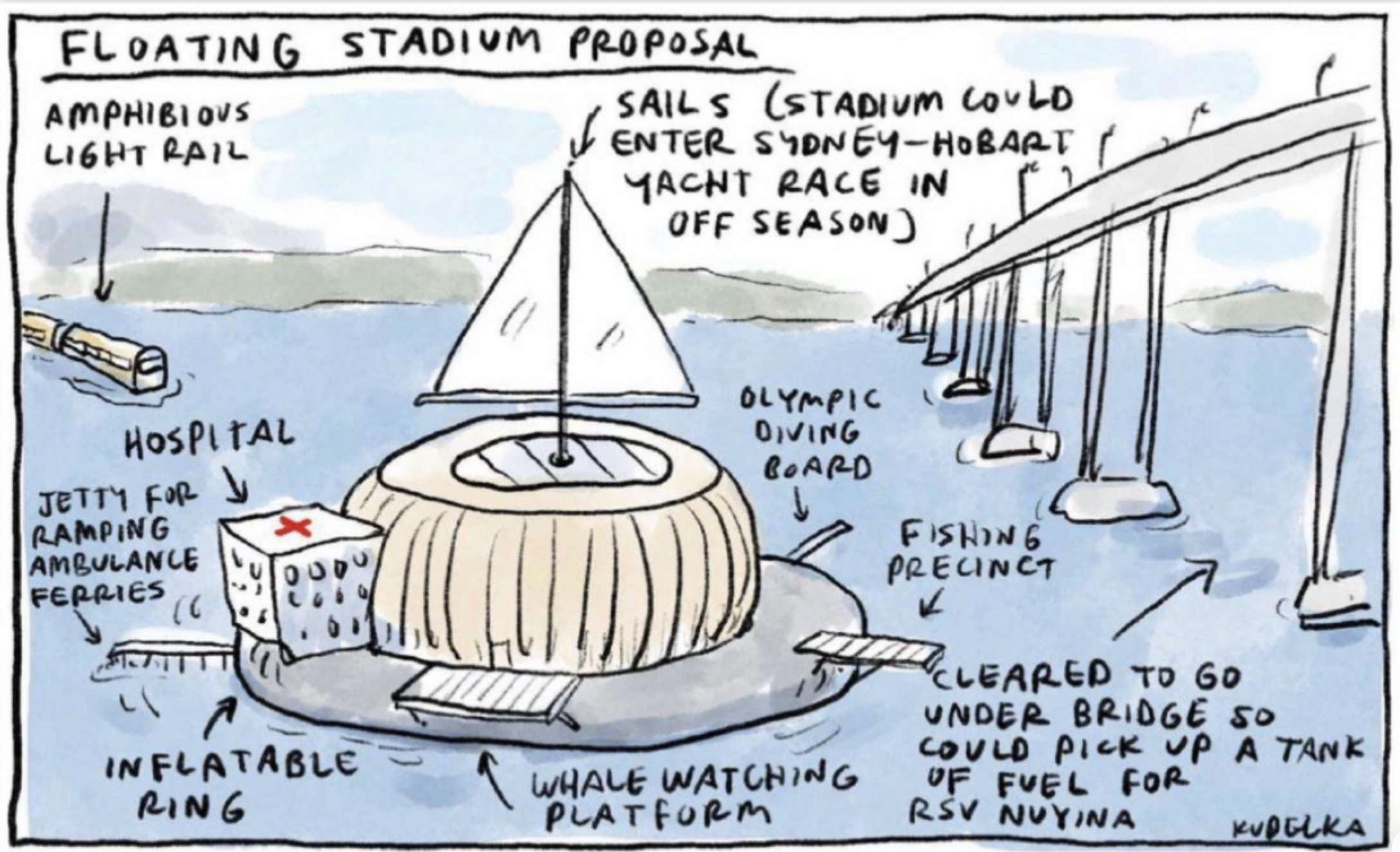
One very brilliant drawing from Jon Kudelka
There is a particular kind of time spent in grandstands and on sidelines.
It is not dramatic time.
It is repetitive, often cold, sometimes boring, occasionally joyful.
It is time spent watching children grow, recognising familiar faces before you know names, swapping half conversations, learning routines. You come to know people sideways, through presence rather than introduction.
These are not remarkable places.
But they are where community quietly forms.
Ordinary spaces, real connection
Community is often spoken about as something abstract, something to be built, funded, planned or announced.
In reality, it happens in ordinary places. On plastic seats. Along fence lines. Standing with a coffee on a winter morning, watching children play, noticing who keeps turning up.
These spaces don’t ask much of us. Just time. Just presence.
And over years, that time accumulates into something that matters.
Jon, in that space
Jon Kudelka was part of that world.
He was a South Hobart FC dad. His son Oskar has grown up around our club and around Morton’s Soccer School, over many years. Jon was not there as a public figure. He was there as a parent, a presence, one of many people who share these small, repeated moments of community life.
Like so many families, our connection was built not through ceremony, but through proximity.
How Jon saw the world
Jon’s public work was anything but ordinary. He was a brilliant artist and political cartoonist, widely admired for his clarity, restraint and dry wit. He had an extraordinary ability to call out nonsense, power and imbalance without shouting and without cruelty.
His humour never needed embellishment. It trusted the reader to notice what mattered.
When Jon shared news of his diagnosis, I messaged to ask if there was anything we could do.
He replied simply:
“Bit of a crummy night.”
Then, with perfect timing:
“A cure for brain tumours would be ideal.”
There was no performance in that exchange. Just honesty, humour and dignity.
Noticing imbalance
Jon often turned his attention to the way priorities are framed and to the gap between spectacle and everyday life.
In one cartoon, he imagined a floating stadium proposal bristling with grand ideas and annotated ambitions. Light rail. Whale watching platforms. Olympic diving boards. Prestige layered upon prestige.
It was funny, ridiculous and uncomfortably accurate.
What lingered was not what was drawn, but what was absent. The ordinary spaces. The everyday places where people actually gather, week after week, season after season.
Jon didn’t need to explain the point. He trusted us to see it.
Why these places matter
Most people don’t measure their lives by landmarks or major projects.
They measure them by who was there.
By who sat nearby. Who shared the cold mornings. Who drifted in and out of view as years passed.
These places teach us to notice presence, and absence. They carry memory forward not through ceremony, but through repetition.
They don’t just hold sport.
They hold people, and time.
What remains
Jon is remembered by many through his work, which continues to hang on walls, challenge thinking and make people laugh in uncomfortable recognition.
We will remember Jon every day through Oskar, and through his artwork that adorns our home.
But also through these shared spaces. Through time spent together without ceremony. Through the quiet accumulation of presence.
Community is not built in grand gestures.
It is built in showing up.
Jon understood that.
And that is how he remains with us.