Football Tasmania, It’s Time to Fund Junior Associations
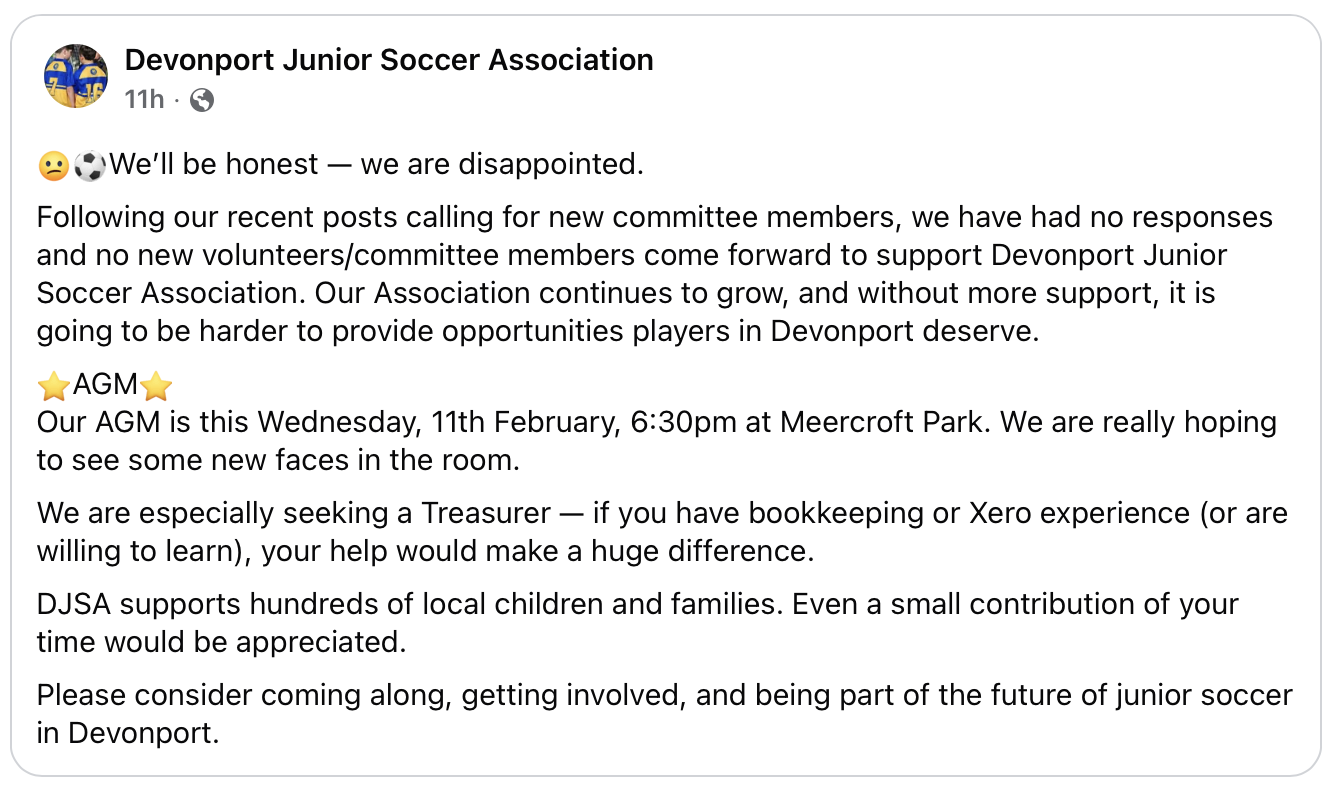
I saw a post yesterday from Devonport Junior Soccer Association (DJSA).
No new committee members.
No volunteers stepping forward.
An AGM approaching with hope, and a quiet sense of dread.
I felt it immediately, because the same thing is happening at the Central Region Junior Football Association (CRJFA).
No new nominations for 2026.
No new hands up.
I want to acknowledge DJSA for making this public. I understand exactly why that post was written. Putting your hand up to say “we need help” takes courage, especially in volunteer sport, and it reflects responsibility, not failure.
If I didn’t literally tap people on the shoulder, there would be no one to run these associations. That is not a criticism of our community. It is a statement of reality.
This is not about people not caring.
People care deeply.
They are just tired.
The myth of the “volunteer role”
Volunteer sport still trades on an old idea, that committee roles are light-touch, well-meaning, a few meetings a year and a sausage sizzle.
That hasn’t been true for a long time.
Modern volunteer roles now carry responsibility for governance, child safeguarding, compliance, risk management, finance, dispute resolution, insurance, equipment provision, ground bookings, policies, codes of conduct and increasingly complex reporting.
It is not casual help.
It is not ad hoc.
It is often the equivalent of a second job.
And unlike a job, it comes with no pay, little protection and, at times, very public criticism.
“They register themselves” is not an answer
It will be argued that junior associations are not essential because players “register themselves”.
That argument misses the point entirely.
Players may click the button, but associations do everything that makes that click meaningful.
They structure competitions.
They allocate teams and grades.
They manage eligibility, transfers, refunds and exceptions.
They handle disputes, safeguarding issues and risk matters that no automated system can resolve.
They liaise with clubs, councils, referees, schools and families week after week.
Registration without administration is just a database.
Football without junior associations is not self-organising. It is unmanaged.
The quiet shift no one talks about
What I’m seeing, across football and beyond it, is not a lack of goodwill. It is a shift in how people manage their time and energy.
People are busy.
People are stretched.
People are already juggling work, family, cost of living and their own mental load.
Many people would rather pay for someone else to do the role than absorb it themselves. That is not selfishness. It is realism.
But community sport has not adjusted to that reality.
We still rely on goodwill as if it were infinite.
It isn’t.
This does not require a large solution
This is important to say clearly.
Supporting junior associations does not require a large or complex funding model.
In many cases, one properly funded administration role would make a material difference.
Someone to manage registrations, communications, scheduling, compliance and day-to-day administration, freeing volunteers to govern rather than firefight.
At CRJFA, we registered 3,750 junior players in 2026. That scale of participation does not run itself, yet it is currently supported almost entirely by unpaid labour.
The false economy at the heart of the system
If junior associations begin to fail, the work does not disappear.
It simply moves.
And when it moves, it becomes paid.
Competition management.
Dispute resolution.
Safeguarding oversight.
Communication with families.
Operational problem-solving every weekend.
If those functions are no longer carried by volunteers, they will need to be carried by employees.
That will cost far more than supporting the volunteer model that already exists.
The current system survives not because it is efficient, but because it is subsidised by unpaid labour.
That is not a strategy.
It is a debt.
What happens when the engine room stops
Junior associations are the engine room of football.
They register the bulk of players.
They run the largest number of games.
They manage the greatest volunteer base.
They carry the heaviest compliance and safeguarding burden.
Yet there is no meaningful, structural funding that recognises the governance and administrative load they now carry.
At CRJFA we are already planning for fee increases in 2027, not to expand or improve services, but simply to survive.
To begin paying executive roles fairly for the work actually undertaken.
Because the alternative is clear.
Volunteer organisations will not gently fade away.
They will collapse.
Or they will be reprieved at the last minute by the same small group of people who always step in, again.
That is not governance.
That is crisis management.
Time for a shift in thinking
The old model assumed endless goodwill, spare time and low risk.
The game has changed.
The risks have changed.
The workload has changed.
If the structures beneath the game do not change as well, participation numbers alone will not save us.
Time to fund junior associations, Football Tasmania, before the volunteer model collapses and you are forced to replace it at far greater cost.