We Grew the Game. The System Didn’t
The numbers were always there
The suitcase is proving to be total gold.
Every clipping feels like a window into something we think is new, but isn’t.
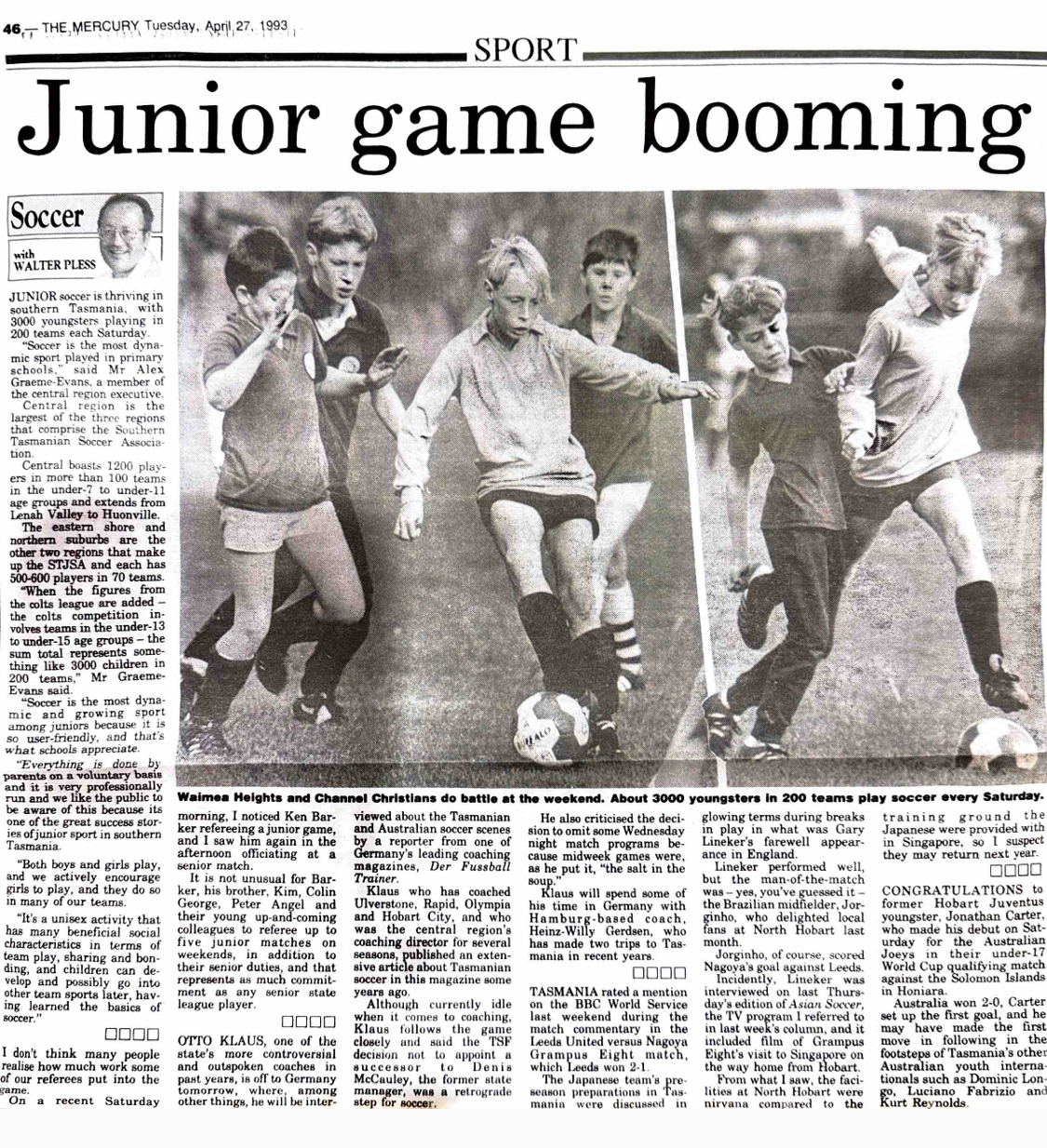
Today I came across an article from 1993, written by Walter Pless, a man I had the privilege of interviewing earlier this year. A deep football mind. Observant. Honest. Someone who has watched the game closely, over a long time.
The headline stopped me.
Junior game booming.
Not growing. Not developing. Not “building”.
Booming.
What Walter saw
Walter wrote that junior soccer in southern Tasmania involved around 3,000 youngsters, across 200 teams, playing every Saturday.
He described it as:
“the most dynamic sport played in primary schools”
He pointed to why it worked.
It was accessible.
It was inclusive.
It was run by volunteers.
“Everything is done by parents on a voluntary basis,” he wrote.
And importantly, he didn’t frame it as fragile.
He framed it as strong.
What I see now
As many of you know, I am President of CRJFA. I have been for around a decade.
It is an association I genuinely love.
It exists for a simple reason.
To provide football for children aged U5 to U12.
To keep it affordable.
To let kids play.
And it still runs the same way Walter described.
Delegates from clubs and schools.
Volunteers.
Parents giving up time, week after week.
Holding it together.
But here is the part that matters
Last season, CRJFA alone had around 3,750 registered players.
Read that again.
That is not the whole state.
That is not multiple regions.
That is one association.
Walter’s article refers to around 3,000 players across the system in 1993.
The game has not been built.
It has grown.
So let’s stop pretending
We talk about “growing the game” as if it is something fragile.
As if it needs to be convinced to exist.
It doesn’t.
The game is already here.
It has been for decades.
It has grown quietly, consistently, without fanfare.
Driven by volunteers.
Sustained by community.
Carried, in many cases, despite the system around it.
And this is where it becomes uncomfortable
If junior football is where the numbers are…
Where is the support?
Where are the facilities that reflect that scale?
Where is the investment that matches participation?
Where is the visibility in public conversation, in planning, in funding decisions?
Because there is a gap.
And it is not a small one.
It is a structural gap between:
the number of children playing the game
and
the value placed on it
Walter saw it. We are still living it
What makes this article powerful is not nostalgia.
It is recognition.
Walter described a game that was already organised, already inclusive, already strong.
He described volunteers doing the work.
Referees giving their time.
Communities making it function.
Thirty years later, that foundation still exists.
The numbers are bigger.
The questions are the same.
The truth
We don’t need to prove football matters.
The numbers have already done that.
What we need to ask, honestly, is this:
Why has the system around the game not kept up with the game itself?
The challenge
This is not about growth anymore.
It is about alignment.
Because until the structures, the investment, and the recognition reflect the reality on the ground…
we will keep finding articles like this
and realising
we have been here before
Participation without recognition is not growth.
It is neglect, dressed up as success.