We've been here before: the State League-less years
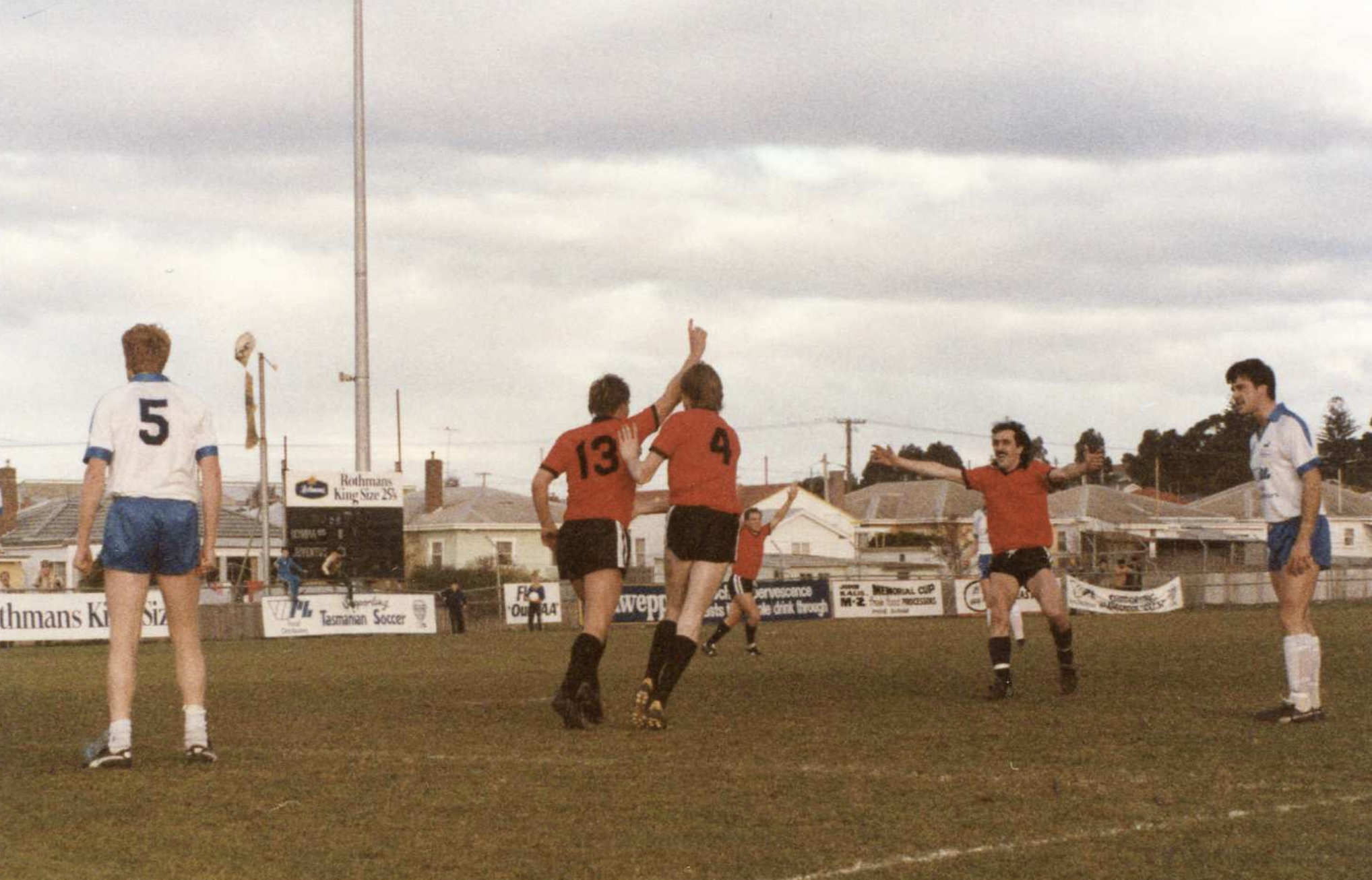
Ken Morton scoring for Juventus against Olympia at KGV Park in 1982. My future husband, although I was still in New Zealand and had no idea who he was! Photo: Ralph Dymond, via Walter Pless.
Part Two: 1982 to 1987
By 1982 I was 23, turning 24.
Michael Jackson was about to release Thriller. Men at Work were singing Down Under. Split Enz had Six Months in a Leaky Boat. E.T. was filling cinemas.
And just a year away, the wonderful Annie Lennox was about to give us Sweet Dreams (Are Made of This).
We were still buying LPs and cassettes. The internet was something far removed from ordinary life. The World Wide Web was still years away and there was certainly no mobile phone in your pocket.
And in Tasmania there was something else missing.
The State League.
After just four seasons, it was gone.
For the next six years Tasmania would find out what its top-level football looked like without one.
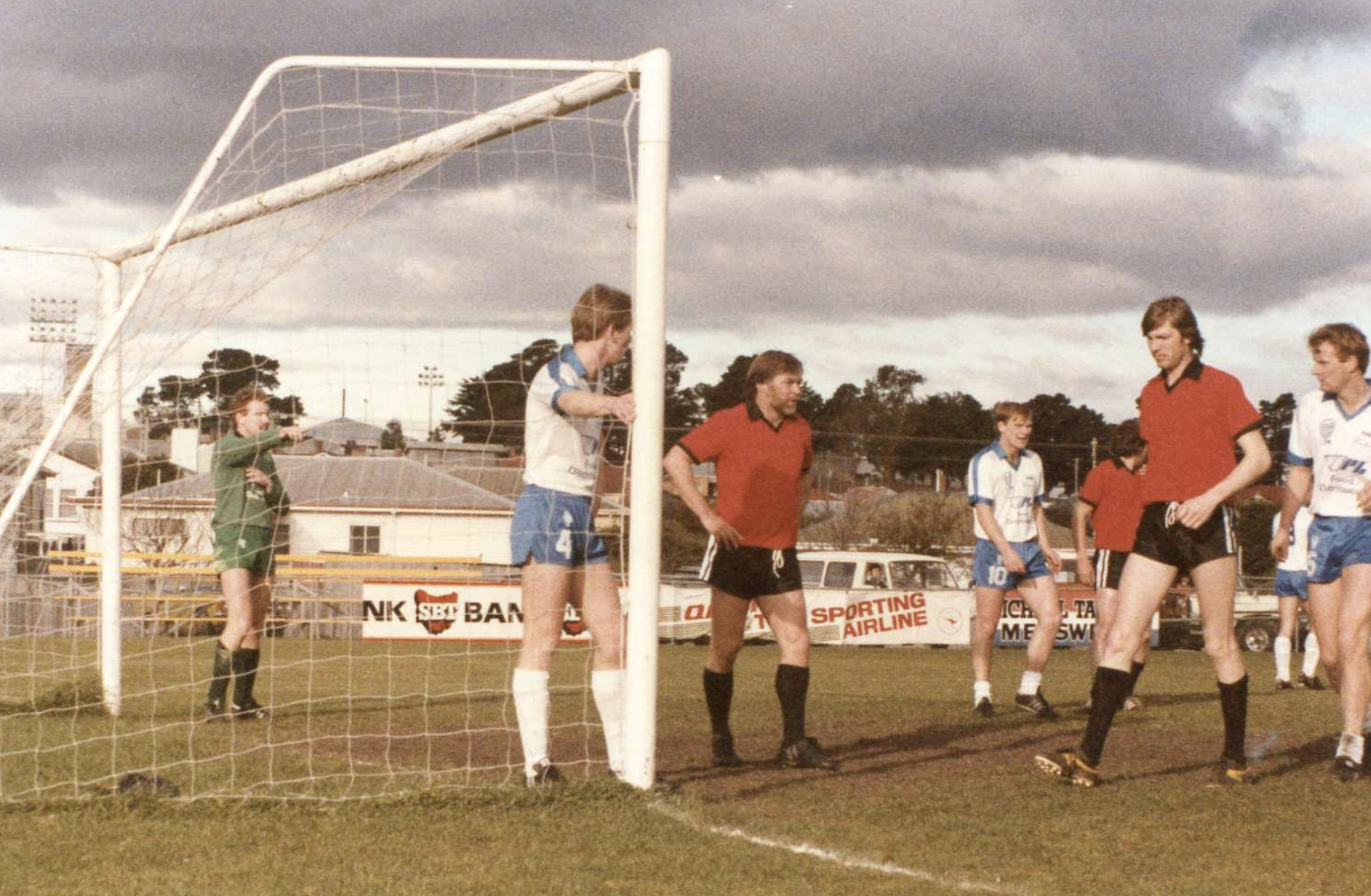
Ken Morton in action for Juventus against Olympia at KGV Park in 1982, moments before scoring. Photo: Ralph Dymond, via Walter Pless.
Before I start
As I said in Part One, I am not a historian.
I am simply curious.
And I wasn't here for this part of the story.
In 1982 I was in New Zealand.
I hadn't even met Ken yet.
He was already in Tasmania, playing.
So I have gone back through as much material as I can find. Old competition tables, club histories, newspaper material and, once again, Walter Pless's extraordinary archive.
Walter has also been kind enough to communicate with me since Part One and I am very grateful for that.
He didn't discover this history 40 years later.
He lived it.
He played, coached and reported Tasmanian football and ultimately spent 25 years as The Mercury's soccer writer.
So I am going to lean on his experience.
Where something is clearly documented, I will say so.
Where different records tell different stories, I will say that too.
And where I have found something interesting but cannot completely verify it, I would rather tell you that than pretend I know.
The State League was gone. Football certainly wasn't.
One of the things I wondered before I started researching this part was whether the collapse of the State League had left some enormous hole in Tasmanian football.
It didn't.
In 1982 Tasmania went back to regional top-level competitions.
The north had Devonport City, Launceston Juventus, George Town United, Ulverstone, Launceston United, Burnie United, Riverside Olympic and Launceston Croatia.
The south included Rapid Wrest Point, Hobart Juventus, Olympia, White Eagles, Croatia Glenorchy, Metro-Claremont, Caledonians and South Hobart.
And here is the first thing that really jumped out at me.
In 1982 they played 21 league games.
Twenty-one.
In both the north and the south.
League games.
Then there were cup matches on top of that and for the leading clubs there was State Championship football as well.
Keep that number in mind.
Because the proposed seven-team NPL in 2027 gives clubs 18 league games.
Seven teams playing each other three times.
Nine at home.
In 1982, without a State League, clubs were playing more league football than our NPL clubs are scheduled to play in 2027.
The regions were strong
Devonport won the northern competition in 1982 with 16 wins from 21 games, scoring 79 goals and conceding only 12.
Launceston Juventus finished second, George Town third and Ulverstone fourth.
In the south, Rapid Wrest Point finished top and then beat Hobart Juventus 4-0 in the grand final.
Rapid and Devonport then met to determine the State Championship.
Rapid won it.
So the State League had disappeared.
The desire to find Tasmania's best team had not.
That is an important distinction.
For most of the season north played north and south played south.
But there was still a statewide prize at the end.
And the pattern continued
In 1983 Devonport again won the north.
Hobart Juventus won the south and became State Champion.
In 1984 George Town had a tremendous northern season, winning 17 of its 20 league matches and scoring 89 goals.
Hobart Juventus won the southern competition and again took the State Championship.
Hobart Juventus were State Champions again in 1985.
Ulverstone won it in 1986.
Olympia in 1987.
There was no State League.
There was still very good football.
The north and north-west were hardly struggling
This may be one of the most important things to understand about these six years.
Northern football had depth.
North-west football had depth.
Devonport.
Ulverstone.
George Town.
Launceston Juventus.
Launceston United.
Burnie.
Riverside.
These clubs were not sitting somewhere on the edge of Tasmania's senior game.
They were a substantial part of it.
Ulverstone were particularly strong.
Walter's archive records them winning the statewide Ampol Cup in 1982 and they went on to become State Champions in 1986.
At one stage they were even flying players in from Sydney.
That tells you something about ambition.
It probably also tells you something about what clubs were prepared to spend.
But I don't want to overstate the imports.
Walter is clear there weren't that many. When Rapid played Juventus in 1982 each side had three. The rest were locally produced.
George Town had a particularly strong period too.
Launceston Juventus remained a major force.
Devonport were powerful.
To be fair, the northern competition did get smaller.
Eight clubs in 1982.
Seven in 1983, playing 18 games.
Six in 1984.
So that 21-game season didn't last everywhere.
But the quality at the top was never in doubt.
The State League might have disappeared, but northern football most certainly had not.
Statewide football never really disappeared either
This is the part I find fascinating.
Tasmania had abandoned a full season-long State League.
But it had not abandoned statewide football.
There were State Championships.
There were statewide cups.
There was representative football.
There were statewide individual awards.
The Rothmans Medal was still recognising the state's best players.
So we had this rather interesting arrangement.
For most of the season the regions stayed apart.
But we still wanted to compare them.
We still wanted a State Champion.
We still wanted statewide recognition.
Perhaps the State League disappeared more easily than the desire for statewide football.
White Eagles are a wonderful thread through the story
Walter's history of White Eagles gives us a particularly good example of what happened to clubs during this period.
White Eagles had won the inaugural State League in 1978.
They were later relegated.
Walter records that they won the Southern Championship in 1981 but could not be promoted because there was no State League left to be promoted into.
Then in 1982 they simply went into the southern competition.
And won it.
Then it fell apart.
In 1983 they finished last in the south with just two wins from 21 games.
Down they went.
In 1984 they were in the second division.
They won 19 of their 21 games and scored 104 goals.
The club rebuilt.
By 1986 White Eagles were again contesting the State Championship, losing to Ulverstone.
Then the State League returned in 1988.
White Eagles won it.
There is something rather lovely about that.
Champions of the first State League in 1978.
Relegated five years later.
Champions again when the State League returned ten years after the first.
What did a Saturday at the football actually look like?
This is where I think we need to be careful when comparing then with now.
The structure of football is one thing.
The world around it is another.
Going to the football in the 1980s was part of a very different social landscape.
If you wanted to watch your team, you generally went to the ground.
There wasn't a livestream waiting for you at home.
You couldn't check the score on Facebook.
You weren't following five other matches on your phone.
For a family, Saturday football might mean getting into the car, heading to the local ground, finding a place around the fence or in the stand and spending the afternoon there.
Kids ran around. Kicked balls about.
Parents talked.
You bought something from the canteen.
Someone disappeared into the clubhouse.
You saw the same people every other Saturday.
The football club was part of the social life of the community.
Walter records 800 people watching Rapid beat Juventus 3-0 in September 1982.
Eight hundred.
For a regional league game.
And regional football had an obvious advantage.
It was local.
The opposition might be from the next suburb or the next town rather than two or three hours away.
Supporters knew the players.
There were familiar rivalries.
And there was a reason to physically turn up because for most people that was how you saw the game.
That world has changed
This is why I don't think we can simply look back at 1982 and say, "Well, regional football worked then, let's just do that again."
Football is consumed differently now.
We livestream NPL and WSL matches.
People can sit at home and watch.
Young people have vastly more entertainment choices.
Families have countless things competing for their Saturdays.
And I do not believe supporters travel to senior football in anything like the numbers they once did.
Some do, of course.
But clubs cannot build a financial model around assuming they will.
That matters.
A home match is not simply a football fixture.
It is an opportunity for a club to make money.
Gate revenue where applicable.
Canteen.
Bar.
Hospitality.
Sponsors.
Functions.
People physically coming into the club.
So when I look at the 2027 NPL and see 18 league matches, I see something else as well.
Nine home games.
Nine.
I think that is woeful from a revenue point of view.
The irony is that football has never been easier to watch.
Someone can watch Launceston City playing in Hobart without leaving Launceston.
Someone can watch Devonport away without buying petrol, a ticket, a coffee, a pie or a beer at the ground.
The football is still being consumed.
The host club may receive very little direct benefit from that person watching it.
The game may be easier to watch than ever.
That doesn't necessarily mean the clubs are better off.
Perhaps regional football suited that world better
The more I look at these six years, the more I wonder whether regional football actually suited the world of the 1980s rather well.
There were plenty of games.
In 1982 the northern and southern competitions each provided 21 league matches.
League matches.
Then there were cup games.
Then, for the successful clubs, State Championship football.
There were local derbies.
Shorter trips.
More local opponents.
Crowds physically attending because that was how you watched the game.
The whole structure existed in a social environment where clubs had a greater chance of capturing the financial benefit of people following their team.
From a purely practical point of view there is quite a lot to like about it.
Which makes what happened next all the more interesting.
If it worked, why bring the State League back?
This is the question that has been bothering me throughout the research for Part Two.
Tasmanian football did not collapse between 1982 and 1987.
Far from it.
There were strong regional competitions.
Quality clubs.
Good players.
State championships.
Statewide cups.
Youth football.
Women's football was developing too.
Launceston City, then Launceston Juventus, records its women's team going through 1987 undefeated and finishing at the top of its competition.
So why, after six years, did Tasmania decide it wanted a State League again?
I haven't yet found the Federation document or contemporary newspaper article that answers that neatly.
There are plenty of clues.
The obvious structural difference is that regional football could produce a northern champion.
It could produce a southern champion.
A playoff could even produce a Tasmanian champion.
What it could not do was have Devonport regularly playing White Eagles.
Ulverstone regularly playing Olympia.
Launceston Juventus regularly playing Hobart Juventus.
The best teams in Tasmania still spent most of their season apart.
There were also some cracks in the south by 1987.
Rapid Wrest Point, State Champions five years earlier, won just two of their 20 games.
Hobart City were excluded partway through the season.
Was the southern competition starting to thin out?
By 1988 the game had apparently decided that regular statewide competition was worth restoring.
Exactly why remains something I am trying to establish.
Was it about playing standards?
Player development?
Sponsorship?
Status?
Pressure from clubs?
A desire for Tasmania's best players and teams to face each other every week?
Possibly some combination of all of them.
But "possibly" is not evidence.
So that question remains open.
And what was Australian rules doing?
There is another little piece of timing I can't ignore.
In 1986 Australian rules football in Tasmania launched its own statewide league.
Two Launceston clubs joined the six Hobart clubs.
In 1987 Devonport and Burnie came in and it was fully statewide.
Then in 1988 soccer brought its State League back.
One year later.
Coincidence?
Maybe.
Or was there a little bit of, well, if they are doing it, perhaps we should be doing it too?
I have found no evidence that proves that.
So I am not saying that is what happened.
But I think it is a perfectly fair question to ask.
Was the return of soccer's State League entirely about what our game needed?
Or was there also a little bit of a knee-jerk response to what was happening elsewhere in Tasmanian sport?
I would love to find something from the time that answers that.
For now, it stays in the interesting-question pile.
Then, in 1988, Tasmania put itself back together
Launceston City's history says it very simply:
"In 1988 the State League was reformed once more."
The revived competition also introduced three points for a win for the first time in Tasmania.
That was more significant than I realised.
Three points for a win was not yet the worldwide norm. England had introduced it earlier in the decade in an effort to reward teams for chasing victories rather than settling for draws. Tasmania adopting it in 1988 was relatively early.
And there is a nice connection to this whole story. Part of the thinking behind the rule elsewhere was to encourage more attacking football and make matches more attractive to spectators.
There we are again.
Crowds.
Revenue.
Making the competition attractive enough for people to want to be there.
Ten teams entered.
White Eagles.
Olympia.
Launceston Juventus.
Hobart Juventus.
Devonport City.
Croatia Glenorchy.
George Town United.
Ulverstone.
Launceston Matric.
Caledonians.
Five southern clubs and five from the northern half of the state.
Home and away against nine different opponents.
A genuine statewide competition again.
White Eagles won it.
Olympia finished second.
Launceston Juventus third.
Tasmania had deliberately put the state back together.
And here is something I have to be honest about.
That 1988 State League gave clubs 18 league games.
Nine at home.
Exactly what the 2027 NPL offers.
Hang on a minute.
Doesn't that undo my argument?
I don't think it does.
In 1988 those 18 games came against nine different opponents.
In 2027 they come against six, three times each.
And 1988 was still a world where people went to the ground to watch.
But I would also point out what happened next.
George Town United played that first season of the new State League.
And then withdrew.
So what do these six years actually tell us?
I started looking at 1982 to 1987 expecting it to be the period when Tasmanian football somehow muddled along waiting for the State League to return.
That isn't what I found.
Regional football appears to have worked pretty well in a number of respects.
There were strong competitions.
There was genuine strength in the north and north-west.
Clubs played substantial seasons.
Local rivalries mattered.
There were statewide cups.
There was representative football.
And Tasmania still found its State Champion.
So I don't think history allows me to say regional football failed.
It didn't.
But nor did those six seasons remove the appetite for a State League.
Tasmania spent six years proving that strong football could exist without one.
Then it brought one back anyway.
I find that fascinating.
And perhaps the most important thing for 2027 is that neither model can simply be lifted out of history and dropped into the present.
The geography hasn't changed very much.
Almost everything else has.
How people spend their Saturdays.
How they watch football.
Whether they travel.
How clubs make money.
What it costs to run a senior program.
What leagues require from clubs.
All of that has changed.
Which brings me back, once again, to nine home games.
If we are asking community clubs to meet the standards and costs of a statewide NPL, there has to be enough football and enough opportunity around that football to make the model sustainable.
Eighteen games may look respectable on a fixture list.
It looked respectable in 1988 too.
Nine home games looks rather different when you are trying to balance a club's books.
And history is about to become even more interesting.
Because in 1988 the State League came back.
Ten teams.
Strong northern and north-western representation.
White Eagles champions.
On the surface Tasmania had rebuilt the statewide competition it had lost six years earlier.
But almost immediately, clubs began coming and going.
That is Part Three.