When Diagrams Start Driving the Story
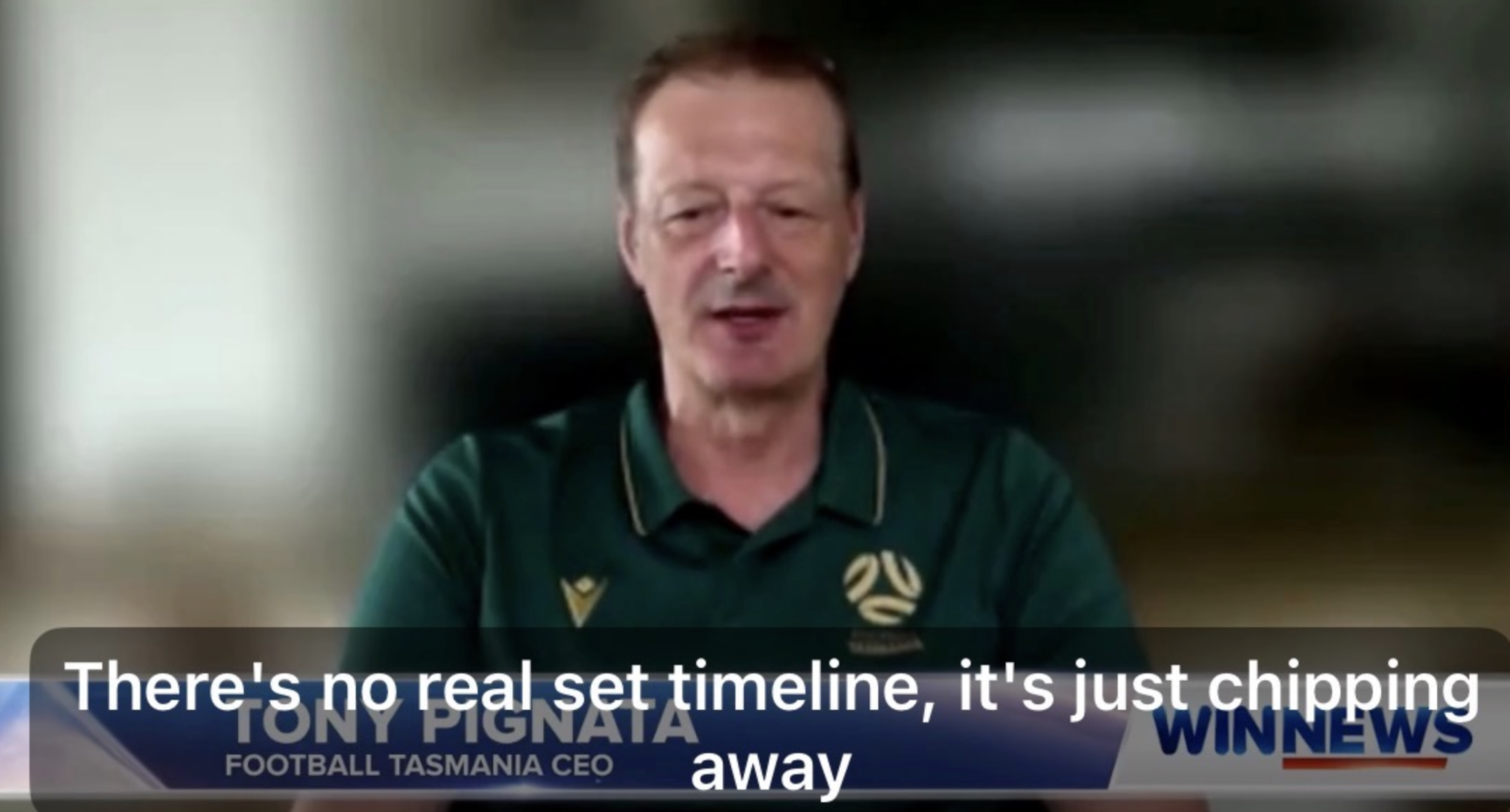
Screenshot Win News interview
I watched the Football Tasmania CEO on WIN News this morning.
Thank you to Brent Costelloe and WIN News for covering football in Tasmania. It matters that our game is part of the public conversation.
What struck me, though, was not what was dramatic.
It was what had shifted.
Because the tone was confident.
Optimistic.
Forward-looking.
But underneath that, the negotiating position of football felt… different.
“I’ve seen the plans and it’s not as big as other stadiums.”
That was the explanation for why Macquarie Point now feels workable for football.
Not participation data.
Not football venue design principles.
Not surface or sightline analysis.
The key reassurance was size.
The stadium is smaller than expected, so football can “fit”.
That is a very specific kind of argument.
It is about accommodation, not design.
A football pitch fitting between boundary lines is not the same thing as a football venue.
Football venues are built around proximity to the touchline, sightlines, acoustics, technical areas, warm-up space and the way the game is experienced. That is the difference between being designed for and being made to work.
Those are not minor details. They shape how the sport lives in a space.
Rectangular Became “Later”
For a long time the language around football infrastructure has been clear.
Football needs a rectangular stadium.
Football deserves infrastructure designed for the sport.
Now the position sounds like this.
Macquarie Point could be a win-win.
The stadium needs content.
Football wants an A-League team.
We can play there.
And eventually we can still work toward a purpose-built rectangular ground.
Eventually is doing a lot of work in that sentence.
Tasmanian football has heard “eventually” before.
On the Agenda Is Not a Plan
Expansion was described as “on the agenda”.
There is no set timeline.
No stage markers.
No stated benchmarks.
In governance language, that is not a project. It is a direction of travel.
Tasmanian football has travelled in hopeful directions before. Often with energy, goodwill and belief, but without the structural anchors that turn hope into delivery.
Optimism is important.
Structure is what turns it into reality.
Content Versus Code
One framing stood out.
The stadium needs content.
Football can help provide it.
That is different from saying football needs a home designed for football.
One positions the sport as a solution to someone else’s infrastructure equation.
The other positions football as a code with its own structural requirements.
When a sport signals it can adapt to infrastructure not designed for it, the urgency to build infrastructure designed for it usually drops.
That is not emotion. That is how policy environments work.
The Summer Calendar
Confidence was expressed that there is space in the summer calendar for an A-League side.
That is probably true.
But calendars do not build teams.
Facilities do.
Training environments.
Change rooms.
Medical spaces.
Admin areas.
Match-ready surfaces.
Those things come from infrastructure planning, not gaps in scheduling.
Home of Football
The most concrete part of the interview was the Home of Football.
Design funding secured.
Early-stage work underway.
A larger build cost flagged.
That sounds like a structured project.
But it also highlights the scale of the journey ahead.
Drawing plans is one stage.
Delivering major infrastructure is another.
In that context, Macquarie Point becomes the near-term solution, while football-specific infrastructure sits further down the road.
Tasmanian sport has seen temporary arrangements become permanent before.
That is why sequencing matters.
“Scrounging” for Fields
The comment was made that during the Hobart Cup, organisers “scrounge around” for enough grounds.
Large tournaments stretching field availability is not evidence of poor organisation. It is evidence of demand outgrowing infrastructure.
Southern Tasmania does not have a pitch quality problem.
It has a pitch quantity problem.
Upgrading a single site improves quality at that location. It does not create more rectangular surfaces. It does not expand capacity. It does not solve scheduling pressure across the system.
That distinction matters when we talk about football infrastructure.
Infrastructure Is Lived, Not Abstract
Infrastructure decisions here are not theoretical.
They shape travel times, volunteer load, access to training spaces and the weekly rhythms of clubs. They affect how families move, how programs run and how sustainable participation really is.
On paper, diagrams can look persuasive.
On the ground, systems are held together by people navigating those realities every week.
When Language Shifts, Pay Attention
This interview was not confrontational.
It was careful.
Measured.
Pragmatic.
That is exactly why it matters.
Because the story may be shifting in small, reasonable-sounding steps.
Rectangular became later.
Purpose-built became eventual.
Football-first became win-win.
Need became fit.
None of those words sound unreasonable.
But together, they tell a story about compromise arriving before foundations are secured.
Tasmanian football has always been good at being reasonable.
History suggests we should also be careful.