Why a Six-Team NPL Makes Competitive Sense - Part 1.
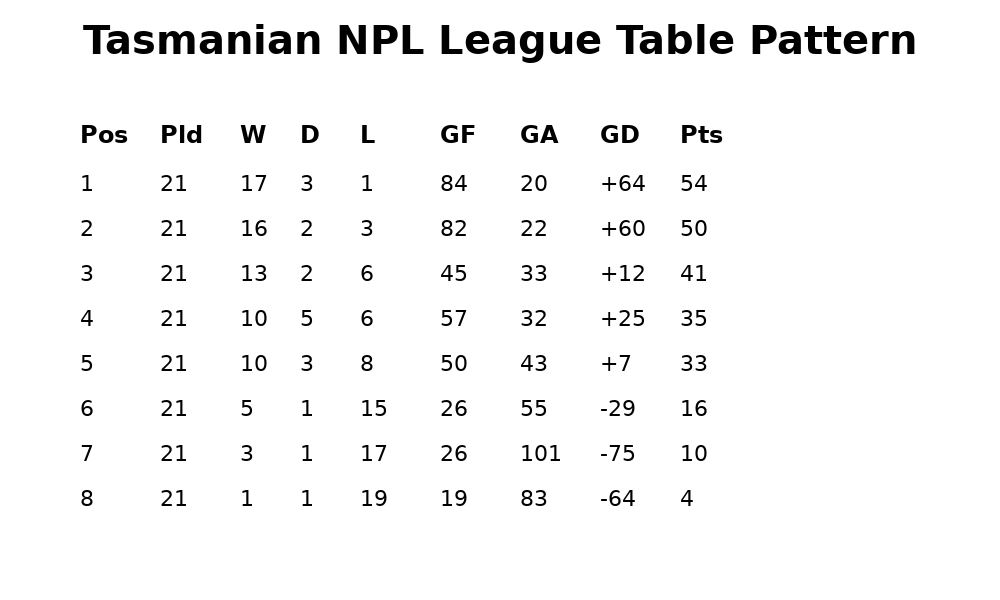
2025 Tasmanian NPL League Table
Yesterday our club held a Board strategic planning session.
Across a wide range of topics, one issue surfaced more than once.
Eighteen games.
Not enough football.
Not enough minutes.
Not enough exposure.
Not enough sustained pressure for players trying to develop at senior level.
It is easy to criticise structures from the outside. It is harder and more useful, to think through what the alternatives might actually look like.
That conversation made me stop and shift perspective.
Instead of pointing out what is not working, what are the practical options. What are the trade-offs. What are the uncomfortable decisions that come with designing a competition that genuinely lifts standards.
Because this is not a simple problem.
Tasmania has geography.
Volunteer-run clubs.
Travel realities.
A small player pool.
A desire to be competitive nationally.
Any structure has to live inside all of those constraints.
But constraints do not remove the central question.
If we accept that eighteen games is not enough meaningful football for the top level, what league design makes the most sense.
This is not about who belongs where.
It is about competitive design.
Reading the Ladder as a Diagnostic Tool
League tables tell stories beyond who finished first.
When recent NPL results are viewed as patterns rather than names, the competition does not look like one tight race. It looks like three distinct performance bands.
A top group separates strongly. High points totals. Large goal difference. High scoring. Few conceded. These teams are tested occasionally, not consistently.
A middle group competes tightly with each other. Balanced results. Moderate goal difference. This is where the most developmentally valuable football tends to occur.
A survival group concedes heavily and carries large negative goal difference. These teams are not simply losing. They are operating at a different depth level. In these environments teams often move into survival mode. Risk reduces. Young players are protected. Confidence erodes. Development slows.
This is not a criticism of any club.
It is a structural signal.
When a league clusters into performance bands, it suggests the distribution of talent across the number of teams may not align with the size of the player pool.
The Scale of the Gap Matters
When we look at the numbers more closely, the goal difference spread across the league was not small.
It was significant.
The teams at the top of the table were operating with very strong positive goal difference, scoring freely and conceding very little. At the other end, some teams carried heavy negative goal difference and high goals conceded totals.
That is not just variance.
That level of separation tells us the competition was not functioning as one consistent performance environment. It suggests a gap in depth, experience and squad capacity across the number of teams at the level.
When the difference between top and bottom becomes that large, several things happen.
Top teams are not stretched often enough.
Bottom teams operate in survival mode rather than development mode.
The middle of the table carries most of the genuinely competitive load.
That is not a criticism of individuals or clubs.
It is a signal that league structure and player distribution may not be aligned.
Why Blow-Outs Matter
Heavy scorelines are not moral failures.
They are indicators.
When the gap between strongest and weakest becomes too wide, top players are not stretched in certain fixtures. Coaches cannot replicate national-level intensity. Spectators disengage from predictable outcomes. The overall standard plateaus rather than rises.
Close games build atmosphere. Rivalries gain meaning. Late-season matches matter. Supporters stay engaged.
Competitive balance is not just about entertainment.
It is about whether the weekly environment resembles the level we say we are developing players for.
Two Structural Levers
There are only two ways to change this.
The number of rounds.
The number of teams.
Both influence player minutes, squad depth pressure, weekly intensity and national competitiveness.
Option One — Eight Teams, Four Rounds
Seven opponents multiplied by four equals twenty eight matches.
This increases exposure. Rotation becomes possible. Injuries do not derail development. The table reflects consistency.
This is the volume model.
But it only works if squad depth across eight clubs keeps matches competitive week after week. More games do not automatically mean more high-level games.
Option Two — Six Teams at the Top Level
Five opponents multiplied by four equals twenty matches.
Fewer total games, but higher intensity.
Stronger squads.
More top-v-top football.
Fewer survival line-ups.
More games where outcomes are genuinely in doubt.
This is the concentration model.
It assumes development comes through sustained pressure rather than pure volume.
Movement Matters
Structure alone does not lift standards.
Movement does.
Promotion and relegation introduce consequence.
Performance determines position.
Complacency has risk.
Ambition has a pathway.
A smaller top league only works if it is open.
If a Championship club wins but chooses not to go up, that is a choice about competitive level. The next eligible club progresses. If none meet standards, the NPL remains unchanged. The structure cannot bend around reluctance.
Top-tier football is a performance environment, not a participation badge.
Geography Is Real
Tasmania is not a compact metro region.
Travel matters. Costs matter. Volunteer capacity matters.
The Championship tiers are already regionalised North and South. That should remain. Geography shapes the second tier.
But geography cannot be the sole determinant of top-tier structure. That leads to fragmentation, not progression.
The challenge is to design a system that manages geography while still demanding competitive standards.
Will Players Tire of Repeated Opponents
Some will ask.
That depends on what the league is for.
Variety is a participation value.
Repeated high-level opposition is a performance value.
Repeated fixtures build tactical depth, adjustment, rivalry and psychological resilience. That mirrors higher-level football.
Retention Matters
When capable players spend seasons underfed for minutes, they drift away.
Not because they do not love football.
Because they want to play.
Structure quietly shapes retention.
A Considered View
This is not complaint. These ideas come from long involvement in the game and recent discussions with Ken, whose experience spans generations and levels.
This is not a club position.
It is a competitive one.
Where This Leads
If a call must be made based on competitive reality rather than comfort, the model most likely to lift weekly standards is clear.
A smaller, open top division.
Six teams. Four rounds. Promotion and relegation.
Not to exclude.
To concentrate quality, increase intensity, create consequence and mirror the environments players face beyond the state system.
Expansion can follow when depth supports it.
Standards rise when structure demands more.
Identifying the structural problem is only the first step.
The next questions are harder.
How promotion and relegation would operate across North and South.
What happens when clubs decline to move up.
And how standards can be protected while geography is respected.
Those mechanics matter just as much as league size, and I will look at them next.